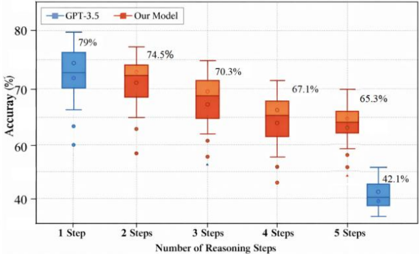
## Box Plot: Accuracy Comparison of GPT-3.5 and Our Model Across Reasoning Steps
### Overview
The image is a comparative box plot visualizing the accuracy distribution of two models (GPT-3.5 and "Our Model") across varying numbers of reasoning steps (1–5 steps). Accuracy is measured in percentage, with box plots showing median, quartiles, and outliers.
### Components/Axes
- **X-Axis**: "Number of Reasoning Steps" (categories: 1 Step, 2 Steps, 3 Steps, 4 Steps, 5 Steps).
- **Y-Axis**: "Accuracy (%)" (range: 40%–80%).
- **Legend**:
- Blue square: GPT-3.5
- Red square: Our Model
- **Box Plot Elements**:
- Median (horizontal line inside the box).
- Interquartile range (box boundaries).
- Whiskers (extending to min/max excluding outliers).
- Outliers (individual dots beyond whiskers).
### Detailed Analysis
1. **1 Step**:
- GPT-3.5: Median ~79% (blue box), range ~60%–79%.
- Our Model: Not present (no red box).
2. **2 Steps**:
- GPT-3.5: Median ~74.5% (blue box), range ~60%–74.5%.
- Our Model: Median ~70.3% (red box), range ~55%–70.3%.
3. **3 Steps**:
- GPT-3.5: Median ~70.3% (blue box), range ~55%–70.3%.
- Our Model: Median ~67.1% (red box), range ~50%–67.1%.
4. **4 Steps**:
- GPT-3.5: Median ~65.3% (blue box), range ~40%–65.3%.
- Our Model: Median ~65.3% (red box), range ~50%–65.3%.
5. **5 Steps**:
- GPT-3.5: Median ~42.1% (blue box), range ~30%–42.1%.
- Our Model: Median ~65.3% (red box), range ~50%–65.3%.
### Key Observations
- **GPT-3.5**:
- Accuracy declines sharply with increasing steps (79% → 42.1%).
- Outliers at 5 Steps suggest extreme underperformance in some cases.
- **Our Model**:
- Maintains relatively stable accuracy (74.5% → 65.3%) across steps.
- Outliers at 5 Steps are lower than the median but less extreme than GPT-3.5’s drop.
### Interpretation
The data demonstrates that **Our Model** exhibits greater robustness in multi-step reasoning tasks compared to GPT-3.5. While GPT-3.5’s accuracy deteriorates significantly with complexity (e.g., 79% at 1 step vs. 42.1% at 5 steps), Our Model’s performance remains consistent, suggesting better architectural or algorithmic design for handling sequential reasoning. The outliers for Our Model at 5 steps indicate occasional failures but do not negate the overall trend of stability. This implies potential advantages in applications requiring complex, multi-stage problem-solving.