## Table: Explanation, Formalized Output, and Generated Proof
### Overview
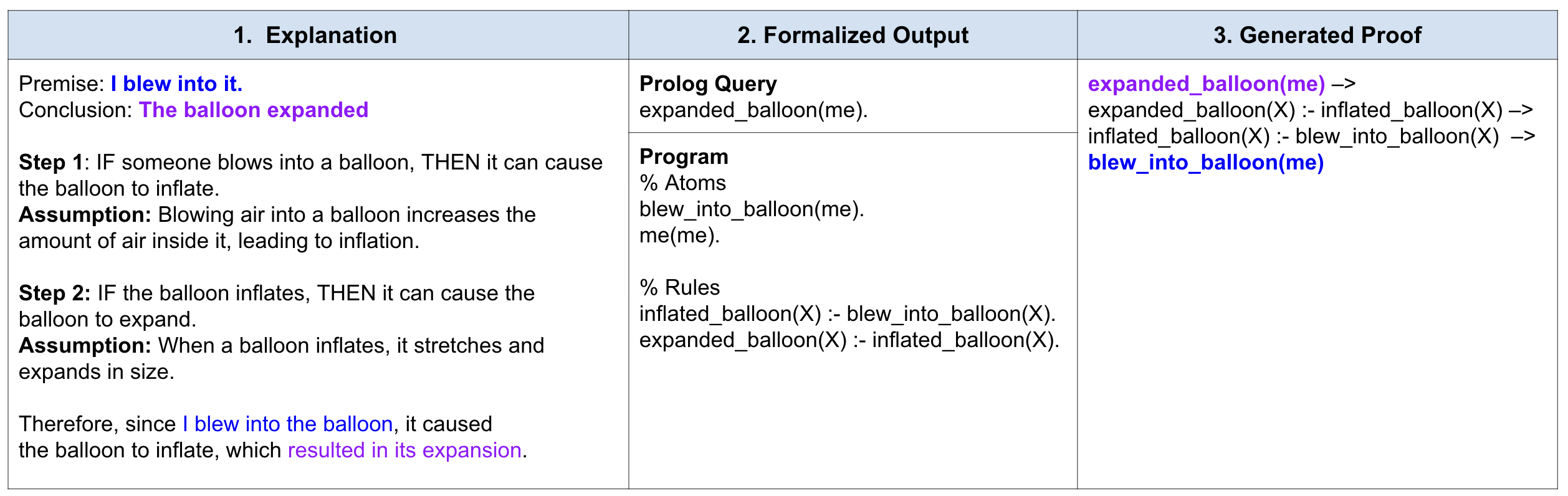
The image presents a table with three columns: "Explanation," "Formalized Output," and "Generated Proof." It describes the process of a balloon expanding after someone blows into it, formalizes this process using Prolog, and generates a proof of the process.
### Components/Axes
* **Column 1:** Explanation
* Premise: I blew into it.
* Conclusion: The balloon expanded.
* Step 1: IF someone blows into a balloon, THEN it can cause the balloon to inflate.
* Assumption: Blowing air into a balloon increases the amount of air inside it, leading to inflation.
* Step 2: IF the balloon inflates, THEN it can cause the balloon to expand.
* Assumption: When a balloon inflates, it stretches and expands in size.
* Therefore, since I blew into the balloon, it caused the balloon to inflate, which resulted in its expansion.
* **Column 2:** Formalized Output
* Prolog Query: expanded\_balloon(me).
* Program:
* % Atoms
* blew\_into\_balloon(me).
* me(me).
* % Rules
* inflated\_balloon(X) :- blew\_into\_balloon(X).
* expanded\_balloon(X) :- inflated\_balloon(X).
* **Column 3:** Generated Proof
* expanded\_balloon(me) ->
* expanded\_balloon(X) :- inflated\_balloon(X) ->
* inflated\_balloon(X) :- blew\_into\_balloon(X) ->
* blew\_into\_balloon(me)
### Detailed Analysis or ### Content Details
**Column 1: Explanation**
* The explanation starts with a premise and a conclusion. The premise is "I blew into it," and the conclusion is "The balloon expanded."
* It then breaks down the process into two steps, each with an "IF...THEN" statement and an assumption.
* Step 1 states that blowing into a balloon can cause it to inflate, with the assumption that blowing air into a balloon increases the amount of air inside, leading to inflation.
* Step 2 states that if the balloon inflates, it can cause the balloon to expand, with the assumption that when a balloon inflates, it stretches and expands in size.
* The explanation concludes by stating that since "I blew into the balloon," it caused the balloon to inflate, which resulted in its expansion.
**Column 2: Formalized Output**
* The formalized output uses Prolog to represent the process.
* The Prolog query is "expanded\_balloon(me)."
* The program defines atoms and rules.
* The atoms are "blew\_into\_balloon(me)." and "me(me)."
* The rules are "inflated\_balloon(X) :- blew\_into\_balloon(X)." and "expanded\_balloon(X) :- inflated\_balloon(X)."
**Column 3: Generated Proof**
* The generated proof shows the logical steps to prove that the balloon expanded.
* It starts with "expanded\_balloon(me) ->" and then shows the steps to reach "blew\_into\_balloon(me)."
### Key Observations
* The table provides a structured way to understand the process of a balloon expanding.
* The explanation is in natural language, while the formalized output uses Prolog.
* The generated proof shows the logical steps to connect the premise to the conclusion.
### Interpretation
The table demonstrates how a simple real-world scenario can be formalized using logic programming. The "Explanation" provides an intuitive understanding, while the "Formalized Output" translates this understanding into a Prolog program. The "Generated Proof" then uses this program to logically derive the conclusion from the premise. This highlights the power of logic programming in representing and reasoning about real-world events.