\n
## Table: Logical Proof Generation
### Overview
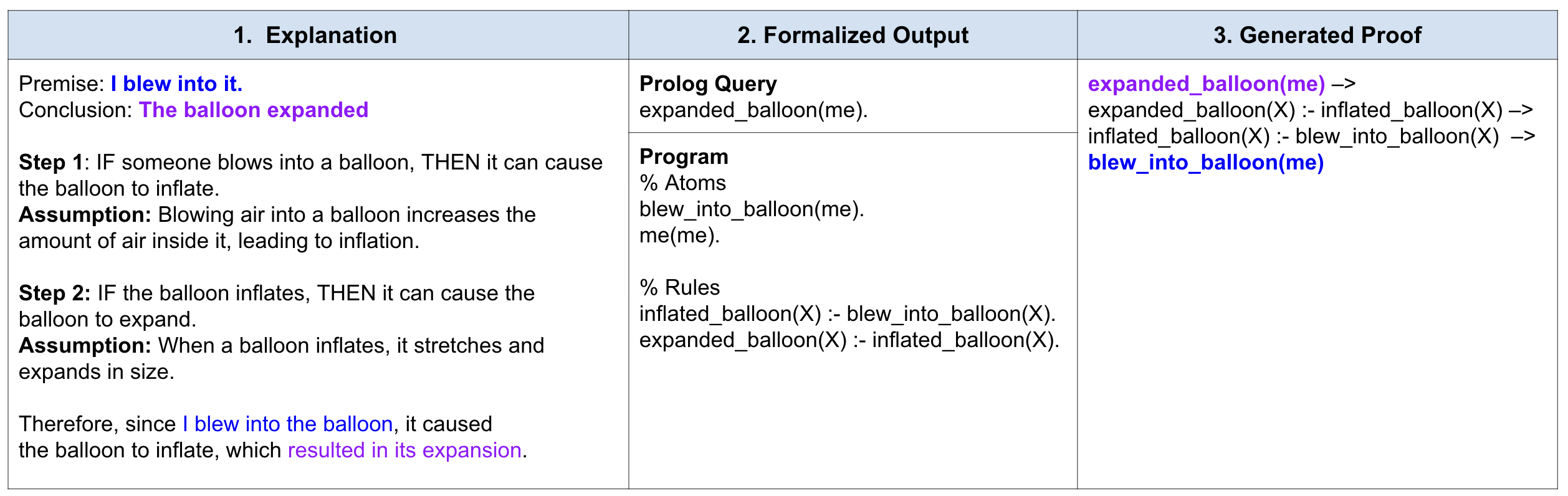
The image presents a table demonstrating a logical proof generation process. The table is divided into three columns: "1. Explanation", "2. Formalized Output", and "3. Generated Proof". It illustrates how a simple premise and conclusion can be formalized into a Prolog query and program, and subsequently used to generate a proof.
### Components/Axes
The table has three columns as described above. Each column represents a stage in the logical proof process. The rows represent steps in the explanation and corresponding formalized outputs.
### Detailed Analysis or Content Details
**Column 1: Explanation**
* **Premise:** "I blew into it."
* **Conclusion:** "The balloon expanded."
* **Step 1:** "IF someone blows into a balloon, THEN it can cause the balloon to inflate."
* **Assumption:** "Blowing air into a balloon increases the amount of air inside it, leading to inflation."
* **Step 2:** "IF the balloon inflates, THEN it can cause the balloon to expand."
* **Assumption:** "When a balloon inflates, it stretches and expands in size."
* **Final Statement:** "Therefore, since I blew into the balloon, it caused the balloon to inflate, which resulted in its expansion."
**Column 2: Formalized Output**
* **Prolog Query:** `expanded_balloon(me).`
* **Program:**
* `% Atoms`
* `blew_into_balloon(me).`
* `me(me).`
* `% Rules`
* `inflated_balloon(X) :- blew_into_balloon(X).`
* `expanded_balloon(X) :- inflated_balloon(X).`
**Column 3: Generated Proof**
* `expanded_balloon(me) ->`
* `expanded_balloon(X) :- inflated_balloon(X) ->`
* `inflated_balloon(X) :- blew_into_balloon(X) ->`
* `blew_into_balloon(me)`
### Key Observations
The table demonstrates a clear chain of reasoning. The explanation provides a human-readable argument, while the formalized output translates this argument into a Prolog program. The generated proof shows how the Prolog program can be used to derive the conclusion from the premise. The use of atoms and rules in the Prolog program mirrors the assumptions and steps in the explanation.
### Interpretation
This table illustrates a fundamental concept in logic and artificial intelligence: the ability to represent knowledge and reasoning in a formal, machine-readable format. The example demonstrates how a simple everyday scenario can be broken down into logical components and used to generate a proof. This process is crucial for building intelligent systems that can reason and make inferences. The table highlights the connection between natural language reasoning and formal logic, and how Prolog can be used as a tool for implementing logical reasoning. The use of "me" as a variable is interesting, representing the subject performing the action. The structure of the proof clearly shows the dependency of each step on the previous one, forming a logical chain.