## Table: Logical Reasoning Formalization Example
### Overview
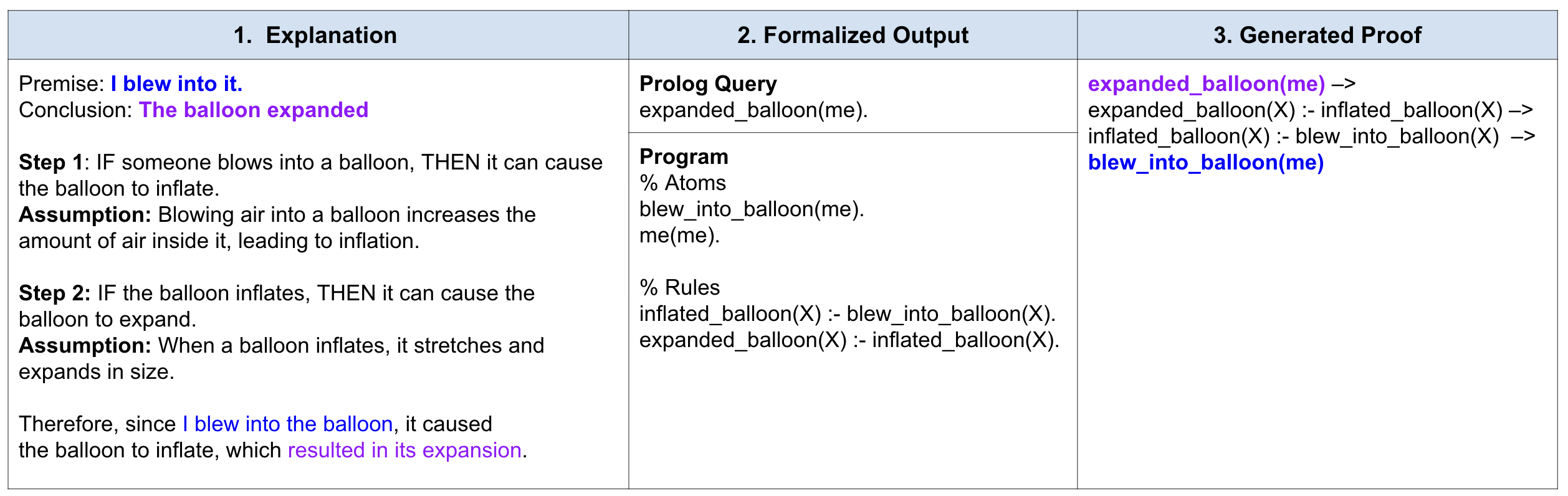
The image displays a three-column table that illustrates the process of translating a simple natural language causal argument into a formal logic program (Prolog) and its corresponding proof chain. The example uses the scenario of blowing into a balloon causing it to expand.
### Components/Axes
The table is structured with three vertical columns, each with a distinct header:
1. **Column 1 Header (Top-Left):** "1. Explanation"
2. **Column 2 Header (Top-Center):** "2. Formalized Output"
3. **Column 3 Header (Top-Right):** "3. Generated Proof"
The table has a light blue header row and white body cells with black borders.
### Detailed Analysis / Content Details
**Column 1: Explanation**
This column contains the natural language reasoning.
* **Premise:** "I blew into it." (The phrase "I blew into it" is in **blue** text).
* **Conclusion:** "The balloon expanded" (The phrase "The balloon expanded" is in **purple** text).
* **Step 1:** "IF someone blows into a balloon, THEN it can cause the balloon to inflate."
* **Assumption:** "Blowing air into a balloon increases the amount of air inside it, leading to inflation."
* **Step 2:** "IF the balloon inflates, THEN it can cause the balloon to expand."
* **Assumption:** "When a balloon inflates, it stretches and expands in size."
* **Final Statement:** "Therefore, since I blew into the balloon, it caused the balloon to inflate, which resulted in its expansion." (Within this sentence, "I blew into the balloon" is in **blue** text, and "resulted in its expansion" is in **purple** text).
**Column 2: Formalized Output**
This column contains the corresponding Prolog program code.
* **Section Header:** "Prolog Query"
* Code: `expanded_balloon(me).`
* **Section Header:** "Program"
* Subsection: "% Atoms"
* Code: `blew_into_balloon(me).`
* Code: `me(me).`
* Subsection: "% Rules"
* Code: `inflated_balloon(X) :- blew_into_balloon(X).`
* Code: `expanded_balloon(X) :- inflated_balloon(X).`
**Column 3: Generated Proof**
This column shows the logical proof chain derived from the program, using color-coding that matches the Explanation column.
* Line 1: `expanded_balloon(me) →` (The predicate `expanded_balloon(me)` is in **purple** text).
* Line 2: `expanded_balloon(X) :- inflated_balloon(X) →`
* Line 3: `inflated_balloon(X) :- blew_into_balloon(X) →`
* Line 4: `blew_into_balloon(me)` (The predicate `blew_into_balloon(me)` is in **blue** text).
### Key Observations
1. **Color-Coding Consistency:** There is a strict visual link between the natural language elements and their formal counterparts. The blue text for the initial action ("I blew into it" / `blew_into_balloon(me)`) and the purple text for the final outcome ("The balloon expanded" / `expanded_balloon(me)`) is maintained across columns 1 and 3.
2. **Structural Mapping:** The table demonstrates a clear, stepwise transformation:
* **Column 1** provides the intuitive, assumption-laden human reasoning.
* **Column 2** strips away the assumptions and translates the core causal rules and facts into a formal, machine-readable syntax (Prolog).
* **Column 3** shows the backward-chaining proof process the Prolog engine would use to derive the conclusion from the initial query and rules.
3. **Logical Flow:** The proof in Column 3 reads from top to bottom as a goal-directed search: to prove `expanded_balloon(me)`, it needs `inflated_balloon(me)`, which in turn requires `blew_into_balloon(me)`, which is a known fact.
### Interpretation
This table serves as a pedagogical or demonstrative tool for symbolic AI and logic programming. It bridges the gap between human-understandable causal reasoning and formal logical representation.
* **What it demonstrates:** It shows how a simple cause-and-effect narrative can be decomposed into atomic facts (`me(me)`, `blew_into_balloon(me)`) and general rules (`inflated_balloon(X) :- ...`). The "Assumptions" in Column 1 are the real-world knowledge that is implicitly encoded into the structure of the rules in Column 2 (e.g., the rule `inflated_balloon(X) :- blew_into_balloon(X).` encapsulates the assumption that blowing causes inflation).
* **Relationship between elements:** The columns represent different "languages" for the same knowledge: natural language, Prolog code, and a proof trace. The color-coding acts as a crucial cross-reference, grounding the abstract symbols (`me`, `blew_into_balloon`) back to the concrete scenario.
* **Underlying purpose:** The image likely aims to explain the process of "formalization" – how to convert vague, context-rich human statements into precise, unambiguous logical statements that a computer can process to derive conclusions reliably. It highlights the power and clarity of logic programming for representing and reasoning about simple causal chains.