## Table: Logical Proof Structure for Balloon Expansion
### Overview
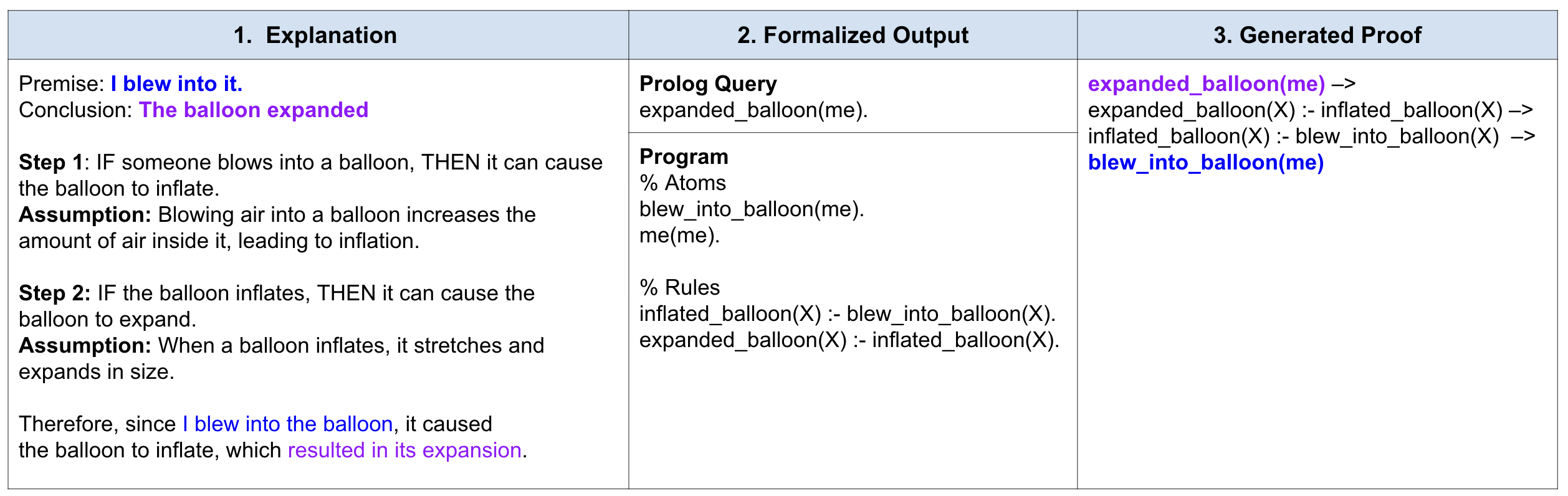
The image presents a three-column table demonstrating the transformation of a natural language statement into a formal logical proof. It illustrates the process of deriving a conclusion ("The balloon expanded") from a premise ("I blew into it") using intermediate steps, formalized rules, and a generated proof.
---
### Components/Axes
1. **Columns**:
- **Column 1 (Explanation)**: Contains natural language reasoning steps.
- **Column 2 (Formalized Output)**: Contains Prolog-like logic rules and queries.
- **Column 3 (Generated Proof)**: Shows step-by-step logical derivation using the rules.
2. **Key Elements**:
- **Premise/Conclusion**: Natural language statements.
- **Steps 1-2**: Conditional reasoning with assumptions.
- **Prolog Query**: `expanded_balloon(me).`
- **Atoms**: `blew_into_balloon(me).`
- **Rules**:
- `inflated_balloon(X) :- blew_into_balloon(X).`
- `expanded_balloon(X) :- inflated_balloon(X).`
---
### Detailed Analysis
#### Column 1: Explanation
- **Premise**: "I blew into it."
- **Conclusion**: "The balloon expanded."
- **Step 1**:
- **If-Then**: "IF someone blows into a balloon, THEN it can cause the balloon to inflate."
- **Assumption**: Blowing air increases internal air volume, leading to inflation.
- **Step 2**:
- **If-Then**: "IF the balloon inflates, THEN it can cause the balloon to expand."
- **Assumption**: Inflation stretches the balloon, increasing its size.
- **Conclusion**: Combines Steps 1 and 2 to derive the final conclusion.
#### Column 2: Formalized Output
- **Prolog Query**: `expanded_balloon(me).`
*(Asks if the balloon expanded for "me".)*
- **Program**:
- **Atoms**: `blew_into_balloon(me).`
*(Formalizes the premise.)*
- **Rules**:
1. `inflated_balloon(X) :- blew_into_balloon(X).`
*(If X blew into the balloon, then X inflated it.)*
2. `expanded_balloon(X) :- inflated_balloon(X).`
*(If X inflated the balloon, then X expanded it.)*
#### Column 3: Generated Proof
- **Logical Derivation**:
1. `expanded_balloon(me) ->`
*(Starts with the query.)*
2. `expanded_balloon(X) :- inflated_balloon(X).`
*(Applies Rule 2 with X = "me".)*
3. `inflated_balloon(X) :- blew_into_balloon(X).`
*(Applies Rule 1 with X = "me".)*
4. `blew_into_balloon(me).`
*(Uses the atom from Column 2.)*
5. **Final Result**: `blew_into_balloon(me).`
*(Proves the premise leads to the conclusion via the rules.)*
---
### Key Observations
1. **Logical Flow**: The proof mirrors the natural language explanation, showing how each step corresponds to a rule.
2. **Modus Ponens**: The proof uses this inference rule to chain premises and rules.
3. **Variable Binding**: The variable `X` is consistently bound to "me" throughout the derivation.
---
### Interpretation
This table demonstrates **automated theorem proving** in logic programming. It shows how a natural language statement ("I blew into it") can be translated into formal logic (Prolog rules) and used to derive a conclusion ("The balloon expanded"). The process highlights:
- **Abduction**: Inferring causes from effects (e.g., "I blew into it" → "The balloon expanded").
- **Rule-Based Reasoning**: Using predefined rules to connect observations to conclusions.
- **Formalization**: Translating assumptions into executable logic (e.g., `blew_into_balloon(me)`).
The structure is critical for AI systems that require explicit, machine-readable reasoning steps to validate conclusions.