## Histogram: Matmul TFLOPS Distribution
### Overview
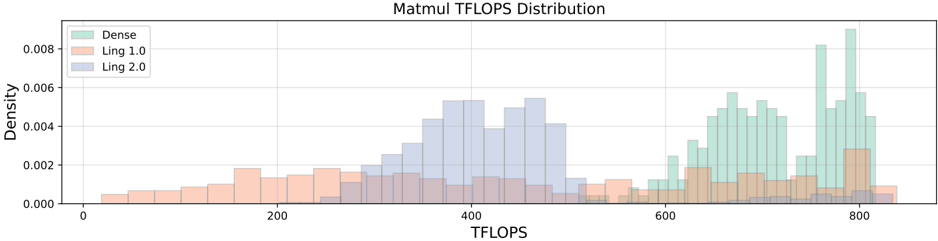
The image is a histogram comparing the distribution of TFLOPS (Tera Floating Point Operations per Second) across three computational methods: "Dense," "Ling 1.0," and "Ling 2.0." The x-axis represents TFLOPS values (0–800), and the y-axis represents density (0–0.008). The legend identifies the three data series with distinct colors: green for "Dense," orange for "Ling 1.0," and purple for "Ling 2.0."
### Components/Axes
- **Title**: "Matmul TFLOPS Distribution" (top center).
- **X-axis**: Labeled "TFLOPS," with values ranging from 0 to 800 in increments of 200.
- **Y-axis**: Labeled "Density," with values ranging from 0 to 0.008 in increments of 0.002.
- **Legend**: Positioned in the top-left corner, with three entries:
- Green: "Dense"
- Orange: "Ling 1.0"
- Purple: "Ling 2.0"
- **Bars**: Three overlapping histograms, each corresponding to one of the three methods.
### Detailed Analysis
- **Dense (Green)**:
- Dominates the right side of the histogram (600–800 TFLOPS).
- Peaks at ~800 TFLOPS with a density of ~0.008.
- Shows a gradual increase in density from 600 TFLOPS onward.
- **Ling 2.0 (Purple)**:
- Peaks at ~400–500 TFLOPS with a density of ~0.006.
- Density declines sharply after 500 TFLOPS.
- **Ling 1.0 (Orange)**:
- Peaks at ~200–300 TFLOPS with a density of ~0.002.
- Density remains low compared to the other two methods.
### Key Observations
1. **Performance Hierarchy**: "Dense" achieves significantly higher TFLOPS than both "Ling" methods, with a clear separation in the distribution.
2. **Ling Method Comparison**: "Ling 2.0" outperforms "Ling 1.0" by ~200 TFLOPS, but both lag far behind "Dense."
3. **Density Distribution**: "Dense" has the highest density, indicating it is the most common or efficient method in this dataset.
### Interpretation
The data suggests that the "Dense" method is the most computationally efficient, achieving near-800 TFLOPS, while the "Ling" methods are less performant. The stark difference in peak TFLOPS between "Dense" and the "Ling" methods implies that "Dense" may be optimized for high-throughput applications, whereas the "Ling" methods might prioritize other factors (e.g., memory efficiency or algorithmic simplicity). The absence of overlap in the highest TFLOPS range (700–800) further emphasizes the superiority of "Dense" in this context. This could inform hardware/software optimization strategies for matrix multiplication tasks.