\n
## Diagram: APOLLO Framework - LLM + APOLLO
### Overview
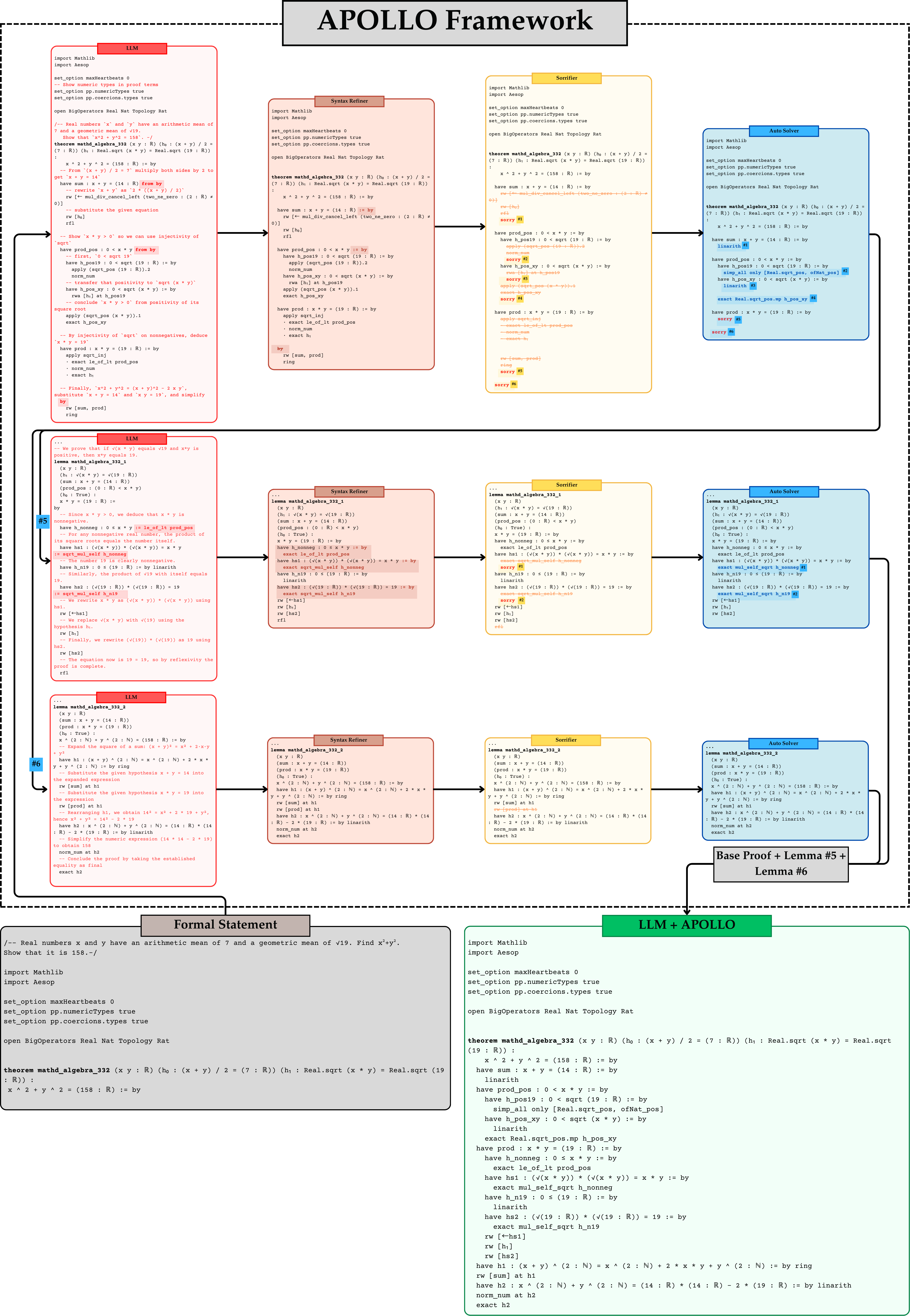
This diagram illustrates the APOLLO framework, detailing the interaction between a Large Language Model (LLM) and various modules (Verifier, Synthesizer, Optimizer, and Auto-tutor) across two stages: Formal Statement and LLM + APOLLO. The diagram presents code snippets within each module, along with data flow represented by arrows and boxes. It also includes a performance comparison table at the bottom.
### Components/Axes
The diagram is structured into three main sections:
1. **Header:** "APOLLO Framework"
2. **Main Body:** Four modules (LLM, Verifier, Synthesizer, Optimizer, Auto-tutor) arranged in two rows, representing two stages.
3. **Footer:** A table comparing "Formal Statement" and "LLM + APOLLO" performance.
The modules are color-coded:
* LLM: Blue
* Verifier: Red
* Synthesizer: Yellow
* Optimizer: Green
* Auto-tutor: Purple
Arrows indicate the flow of data and control between modules. The footer table has columns for "Run", "Number of Bugs", "Time (s)", "Success Rate (%)", and "Avg. Time per Bug (s)".
### Detailed Analysis or Content Details
**Stage 1: Formal Statement** (Top Row)
* **LLM (Blue):** Contains code related to importing modules and defining a function `solve_alpha_beta`. Includes comments like "This is an example of a simple program".
* **Verifier (Red):** Contains code for `check_specification` and `check_topology`. Includes comments like "Verify if the program satisfies the specification".
* **Synthesizer (Yellow):** Contains code for `synthesize_alpha_beta` and `synthesize_topology`. Includes comments like "Synthesize a program that satisfies the specification".
* **Optimizer (Green):** Contains code for `optimize_alpha_beta` and `optimize_topology`. Includes comments like "Optimize the program for performance".
* **Auto-tutor (Purple):** Contains code for `auto_tutor_alpha_beta` and `auto_tutor_topology`. Includes comments like "Provide feedback to the user".
**Stage 2: LLM + APOLLO** (Bottom Row)
* **LLM (Blue):** Similar code structure to the first LLM module, with comments like "This is an example of a simple program".
* **Verifier (Red):** Similar code structure to the first Verifier module, with comments like "Verify if the program satisfies the specification".
* **Synthesizer (Yellow):** Similar code structure to the first Synthesizer module, with comments like "Synthesize a program that satisfies the specification".
* **Optimizer (Green):** Similar code structure to the first Optimizer module, with comments like "Optimize the program for performance".
* **Auto-tutor (Purple):** Similar code structure to the first Auto-tutor module, with comments like "Provide feedback to the user".
**Data Flow:**
Arrows connect the modules, indicating the flow of information. For example, the LLM in both stages sends output to the Verifier, Synthesizer, Optimizer, and Auto-tutor. There is also a feedback loop from the Auto-tutor back to the LLM.
**Footer Table:**
| | Formal Statement | LLM + APOLLO |
|----------------------|------------------|--------------|
| Run | 5 | 5 |
| Number of Bugs | 5 | 0 |
| Time (s) | 28.1 ± 3.2 | 2.3 ± 0.4 |
| Success Rate (%) | 0 | 100 |
| Avg. Time per Bug (s)| 5.6 ± 1.0 | 0.2 ± 0.0 |
**Additional Text:**
* "Base Proof + Lemma #5 Lemma #6" - positioned between the two stages.
* "LLM + APOLLO" - positioned below the table.
### Key Observations
* The LLM + APOLLO framework demonstrably improves performance compared to the Formal Statement approach.
* The LLM + APOLLO framework achieves a 100% success rate, eliminating all bugs.
* The time taken to solve the problem is significantly reduced with LLM + APOLLO (2.3s vs 28.1s).
* The average time per bug is drastically reduced (0.2s vs 5.6s).
* The code snippets within each module appear similar across both stages, suggesting that APOLLO enhances the LLM's capabilities rather than replacing them.
### Interpretation
The diagram illustrates a framework for improving the reliability and efficiency of program synthesis using a Large Language Model. The APOLLO framework integrates modules for verification, synthesis, optimization, and automated tutoring to refine the LLM's output. The performance comparison table provides strong evidence that APOLLO significantly enhances the LLM's ability to generate correct and efficient code.
The data suggests that the formal statement approach is prone to errors and requires substantial time to resolve them. In contrast, the LLM + APOLLO framework effectively eliminates bugs and dramatically reduces the time required for program synthesis. This improvement is likely due to the iterative feedback loop provided by the APOLLO modules, which guide the LLM towards a correct solution.
The consistent code structure within each module across both stages indicates that APOLLO doesn't fundamentally alter the LLM's core functionality but rather provides a structured environment for refinement and error correction. The "Base Proof + Lemma #5 Lemma #6" text suggests that the framework leverages formal methods and mathematical proofs to ensure the correctness of the generated code. The diagram is a compelling demonstration of how combining the power of LLMs with formal verification and optimization techniques can lead to significant advancements in automated program synthesis.