## [Diagram]: APOLLO Framework (Formal Mathematical Proof Pipeline)
### Overview
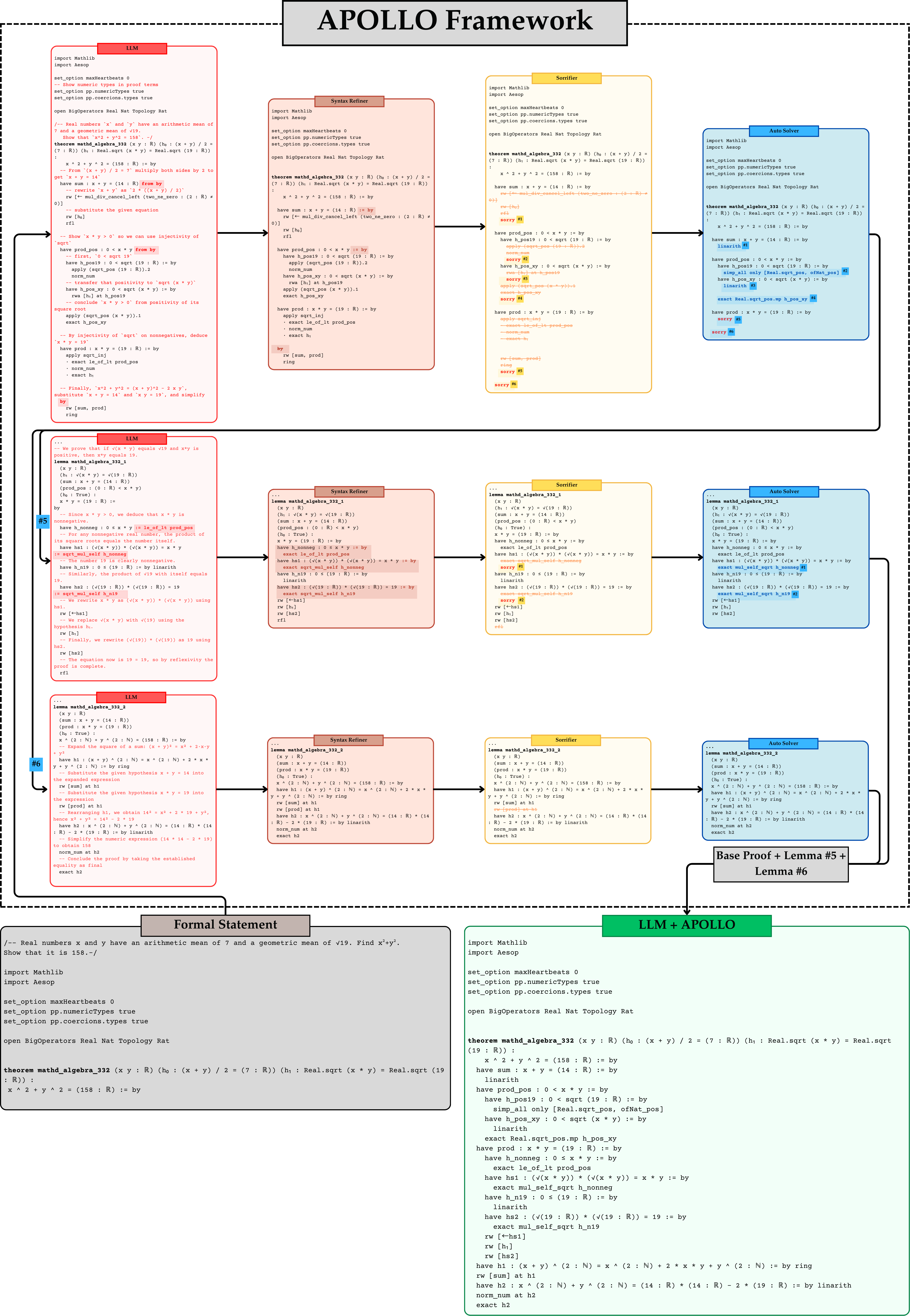
The image depicts the **APOLLO Framework**, a pipeline for generating formal mathematical proofs (in the Lean theorem prover) from a problem statement. It illustrates a modular approach to proof generation, with components for language modeling (LLM), syntax refinement, handling incomplete proofs ("sorry" placeholders), and automated proof completion. The diagram includes three parallel proof attempts (base, Lemma #5, Lemma #6) and a final combined proof.
### Components/Axes
- **Top Section (Proof Pipelines)**: Three parallel workflows (LLM → Syntax Refiner → Sorrifier → Auto Solver) for different proof attempts (base, #5, #6).
- **Color-Coded Components**:
- Red: LLM (generates initial proof sketches).
- Pink: Syntax Refiner (refines Lean syntax).
- Yellow: Sorrifier (handles "sorry" placeholders in Lean).
- Blue: Auto Solver (completes proofs with automated tactics).
- **Arrows**: Show the flow of proof data between components.
- **Bottom Section**:
- **Formal Statement (Gray Box)**: The problem statement in Lean.
- **LLM + APOLLO (Green Box)**: The final combined proof (base proof + Lemmas #5, #6).
### Detailed Analysis
#### Top Pipelines (Proof Attempts)
1. **Base Proof (Top-Left Pipeline)**:
- **LLM (Red)**: Generates a Lean proof with steps like `have sum : x + y = 14 := by ...` (deriving \( x + y = 14 \) from the arithmetic mean) and `have prod : x * y = 19 := by ...` (deriving \( xy = 19 \) from the geometric mean).
- **Syntax Refiner (Pink)**: Refines syntax (e.g., `have sum : x + y = (14 : R) := by ...`).
- **Sorrifier (Yellow)**: Replaces "sorry" placeholders (e.g., `sorry #1`, `sorry #2`) with valid tactics.
- **Auto Solver (Blue)**: Completes the proof using tactics like `linarith` (linear arithmetic) and `ring` (ring theory).
2. **Lemma #5 (Middle Pipeline)**:
- **LLM (Red)**: Proves a lemma about square roots: `lemma mathd_algebra_332_1 (x y : R) (h : Real.sqrt (x * y) = Real.sqrt (19 : R)) : x * y = (19 : R) := by ...` (justifying \( xy = 19 \) from the geometric mean).
- **Syntax Refiner (Pink)**: Refines the lemma’s syntax.
- **Sorrifier (Yellow)**: Handles "sorry" placeholders in the lemma.
- **Auto Solver (Blue)**: Completes the lemma proof.
3. **Lemma #6 (Bottom Pipeline)**:
- **LLM (Red)**: Proves a lemma about algebraic manipulation: `lemma mathd_algebra_332_2 (x y : R) (h : x + y = (14 : R)) (h1 : x * y = (19 : R)) : x ^ 2 + y ^ 2 = (158 : R) := by ...` (deriving \( x^2 + y^2 = 158 \) from \( x + y = 14 \) and \( xy = 19 \)).
- **Syntax Refiner (Pink)**: Refines the lemma’s syntax.
- **Sorrifier (Yellow)**: Handles "sorry" placeholders.
- **Auto Solver (Blue)**: Completes the lemma proof.
#### Bottom Section
- **Formal Statement (Gray Box)**:
The problem: *"Real numbers \( x \) and \( y \) have an arithmetic mean of 7 and a geometric mean of \( \sqrt{19} \). Find \( x^2 + y^2 \). Show that it is 158."*
Translated to Lean:
```lean
theorem mathd_algebra_332 (x y : R)
(h₀ : (x + y) / 2 = (7 : R))
(h₁ : Real.sqrt (x * y) = Real.sqrt (19 : R)) :
x ^ 2 + y ^ 2 = (158 : R) := by ...
```
- **LLM + APOLLO (Green Box)**:
The final combined proof, integrating the base proof and Lemmas #5, #6. Key steps:
- Derive \( x + y = 14 \) (from \( (x + y)/2 = 7 \)) and \( xy = 19 \) (from \( \sqrt{xy} = \sqrt{19} \)).
- Use \( x^2 + y^2 = (x + y)^2 - 2xy \) to compute \( 14^2 - 2 \cdot 19 = 158 \).
### Key Observations
- **Modular Proof Generation**: The framework breaks the proof into smaller lemmas (#5, #6) and a base proof, then combines them.
- **Component Roles**: LLM generates initial proof sketches, Syntax Refiner fixes syntax, Sorrifier handles incomplete parts ("sorry"), and Auto Solver completes the proof.
- **Lean Tactics**: Uses tactics like `linarith` (linear arithmetic), `ring` (ring theory), `exact` (exact proof), and `norm_num` (numeric normalization).
- **Problem Context**: The problem relies on arithmetic/geometric mean properties: \( x + y = 14 \) (arithmetic mean) and \( xy = 19 \) (geometric mean), leading to \( x^2 + y^2 = 158 \).
### Interpretation
The APOLLO Framework demonstrates a pipeline for **automated theorem proving** in Lean, leveraging LLMs to generate proof sketches, then refining and completing them with specialized components. The modular approach (breaking into lemmas) manages complexity, while the final proof combines algebraic manipulation (from the base proof) with square-root and arithmetic lemmas. This illustrates how AI can assist in formal mathematics by reducing manual effort in theorem proving, enabling more efficient exploration of mathematical truths.