## Line Chart: Test Accuracy vs. Feedback Rounds
### Overview
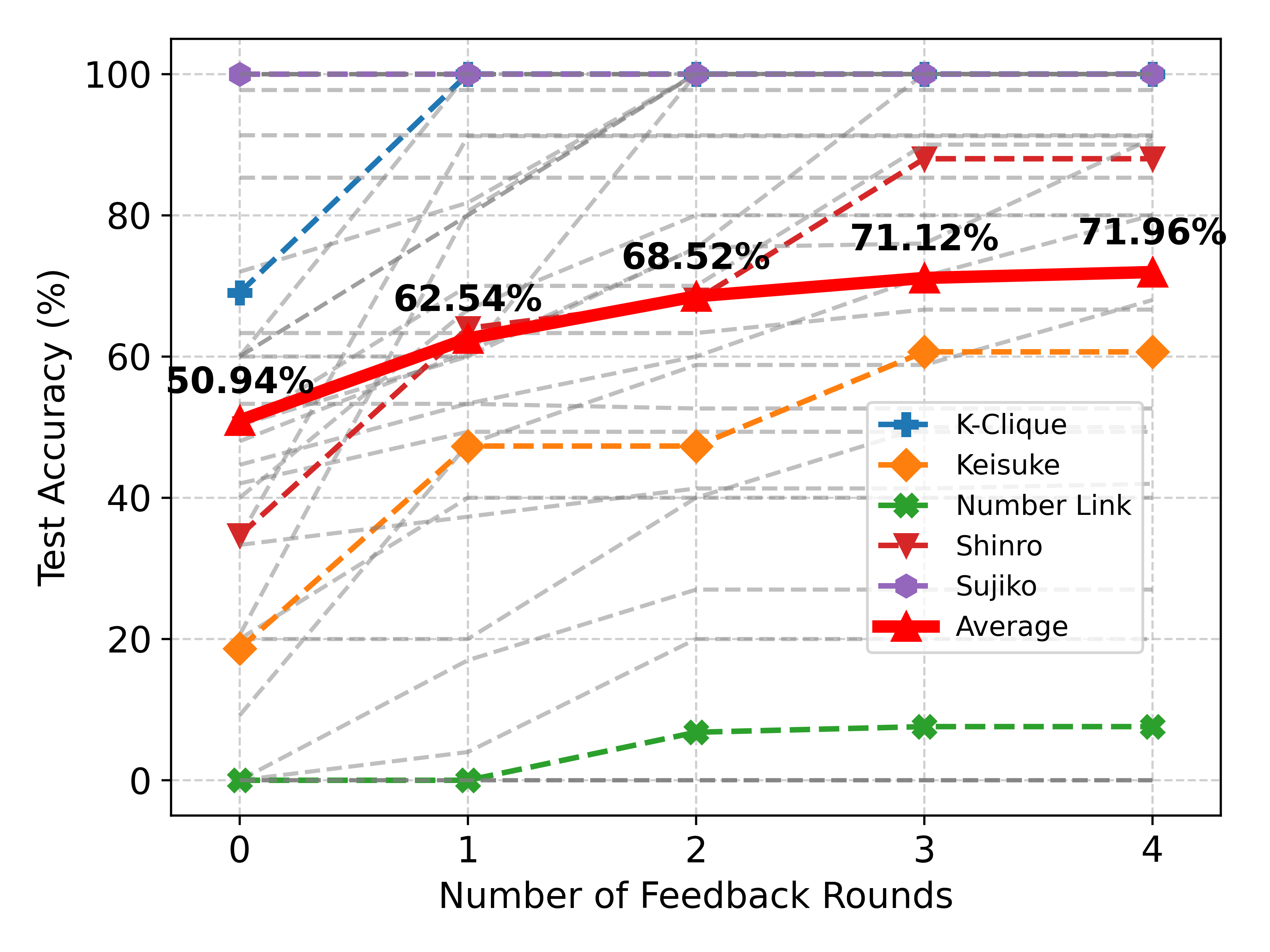
This line chart displays the test accuracy of five different methods (K-Clique, Keisuke, Number Link, Shinro, and Sujiko) and their average, as a function of the number of feedback rounds. The chart shows how the accuracy of each method changes with increasing feedback.
### Components/Axes
* **X-axis:** Number of Feedback Rounds (0, 1, 2, 3, 4)
* **Y-axis:** Test Accuracy (%) (Scale from 0 to 100)
* **Legend:** Located in the bottom-right corner, identifies each line with a unique color and label:
* K-Clique (Blue)
* Keisuke (Gray)
* Number Link (Green)
* Shinro (Orange)
* Sujiko (Purple)
* Average (Red)
* **Data Markers:** Each data point is marked with a symbol corresponding to its method.
* **Gridlines:** Vertical gridlines are present to aid in reading values.
### Detailed Analysis
Here's a breakdown of each line's trend and approximate data points, verified against the legend colors:
* **K-Clique (Blue):** The line slopes sharply upward from 0 to 1 feedback rounds, then plateaus.
* 0 Rounds: ~68%
* 1 Round: ~95%
* 2 Rounds: ~98%
* 3 Rounds: ~99%
* 4 Rounds: ~99%
* **Keisuke (Gray):** The line shows a moderate upward trend, leveling off after 2 rounds.
* 0 Rounds: ~55%
* 1 Round: ~62.54%
* 2 Rounds: ~68.52%
* 3 Rounds: ~71.12%
* 4 Rounds: ~71.96%
* **Number Link (Green):** The line remains relatively flat, with a slight increase.
* 0 Rounds: ~-5%
* 1 Round: ~5%
* 2 Rounds: ~8%
* 3 Rounds: ~10%
* 4 Rounds: ~12%
* **Shinro (Orange):** The line shows a moderate upward trend, with a slight curve.
* 0 Rounds: ~40%
* 1 Round: ~45%
* 2 Rounds: ~50%
* 3 Rounds: ~55%
* 4 Rounds: ~58%
* **Sujiko (Purple):** The line rises quickly and plateaus near 100% accuracy.
* 0 Rounds: ~80%
* 1 Round: ~95%
* 2 Rounds: ~100%
* 3 Rounds: ~100%
* 4 Rounds: ~100%
* **Average (Red):** The line shows a consistent upward trend, but at a decreasing rate.
* 0 Rounds: ~50.94%
* 1 Round: ~62.54%
* 2 Rounds: ~68.52%
* 3 Rounds: ~71.12%
* 4 Rounds: ~71.96%
### Key Observations
* K-Clique and Sujiko achieve very high accuracy (close to 100%) with only a few feedback rounds.
* Number Link consistently exhibits the lowest accuracy across all feedback rounds.
* The average accuracy increases with feedback rounds, but the rate of increase diminishes.
* Keisuke and Shinro show moderate improvement with feedback, but their accuracy remains lower than K-Clique and Sujiko.
### Interpretation
The chart demonstrates the effectiveness of iterative feedback in improving the test accuracy of different methods. The significant performance gains observed in K-Clique and Sujiko suggest that these methods are particularly sensitive to feedback and can quickly converge to high accuracy. The relatively flat performance of Number Link indicates that this method may be less responsive to feedback or inherently more difficult to improve. The diminishing rate of improvement in the average accuracy suggests that there may be a limit to the benefits of additional feedback rounds. This data could be used to optimize the feedback process for each method, potentially focusing more feedback on methods like Number Link and less on those that quickly reach high accuracy. The differences in performance between the methods could also indicate underlying differences in their algorithms or their suitability for the given task.