## Textual Document: Argument Analysis & Question Response
### Overview
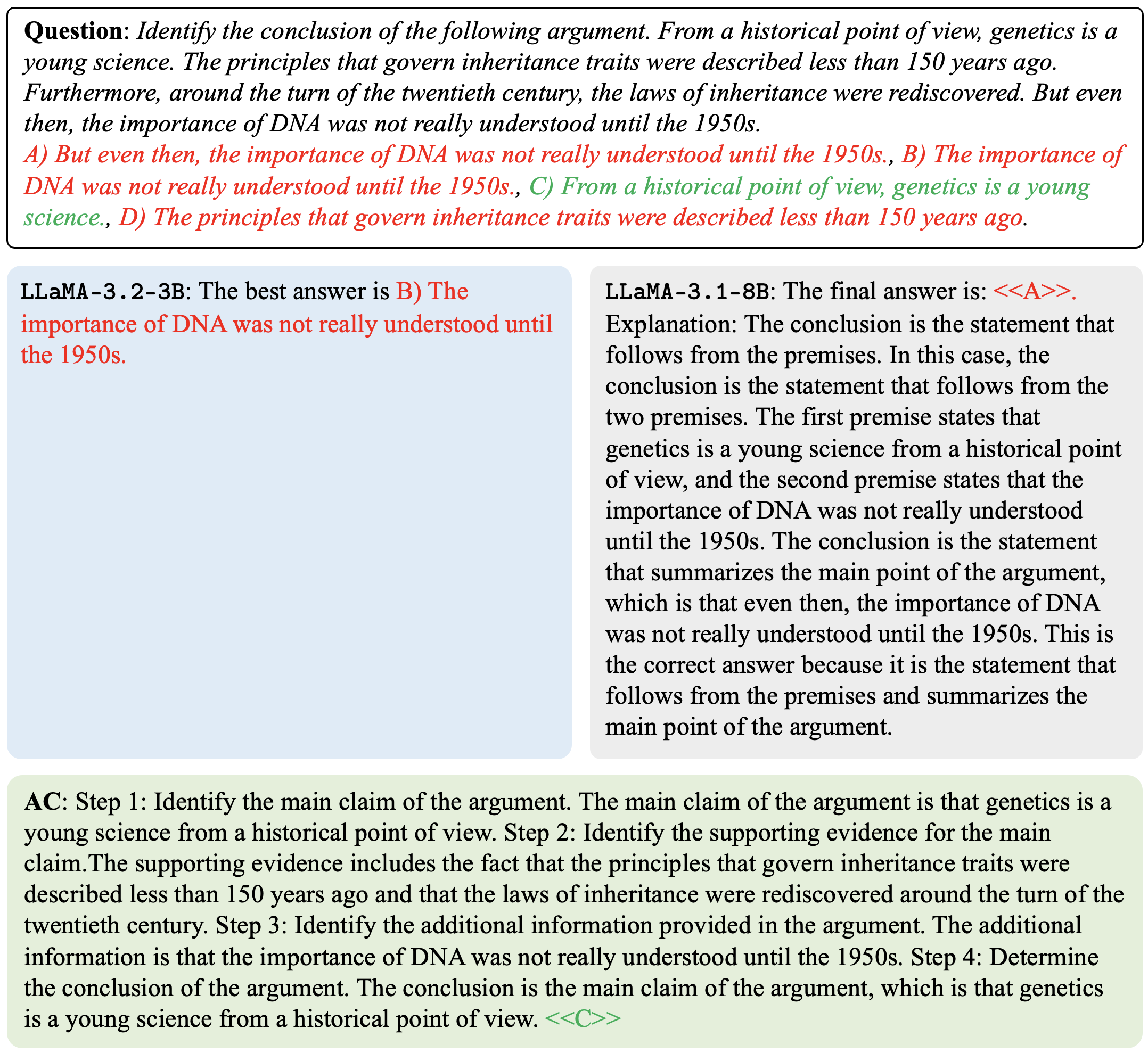
The image presents a question regarding the conclusion of a given argument about the historical understanding of genetics and DNA. Below the question are multiple-choice answers, with one marked as the "best answer" and a detailed explanation provided. Further below is a step-by-step breakdown of how to arrive at the correct answer. The document appears to be an educational resource, likely for a logic or critical thinking course.
### Components/Axes
The document is structured into the following sections:
1. **Question:** A statement presenting an argument followed by a question about its conclusion.
2. **Multiple Choice Answers:** Four options (A, B, C, D) representing potential conclusions.
3. **Best Answer Identification:** Indicates the correct answer ("The best answer is B") with the corresponding text highlighted in bold.
4. **Explanation:** A detailed justification for why the selected answer is the correct conclusion.
5. **AC: Step-by-Step Analysis:** A numbered breakdown of the logical steps to determine the conclusion.
### Detailed Analysis or Content Details
**Question:** "Identify the conclusion of the following argument. From a historical point of view, genetics is a young science. The principles that govern inheritance traits were described less than 150 years ago. Furthermore, around the turn of the twentieth century, the laws of inheritance were rediscovered. But even then, the importance of DNA was not really understood until the 1950s."
**Multiple Choice Answers:**
* A) But even then, the importance of DNA was not really understood until the 1950s.
* B) The importance of DNA was not really understood until the 1950s.
* C) From a historical point of view, genetics is a young science.
* D) The principles that govern inheritance traits were described less than 150 years ago.
**Best Answer:** "LLaMA-3.2-3B: The best answer is B) **The importance of DNA was not really understood until the 1950s.**"
**Explanation:** "Explanation: The conclusion is the statement that follows from the premises. In this case, the conclusion is the statement that follows from the two premises. The first premise states that genetics is a young science from a historical point of view, and the second premise states that the importance of DNA was not really understood until the 1950s. The conclusion is the statement that summarizes the main point of the argument, which is that even then, the importance of DNA was not really understood until the 1950s. This is the correct answer because it is the statement that follows from the premises and summarizes the main point of the argument."
**AC: Step-by-Step Analysis:**
* Step 1: Identify the main claim of the argument. The main claim of the argument is that genetics is a young science from a historical point of view.
* Step 2: Identify the supporting evidence for the main claim. The supporting evidence includes the fact that the principles that govern inheritance traits were described less than 150 years ago and that the laws of inheritance were rediscovered around the turn of the twentieth century.
* Step 3: Identify the additional information provided in the argument. The additional information is that the importance of DNA was not really understood until the 1950s.
* Step 4: Determine the conclusion of the argument. The conclusion is the main claim of the 1950s, which is that genetics is a young science from a historical point of view.
### Key Observations
The explanation and step-by-step analysis seem to contain a slight logical inconsistency. While answer B is identified as the best answer, the explanation and AC analysis ultimately state that the conclusion is that "genetics is a young science from a historical point of view" (which corresponds to answer C). This suggests a potential error in the explanation or analysis. The document also includes "LLaMA-3.1-8B: The final answer is: <<A>>" and "LLaMA-3.1-8B: The final answer is: <<C>>" which are likely intermediate steps or alternative responses from a language model.
### Interpretation
This document demonstrates a critical thinking exercise focused on identifying the conclusion of an argument. The argument itself establishes the relative youth of genetics as a scientific field, supported by the recent understanding of DNA's role. The core issue is discerning whether the conclusion is a broad statement about the field of genetics (answer C) or a specific point about the delayed understanding of a key component (DNA, answer B). The document's internal inconsistency suggests that the process of identifying conclusions can be nuanced and prone to misinterpretation, even with detailed explanations. The inclusion of LLaMA outputs indicates the use of a large language model in the process, potentially as a tool for generating explanations or alternative answers. The document serves as a valuable example for teaching logical reasoning and the importance of careful analysis.