## Textual Content: Argument Analysis on Genetics as a Young Science
### Overview
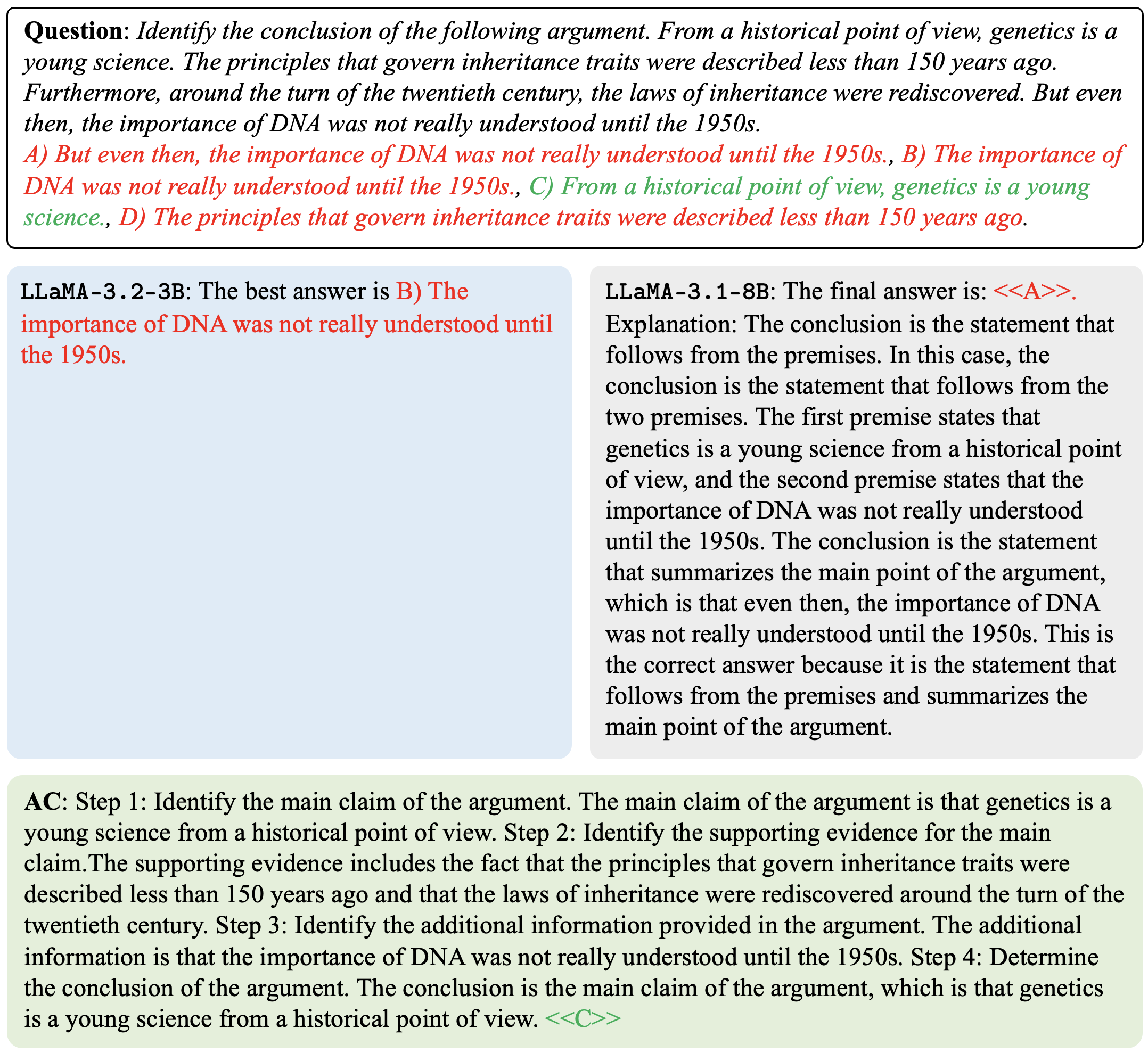
The image contains a textual argument analysis task. It presents a question asking to identify the conclusion of an argument about genetics being a "young science" from a historical perspective. The argument includes premises about the timeline of genetic discoveries and DNA's role. Four answer choices (A–D) are provided, with explanations from two AI models (LLaMA-3.2-3B and LLaMA-3.1-8B) and a step-by-step reasoning process (AC).
### Components/Axes
- **Question**: "Identify the conclusion of the following argument. From a historical point of view, genetics is a young science. The principles that govern inheritance traits were described less than 150 years ago. Furthermore, around the turn of the twentieth century, the laws of inheritance were rediscovered. But even then, the importance of DNA was not really understood until the 1950s."
- **Answer Choices**:
- **A)**: "But even then, the importance of DNA was not really understood until the 1950s."
- **B)**: "The importance of DNA was not really understood until the 1950s."
- **C)**: "From a historical point of view, genetics is a young science."
- **D)**: "The principles that govern inheritance traits were described less than 150 years ago."
- **Explanations**:
- **LLaMA-3.2-3B**: States that the best answer is **B**, emphasizing that the conclusion follows from the premises.
- **LLaMA-3.1-8B**: Confirms **A** as the final answer, explaining that the conclusion summarizes the premises.
- **Step-by-Step Reasoning (AC)**:
1. **Step 1**: Identify the main claim (genetics is a young science).
2. **Step 2**: Supporting evidence (principles of inheritance described <150 years ago; laws rediscovered ~1900).
3. **Step 3**: Additional information (DNA's importance not understood until the 1950s).
4. **Step 4**: Conclusion (genetics is a young science).
### Detailed Analysis
- **Question Text**:
The argument establishes genetics as a young science by citing historical milestones:
- Principles of inheritance described <150 years ago.
- Laws of inheritance rediscovered ~1900.
- DNA's importance not understood until the 1950s.
- **Answer Choices**:
- **A** and **B** both reference DNA's delayed understanding, but **A** includes the phrase "But even then," which is part of the original argument's structure.
- **C** restates the main claim.
- **D** repeats a premise.
- **Model Explanations**:
- **LLaMA-3.2-3B** argues **B** is correct because it directly follows from the premises.
- **LLaMA-3.1-8B** claims **A** is correct, noting that the conclusion summarizes the premises.
- **AC Reasoning**:
The step-by-step process isolates the main claim (Step 1), supporting evidence (Steps 2–3), and concludes that genetics is a young science (Step 4).
### Key Observations
- The argument hinges on the timeline of genetic discoveries to define genetics as a "young science."
- **A** and **B** are semantically similar but differ in phrasing. **A** includes a transitional phrase ("But even then") from the original text, while **B** is a direct statement.
- Both models agree on the conclusion but differ in their reasoning (e.g., **B** as a summary vs. **A** as a restatement).
### Interpretation
The text demonstrates how conclusions are derived from premises in logical arguments. The debate between **A** and **B** highlights nuances in phrasing and the importance of transitional language in argument structure. The AC steps provide a framework for dissecting arguments, emphasizing the separation of claims, evidence, and conclusions. The models' conflicting interpretations suggest that the conclusion could be interpreted as either a restatement of the main claim (**A**) or a synthesis of the premises (**B**), depending on contextual emphasis.