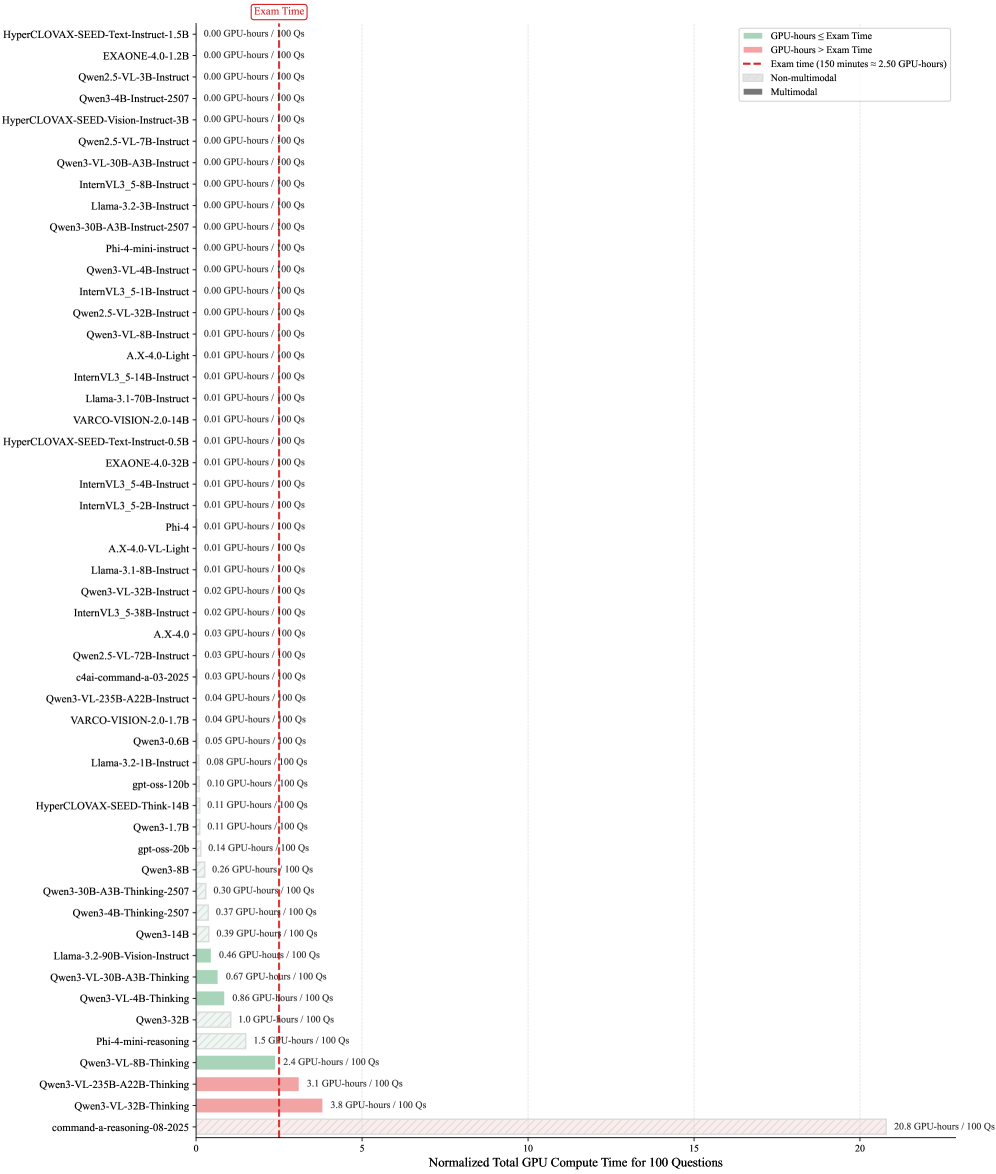
## Bar Chart: Normalized Total GPU Compute Time for 100 Questions
### Overview
The chart compares GPU compute times across various models and tasks, normalized for 100 questions. It uses color-coded bars to indicate whether compute times fall below, exceed, or are non-multimodal relative to an exam time threshold (2.50 GPU-hours).
### Components/Axes
- **X-axis**: "Normalized Total GPU Compute Time for 100 Questions" (ranges from 0 to ~22 GPU-hours).
- **Y-axis**: List of models and tasks (e.g., "HyperCLOVAX-SEED-Text-Instruct-1.5B", "Qwen3-VL-32B-Thinking").
- **Legend** (top-right):
- Green: GPU-hours ≤ Exam Time (≤2.50 GPU-hours).
- Red: GPU-hours > Exam Time (>2.50 GPU-hours).
- Grey: Non-multimodal (solid) or Multimodal (striped).
### Detailed Analysis
- **Data Series**:
- **Green Bars** (≤2.50 GPU-hours): Most entries (e.g., "HyperCLOVAX-SEED-Text-Instruct-1.5B" at 0.00 GPU-hours, "EXAONE-4.0-1.2B" at 0.00 GPU-hours).
- **Red Bars** (>2.50 GPU-hours): Intermediate entries (e.g., "Qwen3-VL-32B-Thinking" at 3.8 GPU-hours, "Phi-4-mini-reasoning" at 1.5 GPU-hours).
- **Grey Bars** (Non-multimodal): Longest entries (e.g., "command-a-reasoning-08-2025" at 20.8 GPU-hours, "Qwen3-VL-32B-Thinking" at 3.8 GPU-hours).
- **Trends**:
- Early entries (top of the chart) are near-zero GPU-hours, suggesting lightweight tasks or models.
- Compute time increases gradually until ~0.5 GPU-hours, then spikes for multimodal tasks (e.g., "Qwen3-VL-32B-Thinking").
- The longest bar ("command-a-reasoning-08-2025") is 20.8 GPU-hours, far exceeding the exam time.
### Key Observations
1. **Efficiency**: Most models (green) complete tasks within the exam time, but only a few (e.g., "EXAONE-4.0-1.2B") have near-zero compute times.
2. **Outliers**: "command-a-reasoning-08-2025" (20.8 GPU-hours) and "Phi-4-mini-reasoning" (1.5 GPU-hours) deviate significantly from the majority.
3. **Multimodal Impact**: Grey bars (non-multimodal) dominate the high-end compute times, indicating inefficiency for complex tasks.
### Interpretation
The data suggests that while many models can handle tasks within the exam time (2.50 GPU-hours), certain multimodal or complex tasks (e.g., "Qwen3-VL-32B-Thinking") require significantly more compute time. The extreme outlier "command-a-reasoning-08-2025" highlights potential inefficiencies in specific workflows, suggesting a need for optimization or alternative architectures. The chart underscores the trade-off between model complexity and computational efficiency, with non-multimodal models generally underperforming in time-sensitive scenarios.