\n
## Diagram: Deep Reasoning Approaches
### Overview
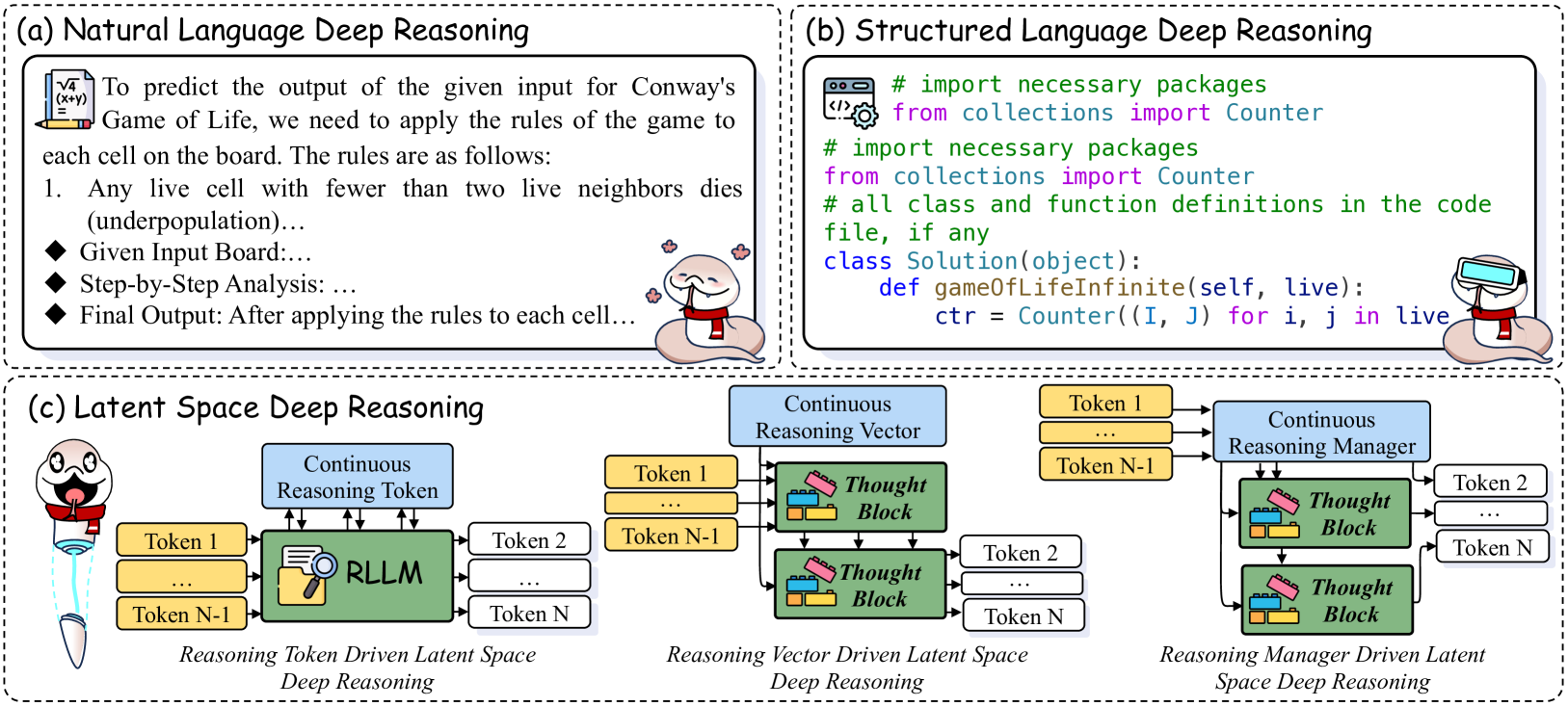
The image presents a comparative diagram illustrating three different approaches to deep reasoning: Natural Language Deep Reasoning, Structured Language Deep Reasoning, and Latent Space Deep Reasoning. Each approach is depicted within a rectangular frame labeled (a), (b), and (c) respectively. The diagram uses visual metaphors (computer, code editor, brain) alongside textual descriptions to explain the process.
### Components/Axes
The diagram is divided into three main sections, each representing a different reasoning approach. Each section contains:
* A title indicating the reasoning approach.
* A textual description of the approach.
* A visual representation of the process.
* Illustrative icons representing input and output.
### Detailed Analysis or Content Details
**(a) Natural Language Deep Reasoning:**
* **Title:** Natural Language Deep Reasoning
* **Text:** "To predict the output of the given input for Conway's Game of Life, we need to apply the rules of the game to each cell on the board. The rules are as follows: 1. Any live cell with fewer than two live neighbors dies (underpopulation). Given Input Board:… Step-by-Step Analysis:… Final Output: After applying the rules to each cell…"
* **Visual:** A computer screen displaying a grid-like pattern (representing Conway's Game of Life board) with some cells highlighted. A brain icon is positioned above the screen, with curved lines suggesting a thought process connecting the brain to the screen.
* **Icons:** A computer monitor on the left, a brain icon in the center, and a robot head on the right.
**(b) Structured Language Deep Reasoning:**
* **Title:** Structured Language Deep Reasoning
* **Text:** "# import necessary packages from collections import Counter # import necessary packages from collections import Counter # all class and function definitions in the code file, if any class Solution(object): def gameOfLifeInfinite(self, live): ctr = Counter((I, J) for i, j in live"
* **Visual:** A code editor window displaying Python code related to Conway's Game of Life. A robot head is positioned to the right of the code editor.
* **Icons:** A code editor icon on the left, and a robot head on the right.
**(c) Latent Space Deep Reasoning:**
* **Title:** Latent Space Deep Reasoning
* **Visual:** This section is more complex, depicting a flow diagram.
* **Left:** A circular icon with a brain and gears, labeled "Continuous Reasoning Token". This feeds into a block labeled "RLLM". The RLLM block outputs "Token 1", "Token N-1", and "Token N".
* **Center:** "Reasoning Vector Driven Latent Space Deep Reasoning". "Token 1", "Token N-1", and "Token N" are input into "Thought Block" boxes.
* **Right:** "Reasoning Manager Driven Latent Space Deep Reasoning". "Token 1", "Token N-1", and "Token N" are input into a "Continuous Reasoning Manager" which outputs "Token 2", "Token N".
* **Labels:** "Reasoning Token Driven Latent Space Deep Reasoning", "Reasoning Vector Driven Latent Space Deep Reasoning", "Reasoning Manager Driven Latent Space Deep Reasoning".
### Key Observations
* The diagram highlights a progression from more explicit (natural language, structured code) to more implicit (latent space) reasoning approaches.
* The Latent Space approach is significantly more complex visually, suggesting a higher level of abstraction.
* All three approaches ultimately aim to solve the same problem (Conway's Game of Life), but utilize different methods.
* The use of robot head icons in (a) and (b) suggests an automated output or solution.
### Interpretation
The diagram illustrates different paradigms for achieving deep reasoning in artificial intelligence. Natural Language Deep Reasoning relies on human-readable rules and explanations. Structured Language Deep Reasoning uses formal code to implement the reasoning process. Latent Space Deep Reasoning, the most advanced approach, operates on abstract representations (tokens and vectors) within a latent space, potentially enabling more flexible and nuanced reasoning. The diagram suggests that as reasoning becomes more sophisticated, it moves away from explicit instructions and towards implicit, learned representations. The complexity of the Latent Space section indicates the challenges and potential of this approach. The common thread is Conway's Game of Life, used as a benchmark problem to demonstrate the capabilities of each reasoning method. The diagram doesn't provide specific data or numerical values, but rather a conceptual comparison of different AI reasoning strategies.