## Flowchart and Code Diagram: Deep Reasoning Architectures
### Overview
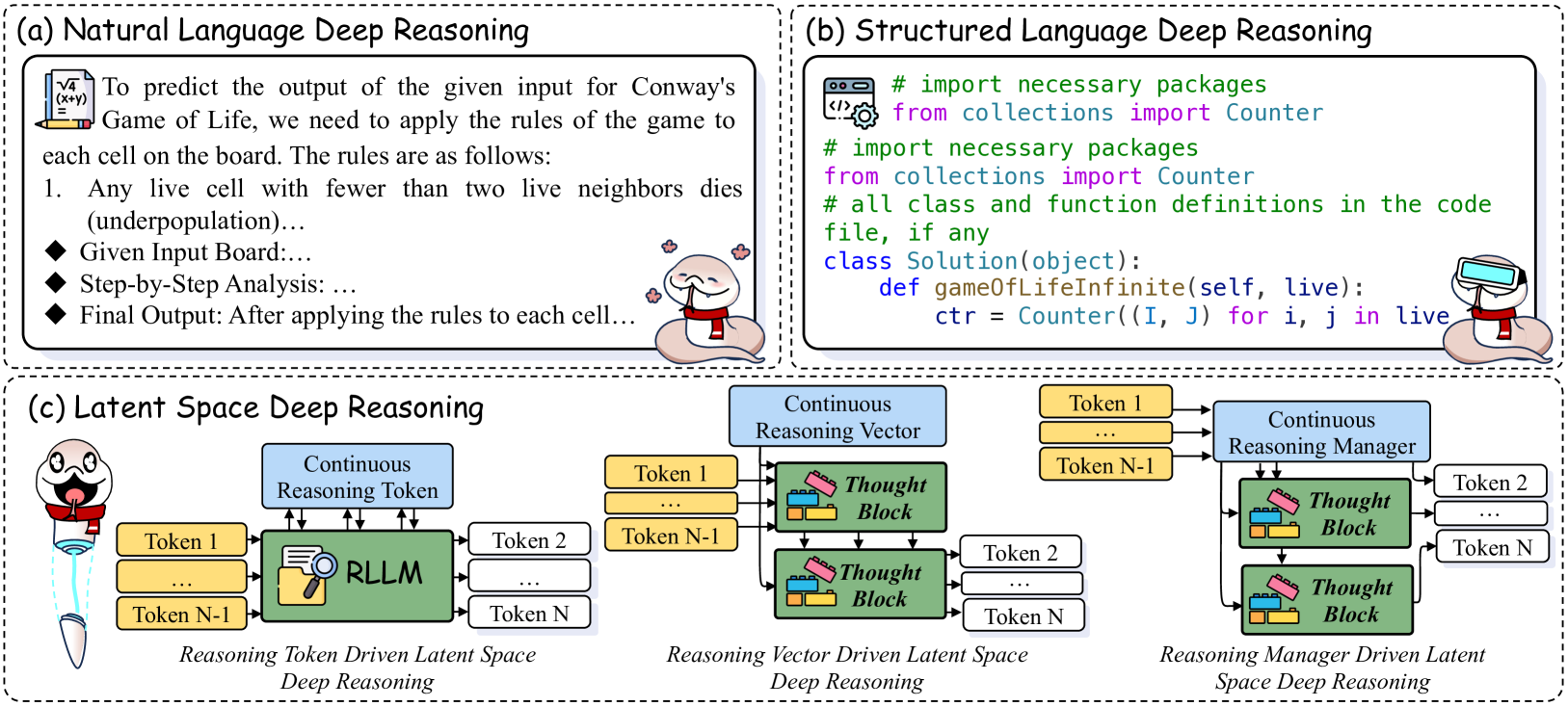
The image presents three distinct reasoning frameworks:
1. **Natural Language Deep Reasoning** (a)
2. **Structured Language Deep Reasoning** (b)
3. **Latent Space Deep Reasoning** (c)
Each section combines textual explanations with visual diagrams to illustrate computational reasoning processes.
---
### Components/Axes
#### (a) Natural Language Deep Reasoning
- **Textual Content**:
- Rules for Conway's Game of Life:
1. Underpopulation: Live cell with <2 neighbors dies.
2. Survival: Live cell with 2-3 neighbors survives.
3. Reproduction: Dead cell with 3 neighbors becomes alive.
- Workflow:
- Input Board → Step-by-Step Analysis → Final Output
- **Visual Elements**:
- Flowchart with arrows connecting "Input Board" → "Step-by-Step Analysis" → "Final Output".
- Icons: Pencil (input), magnifying glass (analysis), checkered flag (output).
#### (b) Structured Language Deep Reasoning
- **Textual Content**:
- Python code snippet for Game of Life:
```python
from collections import Counter
class Solution:
def gameOfLifeInfinite(self, live):
ctr = Counter((i, j) for i, j in live)
```
- Keywords: `import`, `class`, `def`, `Counter`, `for` loops.
- **Visual Elements**:
- Code syntax highlighting:
- Green: Comments (`# import...`)
- Purple: Keywords (`from`, `class`, `def`)
- Blue: Variables (`ctr`, `live`)
#### (c) Latent Space Deep Reasoning
- **Textual Content**:
- Three reasoning paradigms:
1. **Reasoning Token Driven Latent Space**
2. **Reasoning Vector Driven Latent Space**
3. **Reasoning Manager Driven Latent Space**
- **Visual Elements**:
- **Thought Blocks**: Green rectangles with pink "thought" icons.
- **Continuous Reasoning Vectors**: Blue arrows.
- **Token Flow**: Yellow rectangles labeled "Token 1" to "Token N".
- **RLLM**: Green rectangle with magnifying glass icon.
---
### Detailed Analysis
#### (a) Natural Language Deep Reasoning
- **Rules**:
- Underpopulation: "Any live cell with fewer than two live neighbors dies."
- Survival: Implied by "2-3 neighbors" (not explicitly stated but inferred).
- Reproduction: "Dead cell with 3 neighbors becomes alive."
- **Workflow**:
- Input Board (initial state) → Apply rules iteratively → Final Output (next state).
#### (b) Structured Language Deep Reasoning
- **Code Structure**:
- Imports: `collections.Counter` for neighbor counting.
- Class `Solution`: Encapsulates the game logic.
- Method `gameOfLifeInfinite`: Processes live cell coordinates.
- **Key Components**:
- `ctr = Counter((i, j) for i, j in live)`: Counts live cell positions.
#### (c) Latent Space Deep Reasoning
- **Architectures**:
1. **Token Driven**: Tokens (1 to N) feed into RLLM for reasoning.
2. **Vector Driven**: Continuous vectors route through "Thought Blocks" to generate tokens.
3. **Manager Driven**: Central "Reasoning Manager" orchestrates token flow between Thought Blocks.
---
### Key Observations
1. **Natural Language**: Explicitly defines Game of Life rules but omits survival condition.
2. **Code**: Uses Python’s `Counter` for efficient neighbor tracking.
3. **Latent Space**:
- Token-driven models prioritize sequential reasoning.
- Vector-driven models emphasize continuous state transitions.
- Manager-driven models introduce hierarchical control.
---
### Interpretation
- **Natural Language**: Demonstrates rule-based reasoning but lacks implementation details.
- **Structured Language**: Translates rules into executable code, highlighting computational efficiency.
- **Latent Space**: Illustrates how deep learning models abstract reasoning into tokens, vectors, or managed workflows.
- **Missing Data**: Survival condition in (a) is inferred but not explicitly stated.
- **Design Insight**: The three latent space paradigms suggest a progression from basic token processing to advanced hierarchical reasoning.
This breakdown reveals how reasoning frameworks evolve from rule-based logic to abstract, scalable architectures.