## Diagram: Neural Network Layer Architecture
### Overview
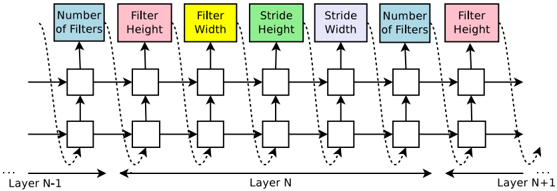
The image depicts a schematic representation of a neural network layer transformation process. It illustrates the flow of data and parameters between adjacent layers (Layer N-1 → Layer N → Layer N+1) with explicit annotations for key architectural components. The diagram uses color-coded boxes to represent different hyperparameters and directional arrows to show data flow.
### Components/Axes
1. **Horizontal Flow**:
- Left-to-right progression from Layer N-1 to Layer N+1
- Dashed arrows indicate parameter inheritance between layers
- Solid arrows show data transformation flow
2. **Parameter Boxes** (color-coded):
- **Blue**: "Number of Filters" (appears at Layer N-1 and Layer N+1)
- **Pink**: "Filter Height" (Layer N-1 and Layer N+1)
- **Yellow**: "Filter Width" (Layer N-1 and Layer N+1)
- **Green**: "Stride Height" (Layer N)
- **Purple**: "Stride Width" (Layer N)
3. **Layer Structure**:
- Layer N-1: Input layer with filter parameters
- Layer N: Intermediate layer with stride parameters
- Layer N+1: Output layer with inherited filter parameters
### Detailed Analysis
- **Filter Parameters**:
- Filter dimensions (height/width) remain consistent between Layer N-1 and N+1
- Stride parameters (height/width) are only specified for Layer N
- Number of filters appears to be preserved across layers (blue boxes)
- **Spatial Relationships**:
- Parameter boxes are vertically stacked in the order:
1. Number of Filters
2. Filter Height
3. Filter Width
4. Stride Height
5. Stride Width
6. Number of Filters
7. Filter Height
- Arrows connect boxes in a cascading pattern, suggesting hierarchical dependencies
### Key Observations
1. **Consistency in Filter Parameters**: Filter dimensions (height/width) are maintained across non-adjacent layers (N-1 and N+1)
2. **Stride Isolation**: Stride parameters only appear in the intermediate layer (N), suggesting they govern downsampling/upsampling operations
3. **Filter Count Preservation**: The number of filters remains constant between input and output layers, implying no dimensional reduction in feature maps
4. **Dashed vs Solid Arrows**: Dashed arrows indicate parameter inheritance, while solid arrows show active data transformation
### Interpretation
This diagram illustrates the fundamental operations in convolutional neural network (CNN) architecture:
1. **Filter Application**: The number, height, and width of filters determine feature extraction capabilities
2. **Stride Control**: Stride parameters in Layer N control spatial downsampling/upsampling between layers
3. **Layer Transformation**: The flow shows how input features (Layer N-1) are transformed through convolutional operations (Layer N) to produce output features (Layer N+1)
4. **Architectural Constraints**: The preservation of filter count and dimensions suggests this represents a standard convolutional block without pooling or stride-based dimensionality changes
The diagram emphasizes the importance of filter configuration in maintaining feature map dimensions while allowing spatial manipulation through stride parameters. The color-coding helps distinguish between static filter properties (blue/yellow/pink) and dynamic stride controls (green/purple).