## Diagram: Comparison of MHA and MTLA Architectures
### Overview
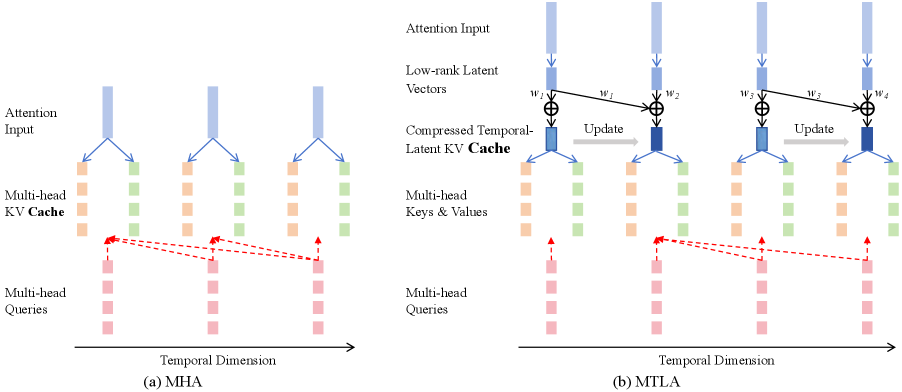
The image compares two transformer-based architectures: **MHA (Multi-head Attention)** and **MTLA (Multi-head Temporal Latent Attention)**. Both diagrams illustrate the flow of data through attention mechanisms, highlighting differences in cache management and temporal processing.
### Components/Axes
- **X-axis**: Labeled "Temporal Dimension" (left to right).
- **Y-axis**: Contains labeled blocks representing components:
- **Attention Input** (blue rectangles at the top).
- **Multi-head KV Cache** (orange/green squares in MHA; blue/green squares in MTLA).
- **Multi-head Queries** (pink rectangles at the bottom).
- **Legend**: Colors correspond to components:
- **Blue**:
- Attention Input (blue rectangles at the top)
- Compressed Temporal-Latent KV Cache (MTLA) [blue squares]
- **Orange**: Multi-head KV Cache (MHA) [orange squares]
- **Green**: Multi-head KV Cache (both MHA and MTLA) [green squares]
- **Pink**: Multi-head Queries (both) [pink rectangles]
### Detailed Analysis
#### (a) MHA Architecture
1. **Flow**:
- Attention Input → Multi-head KV Cache → Multi-head Queries.
- Red dashed arrows indicate attention connections between Queries and KV Cache.
2. **Key Elements**:
- **Multi-head KV Cache**: Static storage of key-value pairs across temporal dimensions.
- **Attention Input**: Directly feeds into the cache without compression.
#### (b) MTLA Architecture
1. **Flow**:
- Attention Input → Low-rank Latent Vectors → Compressed Temporal-Latent KV Cache → Multi-head Queries.
- Update arrows (→) show dynamic modification of the cache.
2. **Key Elements**:
- **Low-rank Latent Vectors**: Reduce dimensionality of input data.
- **Compressed Temporal-Latent KV Cache**: Dynamically updated cache with temporal compression.
- **Multi-head Queries**: Similar to MHA but interact with the compressed cache.
### Key Observations
- **MHA**: Simpler, static cache with direct attention connections.
- **MTLA**: Introduces compression and updates to the cache, suggesting improved efficiency for temporal data.
- **Red Dashed Arrows**: Represent attention weighting in both architectures but differ in cache interaction.
### Interpretation
The MTLA architecture appears designed to handle temporal data more efficiently by compressing latent representations and dynamically updating the cache. This contrasts with MHA’s static cache, which may struggle with long-term dependencies. The use of low-rank latent vectors in MTLA implies a focus on reducing computational complexity while preserving critical information.
**Note**: The diagram does not include numerical values or quantitative data, focusing instead on structural and procedural differences.