## Diagram: Socio-Economic and Political Belief Interactions
### Overview
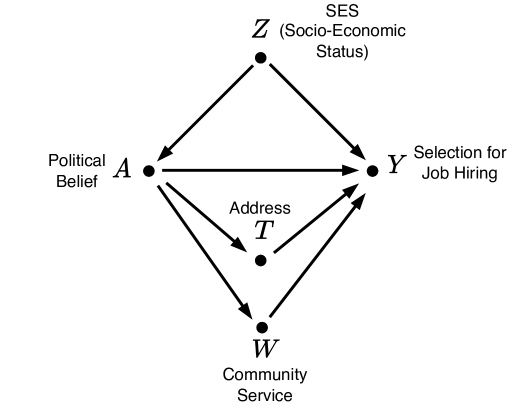
The diagram illustrates a directed graph representing relationships between socio-economic status (SES), political beliefs, job hiring, community service, and address. Arrows indicate directional influences or connections between these components.
### Components/Axes
- **Nodes (Variables):**
- **Z**: SES (Socio-Economic Status) – Positioned at the top of the diagram.
- **Y**: Selection for Job Hiring – Located in the upper-middle section.
- **W**: Community Service – Positioned at the bottom.
- **A**: Political Belief – Located on the left side.
- **T**: Address – Positioned centrally, connected to W.
- **Arrows (Relationships):**
- **A → Y**: Political Belief influences Selection for Job Hiring.
- **A → W**: Political Belief influences Community Service.
- **Y → Z**: Selection for Job Hiring influences SES.
- **T → W**: Address influences Community Service.
### Detailed Analysis
- **Node Labels and Positions:**
- **Z (SES)**: Topmost node, acting as a terminal outcome.
- **Y (Job Hiring)**: Middle-right node, directly connected to Z.
- **W (Community Service)**: Bottom node, connected to both A and T.
- **A (Political Belief)**: Left node, with two outgoing arrows to Y and W.
- **T (Address)**: Central node, with one outgoing arrow to W.
- **Arrow Directions:**
- All arrows point from source nodes (A, Y, T) to target nodes (Y, W, Z), indicating causal or influential relationships.
### Key Observations
1. **Political Belief (A)** is a central driver, influencing both **Job Hiring (Y)** and **Community Service (W)**.
2. **Job Hiring (Y)** directly impacts **SES (Z)**, suggesting a pathway from employment to socio-economic status.
3. **Address (T)** indirectly affects **Community Service (W)**, implying that residential location may influence participation in community activities.
4. **SES (Z)** is the final outcome, receiving input from both **Job Hiring (Y)** and **Community Service (W)**.
### Interpretation
The diagram suggests a model where **Political Belief** acts as a foundational factor shaping opportunities in **Job Hiring** and **Community Service**, which in turn influence **SES**. The inclusion of **Address (T)** as a mediator highlights the role of environmental or geographic factors in community engagement. This structure implies that socio-economic outcomes are not solely determined by individual actions (e.g., job hiring) but are also mediated by systemic factors like political ideology and residential context. The absence of feedback loops (e.g., SES influencing political beliefs) suggests a unidirectional model, though real-world dynamics may involve more complex interactions.