\n
## Diagram: Causal Model of Job Hiring
### Overview
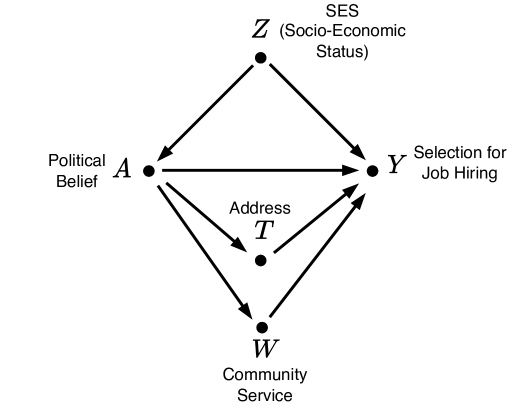
The image depicts a causal diagram illustrating relationships between several variables related to job hiring. The diagram uses nodes (circles) to represent variables and directed arrows to indicate causal relationships. There are no numerical values or scales present; it's a qualitative representation of hypothesized influences.
### Components/Axes
The diagram consists of five variables represented by labeled nodes:
* **A:** Political Belief
* **Z:** SES (Socio-Economic Status)
* **Y:** Selection for Job Hiring
* **T:** Address
* **W:** Community Service
Arrows indicate the following relationships:
* A -> Z
* A -> Y
* Z -> Y
* A -> T
* T -> W
* T -> Y
* W -> Y
### Detailed Analysis or Content Details
The diagram shows a network of causal relationships.
* **Political Belief (A)** influences both **Socio-Economic Status (Z)** and **Selection for Job Hiring (Y)** directly. It also influences **Address (T)**.
* **Socio-Economic Status (Z)** directly influences **Selection for Job Hiring (Y)**.
* **Address (T)** influences both **Community Service (W)** and **Selection for Job Hiring (Y)**.
* **Community Service (W)** directly influences **Selection for Job Hiring (Y)**.
There are no quantitative values associated with these relationships. The diagram only indicates the *presence* of a causal link, not the *strength* of the link.
### Key Observations
The diagram suggests that job hiring decisions are influenced by a complex interplay of factors, including political beliefs, socio-economic status, address, and community service. The variable "Address" appears to be a mediating factor, connecting political beliefs to community service and job hiring. The variable "Selection for Job Hiring" is the ultimate outcome, influenced by multiple upstream variables.
### Interpretation
This diagram represents a theoretical model of how various social factors might influence job hiring outcomes. It suggests that hiring is not solely based on qualifications but is also affected by broader societal factors like political beliefs and socio-economic status. The inclusion of "Address" and "Community Service" suggests that geographic location and civic engagement may also play a role.
The model could be used to investigate potential biases in the hiring process. For example, if individuals with certain political beliefs are systematically disadvantaged in the hiring process, this diagram provides a framework for understanding how that might occur. The model also highlights the potential for interventions aimed at promoting fairness and equity in hiring.
The diagram is a simplified representation of reality. It does not account for other potentially relevant factors, such as education, experience, or skills. It also assumes that the causal relationships are unidirectional, which may not always be the case. However, it provides a useful starting point for understanding the complex factors that influence job hiring outcomes.