## Directed Acyclic Graph (DAG): Causal Model of Job Hiring Selection
### Overview
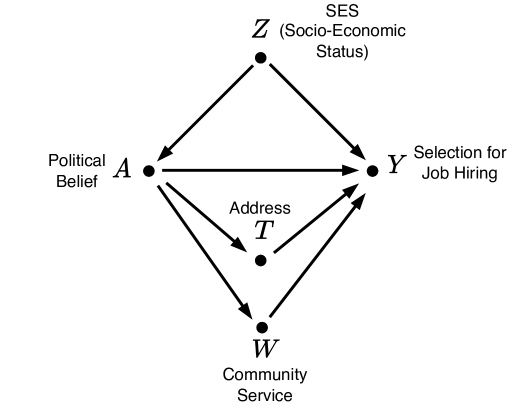
The image displays a directed acyclic graph (DAG), a type of causal diagram used in statistics and social sciences to represent hypothesized causal relationships between variables. The diagram consists of five nodes (variables) connected by directed arrows (causal paths). The layout is hierarchical, with one variable at the top, two in the middle tier, and two in the lower tier.
### Components/Axes
The diagram contains five labeled nodes and seven directed arrows. There are no numerical axes, scales, or legends as this is a conceptual model, not a data chart.
**Nodes (Variables):**
1. **Z** (Top-center): Labeled "SES (Socio-Economic Status)".
2. **A** (Middle-left): Labeled "Political Belief".
3. **Y** (Middle-right): Labeled "Selection for Job Hiring".
4. **T** (Lower-center, below A): Labeled "Address".
5. **W** (Bottom-center): Labeled "Community Service".
**Directed Arrows (Causal Paths):**
The arrows indicate the direction of hypothesized causal influence.
* From **Z** to **A**.
* From **Z** to **Y**.
* From **A** to **Y**.
* From **A** to **T**.
* From **A** to **W**.
* From **T** to **Y**.
* From **W** to **Y**.
### Detailed Analysis
The graph structures the relationships between the five variables as follows:
* **Z (SES)** is positioned as an exogenous variable (no incoming arrows). It has direct causal paths to both **A (Political Belief)** and **Y (Selection for Job Hiring)**.
* **A (Political Belief)** is a central node with multiple outgoing paths. It is influenced by **Z** and, in turn, influences **Y**, **T (Address)**, and **W (Community Service)**.
* **Y (Selection for Job Hiring)** is the primary outcome variable. It receives direct causal inputs from four other variables: **Z**, **A**, **T**, and **W**.
* **T (Address)** and **W (Community Service)** are intermediate variables. They are both influenced by **A** and both directly influence **Y**. They do not have a direct connection to each other.
### Key Observations
1. **Multiple Pathways to Outcome:** The outcome variable **Y** is influenced by four distinct direct causes.
2. **Central Role of Political Belief (A):** Variable **A** acts as a key mediator and confounder. It is influenced by **Z** and transmits that influence to **Y** through three separate pathways: directly, via **T**, and via **W**.
3. **Confounder Structure:** **Z (SES)** is a common cause of both **A** and **Y**, making it a potential confounder for the relationship between **A** and **Y** if not controlled for.
4. **Mediator Chain:** There is a clear mediator chain: **A → T → Y** and **A → W → Y**. This suggests that Political Belief may affect job hiring outcomes indirectly through its influence on an individual's Address and Community Service activities.
### Interpretation
This DAG represents a theoretical model for investigating factors that influence job hiring selection. It posits that Socio-Economic Status (SES) has both a direct effect on hiring and an indirect effect through shaping Political Belief. Political Belief itself is modeled as having a direct effect on hiring, as well as indirect effects mediated by a person's residential Address and their involvement in Community Service.
The diagram is a tool for research design. It helps identify which variables must be measured and controlled for to estimate the "true" causal effect of one variable on another. For example, to study the direct effect of Political Belief (A) on Hiring (Y), a researcher would need to statistically control for SES (Z) to block the confounding path Z → A and Z → Y. They might also need to consider whether Address (T) and Community Service (W) are mediators (part of the causal pathway) or confounders (common causes of A and Y), which would require different analytical approaches. The model suggests that simply observing a correlation between Political Belief and Hiring outcomes could be misleading without accounting for these complex interrelationships.