## Diagram: Brain with Domain Adaptation
### Overview
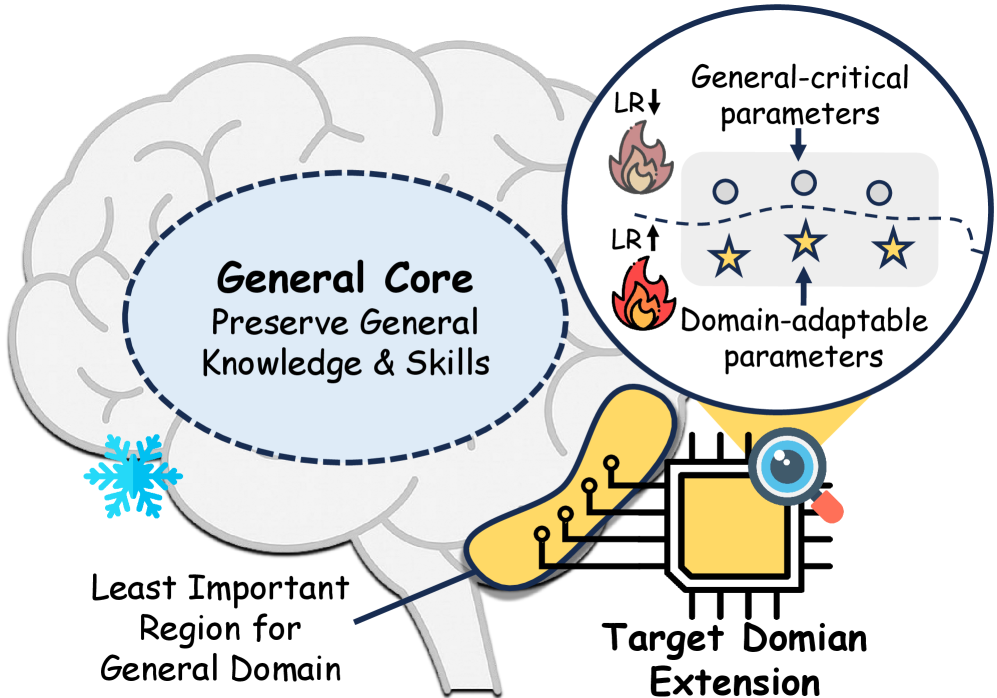
The image is a diagram illustrating the concept of domain adaptation in the context of a brain-like structure. It shows a brain with labeled regions representing general knowledge, less important regions, and a target domain extension. A magnified view highlights the distinction between general-critical parameters and domain-adaptable parameters, indicating how learning rates (LR) are adjusted during adaptation.
### Components/Axes
* **Brain:** A simplified representation of a brain, serving as the central metaphor.
* **General Core:** A blue oval within the brain, labeled "General Core" and "Preserve General Knowledge & Skills."
* **Least Important Region for General Domain:** A region at the bottom-left of the brain, marked with a snowflake icon.
* **Target Domain Extension:** A yellow square with integrated circuit-like connections, representing the area for domain-specific learning.
* **Magnified View:** A circular inset showing "General-critical parameters" (represented by circles) and "Domain-adaptable parameters" (represented by stars).
* **Learning Rate (LR) Indicators:** Flames with arrows pointing up (LR↑) and down (LR↓) next to the parameters in the magnified view.
### Detailed Analysis
* **General Core:** Located in the center of the brain, this area is responsible for preserving general knowledge and skills.
* **Least Important Region:** Situated at the bottom-left, this region is deemed less crucial for general domain tasks, indicated by a blue snowflake.
* **Target Domain Extension:** A yellow square at the bottom-right, connected to the brain via a yellow extension, represents the area where domain-specific learning occurs. It has a magnifying glass icon, suggesting closer inspection.
* **Magnified View Details:**
* **General-critical parameters:** Represented by circles, these parameters are associated with a decreased learning rate (LR↓), indicated by a flame icon with a downward arrow.
* **Domain-adaptable parameters:** Represented by stars, these parameters are associated with an increased learning rate (LR↑), indicated by a flame icon with an upward arrow.
* The parameters are separated by a dashed line.
### Key Observations
* The diagram emphasizes the distinction between general knowledge and domain-specific learning.
* Learning rates are adjusted differently for general-critical and domain-adaptable parameters.
* The "Least Important Region" suggests a potential area for modification or pruning during domain adaptation.
### Interpretation
The diagram illustrates a domain adaptation strategy where the brain (or a neural network) retains its core general knowledge while adapting to a specific target domain. The "General Core" represents the pre-trained knowledge, while the "Target Domain Extension" signifies the area where new, domain-specific knowledge is acquired. The magnified view highlights the key mechanism: adjusting learning rates. General-critical parameters, essential for general knowledge, have their learning rates reduced to prevent catastrophic forgetting. Domain-adaptable parameters, crucial for the new domain, have their learning rates increased to facilitate learning. The "Least Important Region" might represent parameters that can be pruned or repurposed without significantly affecting general performance. This approach aims to balance knowledge retention and adaptation, enabling the system to perform well in both general and specific domains.