\n
## Diagram: Brain Regions and Parameter Adaptation
### Overview
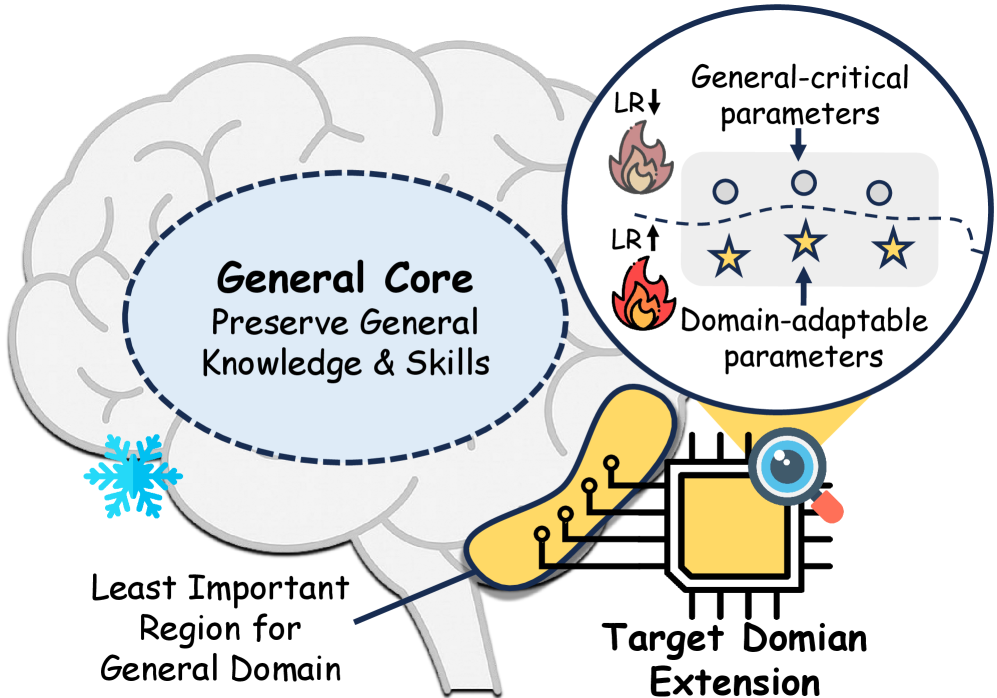
The image is a diagram illustrating different regions of the brain and their relationship to parameter adaptation, specifically in the context of learning and skill acquisition. It depicts a stylized brain with highlighted areas representing a "General Core" and a "Target Domain Extension," along with visual representations of parameters and their adaptability.
### Components/Axes
The diagram consists of the following key components:
* **Brain Outline:** A simplified outline of a brain, providing the overall structure.
* **General Core:** A large, light blue, dashed-outline region encompassing a significant portion of the brain. Labeled "General Core / Preserve General Knowledge & Skills".
* **Target Domain Extension:** A yellow region located in the lower-right portion of the brain, labeled "Target Domain Extension".
* **Parameter Representations:** Within the "General Core" region, there are visual representations of parameters:
* Circles: Representing "General-critical parameters".
* Stars: Representing "Domain-adaptable parameters".
* Flames: Representing the influence of "Learning Rate" (LR) on the parameters.
* **Learning Rate Indicators:** "LR↑" and "LR↓" labels indicating increasing and decreasing learning rates, respectively.
* **Symbolic Representations:** A snowflake in the light blue region labeled "Least Important Region for General Domain". An eye within a rectangle in the yellow region.
* **Connection Lines:** White lines representing connections and pathways within the brain.
### Detailed Analysis or Content Details
The diagram illustrates the following relationships:
* **General Core:** This region is responsible for preserving general knowledge and skills. It contains both "General-critical parameters" (represented by circles) and "Domain-adaptable parameters" (represented by stars).
* **Parameter Adaptation:** The diagram shows that the "Domain-adaptable parameters" (stars) are influenced by the "Learning Rate" (LR). An upward arrow (LR↑) next to a flame indicates that increasing the learning rate enhances adaptation of these parameters. A downward arrow (LR↓) indicates the opposite.
* **Target Domain Extension:** This region is associated with specific domain knowledge and skills. It contains a visual representation of an eye within a rectangle, suggesting focus or perception.
* **Least Important Region:** The snowflake symbol in the light blue region indicates an area of the brain considered less important for general domain knowledge.
* **Spatial Arrangement:** The "General Core" occupies a larger portion of the brain, while the "Target Domain Extension" is a more localized area. This suggests that general knowledge and skills form the foundation, while specific domain expertise builds upon that foundation.
### Key Observations
* The diagram emphasizes the importance of adaptable parameters for learning new skills.
* The learning rate is presented as a key factor in controlling the adaptation process.
* The distinction between "General-critical" and "Domain-adaptable" parameters suggests a hierarchical organization of knowledge and skills.
* The visual metaphor of flames representing learning rate and adaptation is striking.
### Interpretation
The diagram illustrates a cognitive model of learning and skill acquisition. It suggests that the brain has a core set of parameters that are essential for general intelligence and knowledge, and a separate set of parameters that are more flexible and adaptable to specific domains. The learning rate acts as a control mechanism, regulating how quickly and effectively these adaptable parameters are modified.
The "General Core" represents foundational knowledge and skills that are broadly applicable, while the "Target Domain Extension" represents specialized expertise. The diagram implies that effective learning involves adjusting the "Domain-adaptable parameters" within the "General Core" to acquire new skills and knowledge. The "Least Important Region" suggests that some areas of the brain may be less crucial for general cognitive function.
The eye symbol within the "Target Domain Extension" could represent focused attention or perceptual processing, highlighting the role of sensory input in learning. The diagram is a conceptual representation and does not provide specific numerical data or quantitative measurements. It is a qualitative illustration of a theoretical framework.