\n
## Diagram: Binaural Processing Model
### Overview
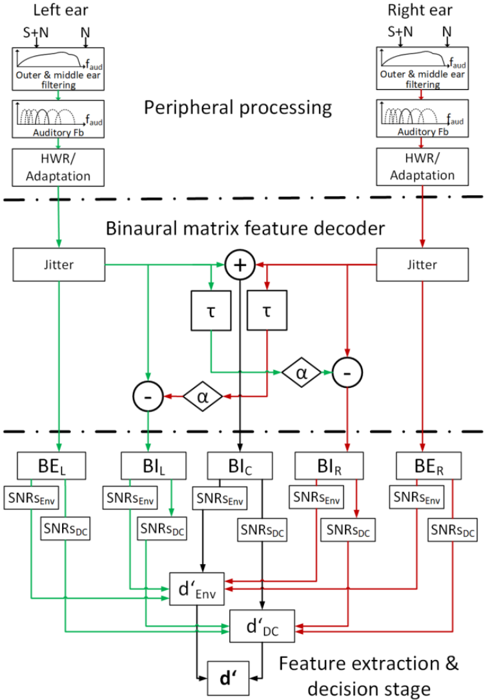
This diagram illustrates a model of binaural processing, depicting the flow of auditory information from the left and right ears through peripheral processing, a binaural matrix feature decoder, and finally to feature extraction and a decision stage. The diagram uses boxes to represent processing stages and arrows to indicate the direction of information flow. Green arrows represent signal flow, while red arrows indicate inhibitory connections.
### Components/Axes
The diagram is structured into three main sections:
1. **Peripheral Processing:** Includes stages for both the left and right ears.
2. **Binaural Matrix Feature Decoder:** The central processing unit.
3. **Feature Extraction & Decision Stage:** The final stage.
Key components and labels include:
* **Left Ear:** S+N (Signal + Noise), Outer & middle ear filtering, f<sub>aud</sub>, Auditory Fb, HWR/Adaptation.
* **Right Ear:** S+N (Signal + Noise), Outer & middle ear filtering, f<sub>aud</sub>, Auditory Fb, HWR/Adaptation.
* **Peripheral processing:** Title for the first section.
* **Binaural matrix feature decoder:** Title for the central section.
* **Jitter:** Present in both left and right ear pathways.
* **τ (Tau):** Delay element.
* **α (Alpha):** Gain element.
* **BE<sub>L</sub>, BE<sub>R</sub>:** Binaural Envelope - Left and Right.
* **BI<sub>L</sub>, BI<sub>R</sub>:** Binaural Intensity - Left and Right.
* **BI<sub>C</sub>:** Binaural Intensity - Center.
* **SNR<sub>Env</sub>:** Signal-to-Noise Ratio - Envelope.
* **SNR<sub>DC</sub>:** Signal-to-Noise Ratio - DC.
* **d'<sub>Env</sub>:** Prime d - Envelope.
* **d'<sub>DC</sub>:** Prime d - DC.
* **d':** Prime d.
* **Feature extraction & decision stage:** Title for the final section.
### Detailed Analysis or Content Details
The diagram shows a parallel processing pathway for the left and right ears.
1. **Peripheral Processing:** Both ears receive a signal plus noise (S+N). This signal undergoes outer and middle ear filtering, characterized by the frequency f<sub>aud</sub>. The filtered signal then passes through an Auditory Filterbank (Fb) and a stage for HWR/Adaptation. Jitter is introduced after this stage.
2. **Binaural Matrix Feature Decoder:** The outputs from the left and right ear pathways converge. The signals pass through delay elements (τ) and gain elements (α). The outputs of these elements feed into the binaural envelope (BE) and binaural intensity (BI) calculations. Specifically:
* BE<sub>L</sub> and BE<sub>R</sub> receive inputs from the left and right pathways, respectively.
* BI<sub>L</sub> and BI<sub>R</sub> receive inputs from the left and right pathways, respectively.
* BI<sub>C</sub> receives inputs from both pathways.
* Each of BE<sub>L</sub>, BE<sub>R</sub>, BI<sub>L</sub>, BI<sub>R</sub>, and BI<sub>C</sub> is associated with SNR<sub>Env</sub> and SNR<sub>DC</sub>.
3. **Feature Extraction & Decision Stage:** The outputs from the binaural intensity and envelope calculations (d'<sub>Env</sub> and d'<sub>DC</sub>) are combined to produce d', which represents the final feature used in the decision stage. Red arrows indicate inhibitory connections from BI<sub>L</sub> and BI<sub>R</sub> to d'<sub>Env</sub> and d'<sub>DC</sub>.
### Key Observations
* The diagram emphasizes parallel processing of auditory information from both ears.
* The use of delay (τ) and gain (α) elements suggests that interaural time and level differences are crucial for binaural processing.
* The SNR calculations (SNR<sub>Env</sub> and SNR<sub>DC</sub>) indicate that the model considers both the envelope and DC components of the signal-to-noise ratio.
* The inhibitory connections (red arrows) suggest a mechanism for suppressing irrelevant or competing signals.
* The diagram does not provide specific numerical values or quantitative data. It is a conceptual model.
### Interpretation
This diagram represents a computational model of how the brain processes binaural auditory information to extract features relevant for sound localization and speech intelligibility. The model highlights the importance of both temporal (delay) and intensity cues in binaural hearing. The SNR calculations suggest that the model accounts for the effects of noise on auditory perception. The inhibitory connections likely represent neural mechanisms for selective attention and noise reduction. The model suggests that the brain extracts features (d') from the binaural signal that are then used to make decisions about the location and characteristics of sound sources. The diagram is a high-level representation and does not delve into the specific neural circuits or algorithms involved in each processing stage. It is a conceptual framework for understanding the principles of binaural hearing.