## Diagram: Contrastive Pretraining and Zero-Shot Prediction Workflow
### Overview
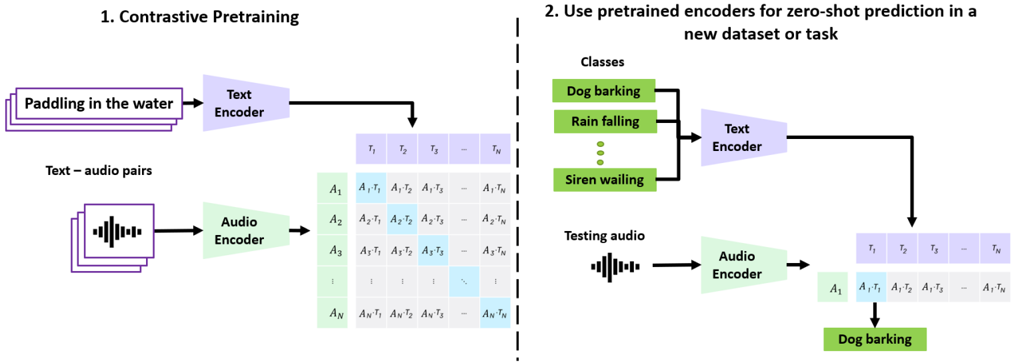
The image illustrates a two-stage process for training and deploying a model that aligns text and audio embeddings for zero-shot prediction. The left section shows **contrastive pretraining** using text-audio pairs, while the right section demonstrates **zero-shot prediction** on new data using pretrained encoders.
---
### Components/Axes
#### Left Section (Contrastive Pretraining):
1. **Text Encoder**:
- Input: Text samples (e.g., "Padding in the water").
- Output: Text embeddings (`T₁, T₂, ..., Tₙ`).
2. **Audio Encoder**:
- Input: Audio waveforms (represented as spectrograms).
- Output: Audio embeddings (`A₁, A₂, ..., Aₙ`).
3. **Text-Audio Pairs**:
- A matrix showing alignment between text and audio embeddings.
- Rows: Audio embeddings (`A₁` to `Aₙ`).
- Columns: Text embeddings (`T₁` to `Tₙ`).
- Entries: Pairings like `A₁T₁`, `A₁T₂`, etc., with color-coded similarity (green, blue, gray).
#### Right Section (Zero-Shot Prediction):
1. **Classes**:
- Example labels: "Dog barking", "Rain falling", "Siren wailing".
2. **Text Encoder**:
- Maps class labels to text embeddings.
3. **Testing Audio**:
- Input: New audio waveform.
- Output: Audio embedding (`A₁`).
4. **Prediction Flow**:
- Audio embedding compared to text embeddings of class labels to predict the class (e.g., "Dog barking").
---
### Detailed Analysis
#### Left Section:
- **Text-Audio Pairing Matrix**:
- Structure: `n x n` grid (audio embeddings as rows, text embeddings as columns).
- Entries:
- `A₁T₁`, `A₁T₂`, ..., `A₁Tₙ` (first row).
- `A₂T₁`, `A₂T₂`, ..., `A₂Tₙ` (second row).
- ...
- `AₙT₁`, `AₙT₂`, ..., `AₙTₙ` (last row).
- Color coding:
- Green: Strong similarity (e.g., `A₁T₁`).
- Blue: Moderate similarity.
- Gray: Weak/no similarity.
- Note: No explicit legend for colors; inferred from visual patterns.
#### Right Section:
- **Prediction Workflow**:
1. Text encoder processes class labels (e.g., "Dog barking") into text embeddings.
2. Testing audio is encoded into an audio embedding (`A₁`).
3. The audio embedding is compared to class text embeddings to identify the closest match (e.g., "Dog barking").
---
### Key Observations
1. **Contrastive Pretraining**:
- Text and audio embeddings are aligned to maximize similarity for matching pairs (e.g., "Padding in the water" paired with its corresponding audio).
- The matrix suggests a focus on contrastive loss, where similar pairs are encouraged, and dissimilar pairs are penalized.
2. **Zero-Shot Prediction**:
- The model generalizes to unseen classes (e.g., "Siren wailing") by leveraging pretrained text-audio embeddings.
- Testing audio is mapped to the closest class embedding without retraining.
3. **Ambiguities**:
- No explicit legend for matrix colors; interpretation relies on visual cues (green = high similarity).
- No numerical values provided for similarity scores or embedding dimensions.
---
### Interpretation
This diagram demonstrates a **contrastive learning framework** where text and audio modalities are jointly trained to share a common embedding space. During pretraining, the model learns to associate text descriptions with their corresponding audio signals (e.g., "Dog barking" with its audio). In the zero-shot phase, the same encoders are reused to predict class labels for new audio data by comparing its embedding to the pretrained text embeddings of known classes.
The absence of a legend for the matrix colors suggests that similarity is inferred visually (e.g., darker shades = higher similarity). The workflow emphasizes **generalization**—the model can classify unseen audio (e.g., "Siren wailing") without task-specific fine-tuning, relying solely on the pretrained text-audio alignment.
This approach is critical for applications like **multimodal search** or **voice-controlled systems**, where labeled training data for every possible class is impractical. The diagram highlights the power of **self-supervised learning** in bridging modalities for downstream tasks.