## Histogram: Number of defs and theorems across samples (N=4715)
### Overview
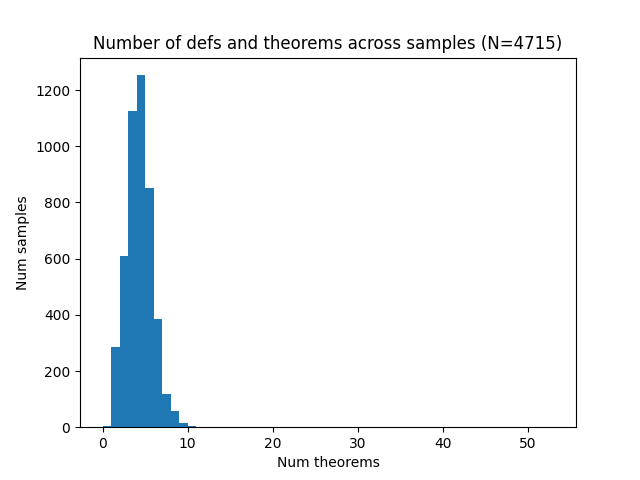
The image is a histogram displaying the distribution of the number of theorems per sample within a dataset of 4,715 samples. The chart shows a strongly right-skewed distribution, where the vast majority of samples contain a small number of theorems, and very few samples contain a large number.
### Components/Axes
* **Title:** "Number of defs and theorems across samples (N=4715)" (Located at the top center of the chart).
* **X-Axis:** Labeled "Num theorems". It represents the number of theorems in a sample. The axis has major tick marks at 0, 10, 20, 30, 40, and 50.
* **Y-Axis:** Labeled "Num samples". It represents the count (frequency) of samples. The axis has major tick marks at 0, 200, 400, 600, 800, 1000, and 1200.
* **Data Series:** A single data series represented by blue vertical bars (a histogram). Each bar's width represents a bin (range) of theorem counts, and its height represents the number of samples falling within that bin.
### Detailed Analysis
The histogram bars are concentrated on the far left side of the chart, indicating the data is heavily skewed.
* **Bin 0-1 (approx.):** The first bar, starting at 0, has a height of approximately 280 samples.
* **Bin 1-2 (approx.):** The second bar is significantly taller, with a height of approximately 600 samples.
* **Bin 2-3 (approx.):** The third bar is the tallest in the chart, reaching a peak of approximately 1250 samples.
* **Bin 3-4 (approx.):** The fourth bar is slightly shorter than the peak, with a height of approximately 1120 samples.
* **Bin 4-5 (approx.):** The fifth bar has a height of approximately 850 samples.
* **Bin 5-6 (approx.):** The sixth bar has a height of approximately 390 samples.
* **Bin 6-7 (approx.):** The seventh bar has a height of approximately 120 samples.
* **Bin 7-8 (approx.):** The eighth bar has a height of approximately 80 samples.
* **Bin 8-9 (approx.):** The ninth bar has a height of approximately 20 samples.
* **Bin 9-10 (approx.):** The tenth bar has a height of approximately 10 samples.
* **Beyond 10:** There are one or two very short, barely visible bars between 10 and 15 on the x-axis, representing a negligible number of samples (likely <5 each). No bars are visible beyond approximately x=15, despite the axis extending to 50.
**Trend Verification:** The visual trend is a sharp, steep rise to a peak at 2-3 theorems, followed by a rapid, exponential-like decay. The line formed by the tops of the bars slopes steeply upward from left to the peak, then slopes steeply downward to the right.
### Key Observations
1. **Strong Right Skew:** The distribution is not symmetric. The tail extends far to the right, but the mass of data is concentrated on the left.
2. **Clear Peak Mode:** The modal bin (most frequent) is for samples containing approximately 2-3 theorems.
3. **Low Theorem Count Dominance:** The overwhelming majority of samples (visually estimated >95%) contain 10 or fewer theorems.
4. **Sparse High-Count Samples:** Samples with more than 10 theorems are extremely rare in this dataset. The x-axis scale to 50 appears largely unused, suggesting the maximum number of theorems in any sample is likely less than 20.
5. **Terminology Note:** The title mentions "defs and theorems," but the x-axis is labeled only "Num theorems." This suggests the chart may specifically be counting theorems, or "defs" (definitions) might be included in the count or analyzed separately in a different chart not shown here.
### Interpretation
This histogram provides a quantitative profile of the complexity of the samples in the dataset (N=4715), where complexity is measured by the number of theorems.
* **What the data suggests:** The dataset is composed primarily of samples that are mathematically or logically simple, containing only a handful of theorems. This could indicate the dataset consists of many short proofs, lemmas, or exercises. The rarity of samples with many theorems suggests that long, complex proofs or comprehensive mathematical developments are uncommon within this collection.
* **Relationship between elements:** The title sets the context (counting theorems across many samples). The axes define the measurement (theorem count vs. frequency). The shape of the histogram directly visualizes the central tendency (low theorem count) and the variance (limited spread) of the dataset's complexity.
* **Notable Anomalies/Considerations:** The primary anomaly is the extreme skew. The disconnect between the title ("defs and theorems") and the axis label ("Num theorems") is a point of ambiguity. It is unclear if definitions are being counted alongside theorems, if the title is slightly inaccurate, or if this is one of a pair of charts. For a technical document, this ambiguity should be clarified. The choice of x-axis range (0-50) is also noteworthy, as it visually emphasizes the emptiness of the higher range, reinforcing the conclusion about the scarcity of complex samples.