## Line Graph: Corrected vs Original Wind Speed
### Overview
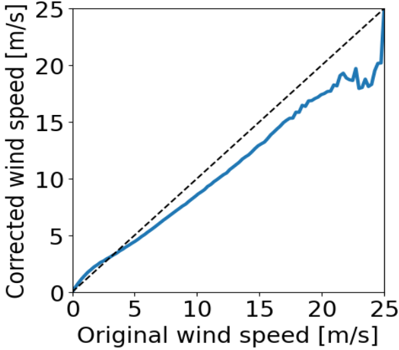
The graph compares corrected wind speed (y-axis) to original wind speed (x-axis) across a range of 0–25 m/s. Two lines are plotted: a solid blue line representing corrected wind speed and a dashed black line representing original wind speed. The corrected wind speed generally follows the original trend but with deviations, particularly at higher speeds.
### Components/Axes
- **X-axis**: "Original wind speed [m/s]" (0–25 m/s, linear scale).
- **Y-axis**: "Corrected wind speed [m/s]" (0–25 m/s, linear scale).
- **Legend**: Located in the top-right corner.
- Solid blue line: "Corrected wind speed".
- Dashed black line: "Original wind speed".
### Detailed Analysis
- **Solid Blue Line (Corrected Wind Speed)**:
- Starts at (0, 0).
- Follows a roughly linear trend with minor fluctuations.
- Key points:
- (5, 5)
- (10, 10)
- (15, 15)
- (20, 18) [~18 m/s]
- (25, 20) [~20 m/s]
- Deviations: Between x=20–25 m/s, the line dips slightly below the dashed line before rising again.
- **Dashed Black Line (Original Wind Speed)**:
- Straight diagonal line from (0, 0) to (25, 25).
- Represents a 1:1 relationship between original and corrected speeds.
### Key Observations
1. **Correction Bias**: The corrected wind speed is consistently lower than the original at lower speeds (e.g., 18 m/s vs. 20 m/s at x=20).
2. **Asymptotic Behavior**: At higher speeds (x=25), corrected speed approaches original speed (20 m/s vs. 25 m/s), suggesting diminishing correction errors.
3. **Fluctuations**: Minor oscillations in the blue line (e.g., ~16–18 m/s between x=15–20) indicate measurement noise or calibration variability.
### Interpretation
The graph demonstrates that wind speed correction introduces a systematic underestimation at lower speeds, likely due to sensor calibration or environmental factors. The convergence of the two lines at higher speeds implies improved accuracy or reduced correction needs in turbulent conditions. The deviations in the corrected line suggest potential instability in the correction algorithm or external variables (e.g., gusts, measurement lag). This could impact applications like wind energy modeling, where precise speed data is critical for turbine efficiency calculations.