## Image Comparison: Hierarchical-3DGS vs. FLOD-3DGS
### Overview
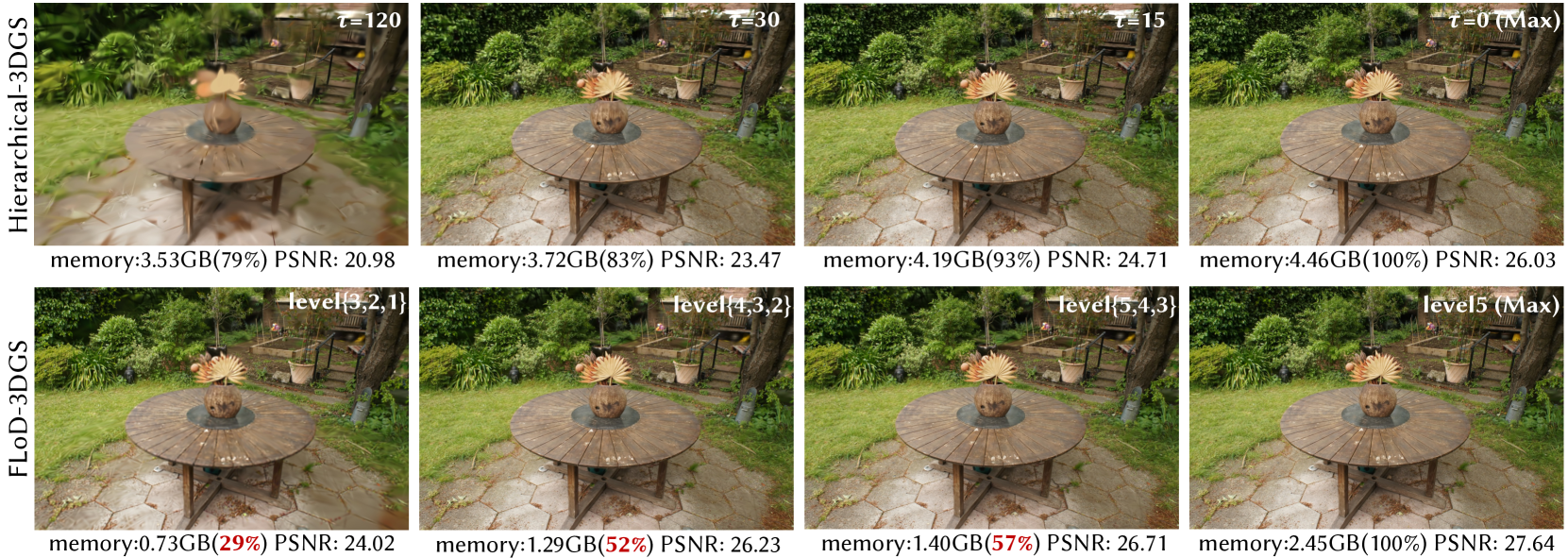
The image presents a comparison of two 3D Gaussian Splatting (3DGS) methods: Hierarchical-3DGS and FLOD-3DGS. It showcases rendered images of a garden scene with a round wooden table at varying levels of detail or time steps (τ). The comparison focuses on memory usage, percentage of maximum memory used, and Peak Signal-to-Noise Ratio (PSNR) as metrics.
### Components/Axes
* **Rows:** The image is divided into two rows, representing the two methods being compared:
* Top Row: Hierarchical-3DGS
* Bottom Row: FLOD-3DGS
* **Columns:** Each row contains four images, representing different detail levels or time steps (τ).
* Column 1: τ = 120 (Hierarchical-3DGS), level{3,2,1} (FLOD-3DGS)
* Column 2: τ = 30 (Hierarchical-3DGS), level{4,3,2} (FLOD-3DGS)
* Column 3: τ = 15 (Hierarchical-3DGS), level{5,4,3} (FLOD-3DGS)
* Column 4: τ = 0 (Max) (Hierarchical-3DGS), level5 (Max) (FLOD-3DGS)
* **Metrics:** Each image is accompanied by the following metrics:
* Memory Usage (in GB)
* Percentage of Maximum Memory Used (in %)
* PSNR (Peak Signal-to-Noise Ratio)
### Detailed Analysis or ### Content Details
**Hierarchical-3DGS (Top Row):**
* **τ = 120:**
* Image Quality: Blurry, low detail.
* Memory: 3.53GB
* Memory Percentage: 79%
* PSNR: 20.98
* **τ = 30:**
* Image Quality: Improved clarity compared to τ = 120.
* Memory: 3.72GB
* Memory Percentage: 83%
* PSNR: 23.47
* **τ = 15:**
* Image Quality: Further improved clarity.
* Memory: 4.19GB
* Memory Percentage: 93%
* PSNR: 24.71
* **τ = 0 (Max):**
* Image Quality: Highest clarity and detail.
* Memory: 4.46GB
* Memory Percentage: 100%
* PSNR: 26.03
**FLOD-3DGS (Bottom Row):**
* **level{3,2,1}:**
* Image Quality: Clearer than Hierarchical-3DGS at τ = 120.
* Memory: 0.73GB
* Memory Percentage: 29% (displayed in red)
* PSNR: 24.02
* **level{4,3,2}:**
* Image Quality: Improved clarity compared to level{3,2,1}.
* Memory: 1.29GB
* Memory Percentage: 52%
* PSNR: 26.23
* **level{5,4,3}:**
* Image Quality: Further improved clarity.
* Memory: 1.40GB
* Memory Percentage: 57% (displayed in red)
* PSNR: 26.71
* **level5 (Max):**
* Image Quality: Highest clarity and detail.
* Memory: 2.45GB
* Memory Percentage: 100%
* PSNR: 27.64
### Key Observations
* **Image Quality:** As τ decreases (Hierarchical-3DGS) or the level increases (FLOD-3DGS), the image quality improves, indicated by higher PSNR values and visually clearer images.
* **Memory Usage:** For Hierarchical-3DGS, memory usage increases as τ decreases. For FLOD-3DGS, memory usage increases as the level increases.
* **Memory Percentage:** The percentage of maximum memory used increases with image quality for both methods. The memory percentages for FLOD-3DGS at levels {3,2,1} and {5,4,3} are highlighted in red, possibly indicating lower memory usage compared to Hierarchical-3DGS at similar PSNR levels.
* **PSNR:** FLOD-3DGS achieves higher PSNR values with lower memory usage compared to Hierarchical-3DGS, especially at lower detail levels.
### Interpretation
The data suggests that FLOD-3DGS is more memory-efficient than Hierarchical-3DGS while achieving comparable or even better image quality (PSNR). This is evident from the lower memory usage and higher PSNR values of FLOD-3DGS at similar detail levels. The red highlighting of memory percentages for FLOD-3DGS further emphasizes its memory efficiency. The image demonstrates the trade-off between image quality, memory usage, and detail level for both methods. FLOD-3DGS appears to be a more optimized approach for rendering 3D scenes, offering a better balance between image quality and memory consumption.