## Flowchart: Agent-to-Agent Protocol
### Overview
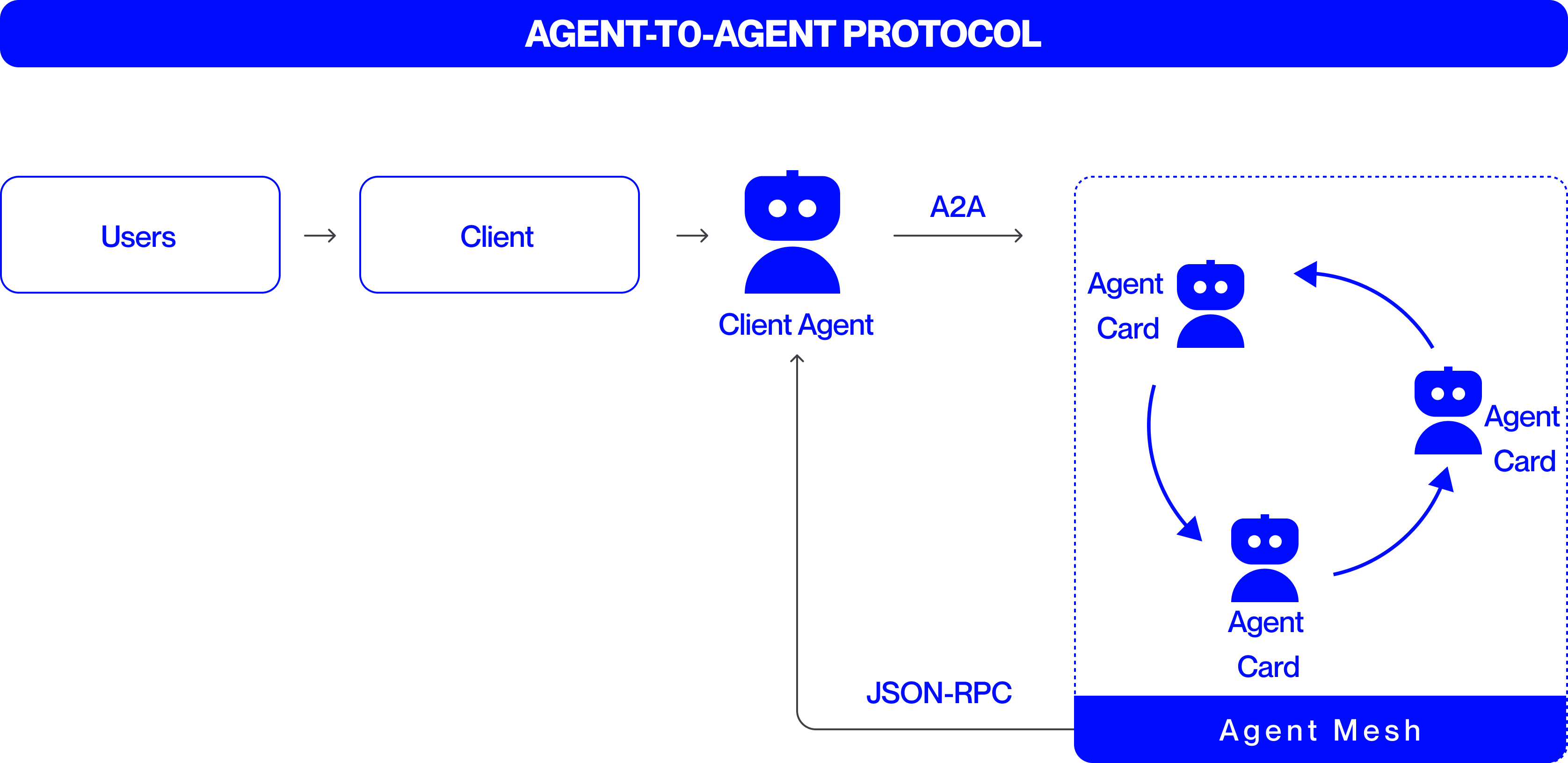
The diagram illustrates an agent-to-agent communication protocol involving users, clients, client agents, and an agent mesh network. It uses arrows to depict data flow and interactions between components.
### Components/Axes
- **Key Elements**:
- **Users**: Rectangular box on the far left.
- **Client**: Rectangular box connected to "Users" via a rightward arrow.
- **Client Agent**: Robot icon connected to "Client" via a rightward arrow.
- **A2A (Agent-to-Agent)**: Label on an arrow pointing from "Client Agent" to the "Agent Mesh."
- **Agent Mesh**: Dotted rectangular box containing three interconnected "Agent Card" icons.
- **JSON-RPC**: Label on an upward arrow connecting "Agent Mesh" back to "Client Agent."
### Detailed Analysis
- **Flow**:
1. **Users → Client**: Arrows indicate a unidirectional flow from users to the client.
2. **Client → Client Agent**: Flow continues to the client agent.
3. **Client Agent → A2A → Agent Mesh**: The client agent initiates communication via the A2A protocol to the agent mesh.
4. **Agent Mesh Internal Flow**: Three "Agent Card" icons form a cyclic loop (Agent Card → Agent Card → Agent Card), suggesting decentralized peer-to-peer interactions.
5. **Agent Mesh → Client Agent**: JSON-RPC protocol enables bidirectional communication between the mesh and the client agent.
- **Notable Features**:
- The "Agent Mesh" is visually isolated in a dotted box, emphasizing its role as a network hub.
- "JSON-RPC" is explicitly labeled, indicating the use of this protocol for structured data exchange.
### Key Observations
- The protocol emphasizes decentralized communication within the agent mesh, with cyclic interactions among agent cards.
- JSON-RPC acts as a bridge between the agent mesh and the client agent, enabling structured data transfer.
- No numerical data or trends are present; the diagram focuses on architectural relationships.
### Interpretation
This protocol demonstrates a decentralized agent communication system where:
1. **Users** interact with a **Client**, which delegates tasks to a **Client Agent**.
2. The **Client Agent** communicates with an **Agent Mesh** (a network of interconnected agents) via the **A2A protocol**.
3. The **Agent Mesh** operates as a self-sustaining network, with agents exchanging data cyclically.
4. **JSON-RPC** ensures standardized, bidirectional communication between the mesh and the client agent, likely enabling complex data queries or commands.
The diagram highlights a modular architecture where the agent mesh handles distributed processing, while the client agent acts as an intermediary between users and the mesh. The use of JSON-RPC suggests a focus on structured, interoperable data exchange, critical for scalable agent systems.