\n
## Diagram: Agent-to-Agent Protocol
### Overview
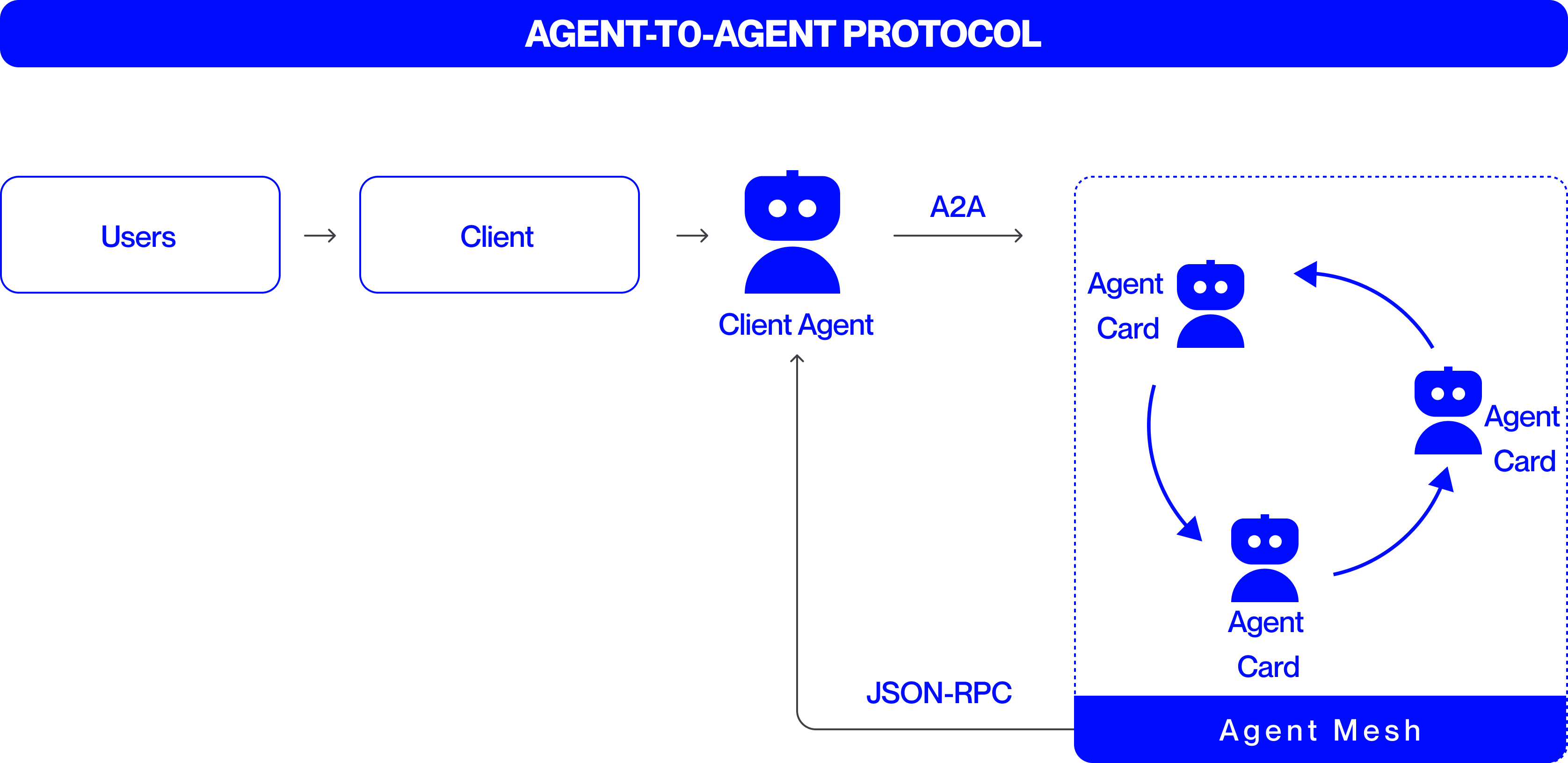
The image is a diagram illustrating an agent-to-agent protocol. It depicts the flow of communication between users, a client, a client agent, and an agent mesh consisting of agent cards. The diagram uses arrows to indicate the direction of communication and labels to identify the components.
### Components/Axes
The diagram consists of the following components:
* **Users:** Represented by a peach-colored rounded rectangle on the left.
* **Client:** A light blue rectangle connected to "Users" by an arrow.
* **Client Agent:** A blue figure with a green halo, connected to "Client" by an arrow. Labeled "Client Agent".
* **A2A:** Text label indicating Agent-to-Agent communication, positioned above the arrow connecting "Client Agent" to the "Agent Mesh".
* **Agent Mesh:** A dotted light blue rectangle containing multiple "Agent Cards". Labeled "Agent Mesh".
* **Agent Card:** Blue figures with green halos within the "Agent Mesh". Labeled "Agent Card".
* **JSON-RPC:** Text label positioned below the arrow connecting "Client Agent" to the "Agent Mesh".
### Detailed Analysis or Content Details
The diagram shows a unidirectional flow from "Users" to "Client", then to "Client Agent". The "Client Agent" communicates with the "Agent Mesh" via "A2A" (Agent-to-Agent) and receives data back via "JSON-RPC". The "Agent Mesh" consists of at least three "Agent Cards", with arrows indicating communication between them. The arrows within the "Agent Mesh" suggest a network or mesh-like communication pattern among the "Agent Cards".
### Key Observations
The diagram highlights a layered architecture where users interact with a client, which then utilizes a client agent to communicate with a network of agents. The use of "A2A" and "JSON-RPC" suggests specific communication protocols employed within the system. The mesh network of "Agent Cards" implies a distributed and potentially scalable architecture.
### Interpretation
This diagram illustrates a system designed for agent-based interactions. The "Agent-to-Agent Protocol" suggests that agents can communicate directly with each other, bypassing the need for a central server. The "Client Agent" acts as an intermediary between the user and the agent network. The use of "JSON-RPC" indicates a standardized method for remote procedure calls between the client agent and the agent mesh. The mesh network of agents suggests a robust and flexible system capable of handling complex interactions and potentially adapting to changing conditions. The diagram emphasizes a decentralized approach to communication and processing, which could offer benefits in terms of scalability, resilience, and efficiency. The diagram does not provide any quantitative data or specific details about the agents' functionalities or the nature of their interactions. It is a high-level architectural overview.