## Diagram: Theory of Mind Interaction Model
### Overview
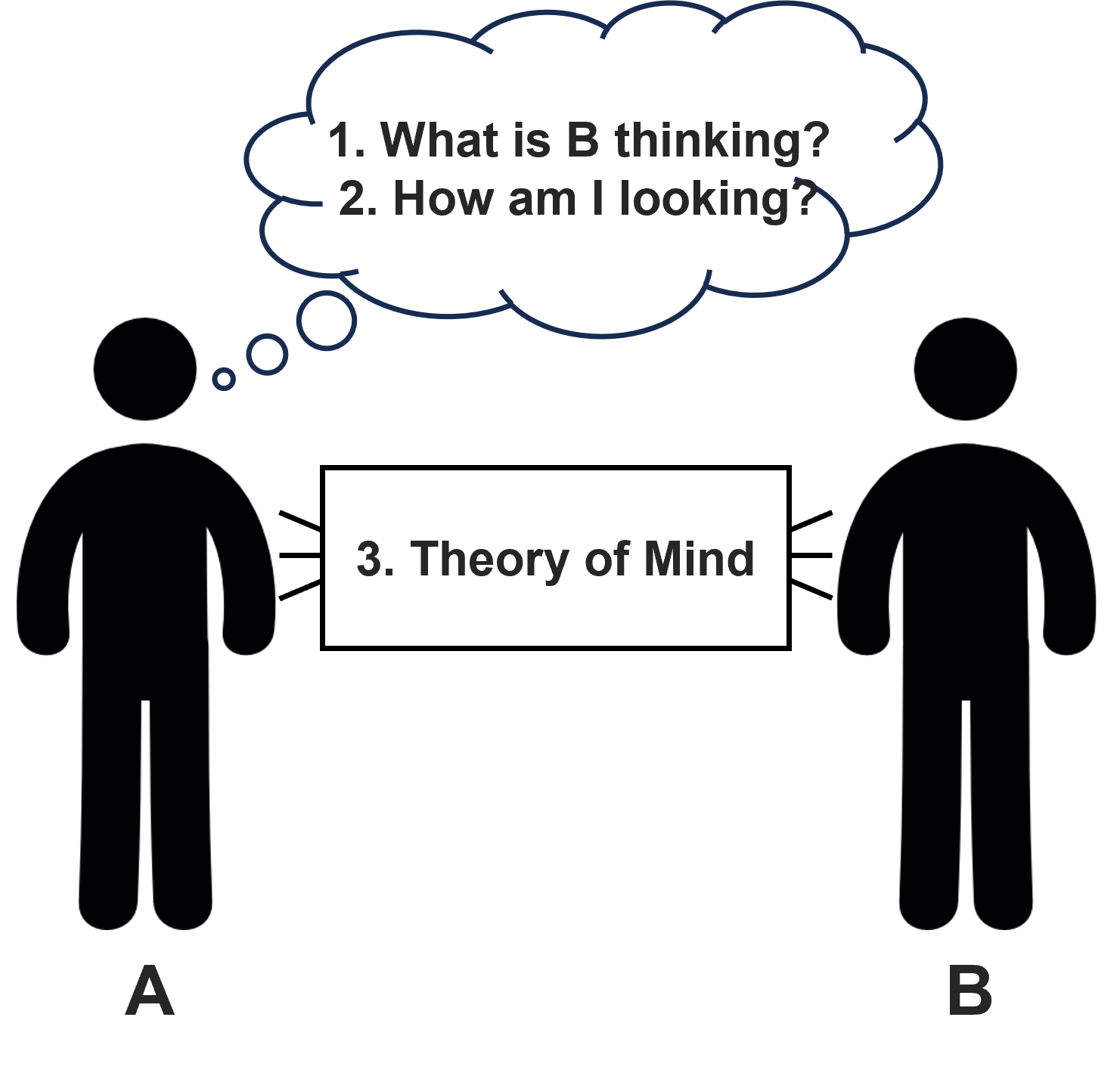
The image depicts a simplified diagram illustrating the concept of "Theory of Mind" (ToM) through two stick figures labeled **A** and **B**. Figure **A** has a thought bubble containing two questions:
1. "What is B thinking?"
2. "How am I looking?"
A central box labeled **"3. Theory of Mind"** is connected to both figures via lines, suggesting a bidirectional relationship between the concept and the individuals.
### Components/Axes
- **Labels**:
- **A**: Left figure (no additional text).
- **B**: Right figure (no additional text).
- **Central Box**: Contains the text **"3. Theory of Mind"** in bold, black font.
- **Visual Elements**:
- Thought bubble from **A** with two numbered questions.
- Lines connecting the central box to both figures, implying interaction.
- No axes, scales, or legends present.
### Content Details
- **Thought Bubble Text**:
1. "What is B thinking?"
2. "How am I looking?"
- **Central Box Text**:
- **"3. Theory of Mind"** (bold, black font).
- **Connections**:
- Lines from the central box to both **A** and **B** indicate a shared conceptual link.
### Key Observations
- The diagram emphasizes **perspective-taking** (question 1) and **self-awareness** (question 2) as core components of Theory of Mind.
- The numbering ("1," "2," "3") suggests a sequential or hierarchical relationship, though no explicit order is implied.
- The minimalist design focuses on abstract representation rather than quantitative data.
### Interpretation
This diagram visually represents the psychological concept of **Theory of Mind**, which involves understanding others' mental states (e.g., beliefs, intentions) and one's own appearance in social contexts.
- **Figure A's Thoughts**: The questions in the thought bubble highlight two critical aspects of ToM:
1. Inferring **B's mental state** (e.g., beliefs, desires).
2. Monitoring **one's own appearance** (e.g., how one is perceived by others).
- **Central Box**: The label "3. Theory of Mind" acts as a conceptual anchor, linking the two figures to the broader idea. The numbering may imply that ToM is the third step in a process, though this is speculative without additional context.
- **Bidirectional Lines**: The connections between the central box and both figures suggest that ToM is a mutual, dynamic process rather than a one-way interaction.
This model underscores the importance of ToM in social cognition, emphasizing empathy, communication, and self-regulation. The absence of quantitative data or explicit flow direction keeps the focus on abstract conceptual relationships.