## Diagram: Evolution of AI Paradigms
### Overview
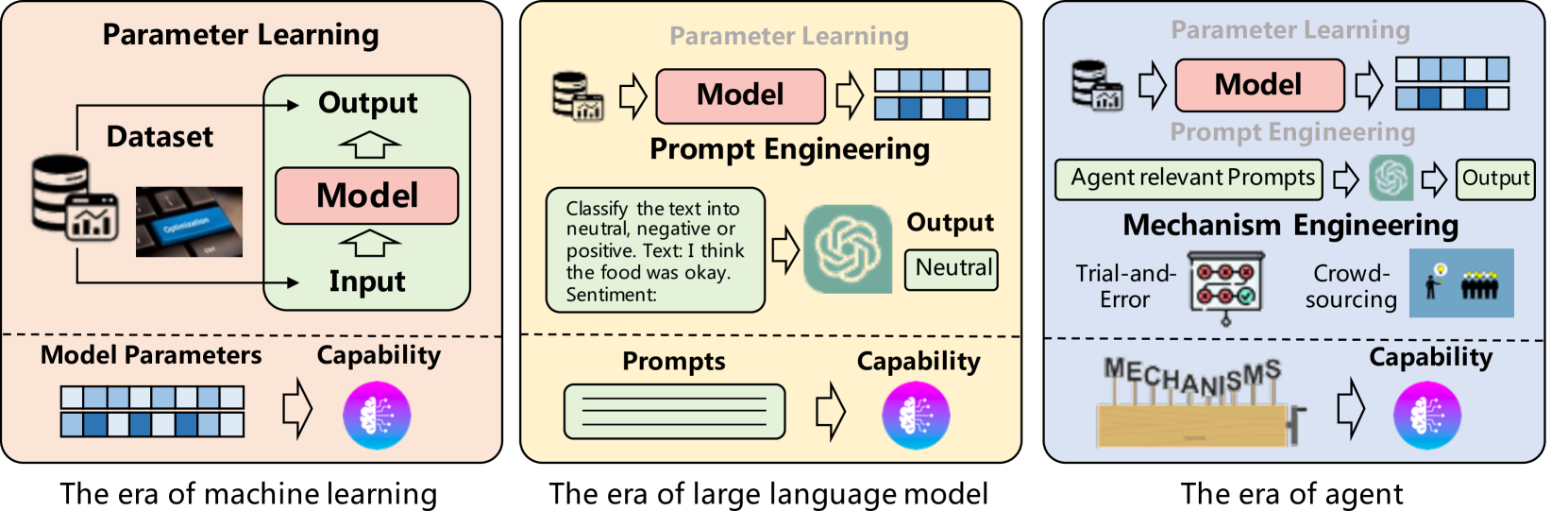
The image presents a comparative diagram illustrating the evolution of AI paradigms across three eras: machine learning, large language models, and agents. Each era is depicted with a distinct workflow, highlighting the key components and processes involved.
### Components/Axes
**Era 1: The era of machine learning (Left Panel)**
* **Title:** Parameter Learning
* **Input:** Data flows from a "Dataset" (represented by a database icon and a keyboard with an "Optimization" key) into the "Model".
* **Model:** A pink box labeled "Model" sits between the input and output.
* **Output:** The "Model" produces an "Output".
* **Model Parameters:** Below the main diagram, "Model Parameters" are represented by a series of blue boxes, varying in shade.
* **Capability:** An arrow points from "Model Parameters" to a "Capability" icon (a brain with circuit patterns).
**Era 2: The era of large language model (Middle Panel)**
* **Title:** Parameter Learning
* **Model:** Data flows into a "Model" (pink box).
* **Prompt Engineering:** The "Model" feeds into "Prompt Engineering".
* **Prompts:** "Prompts" are represented by a horizontal bar.
* **Output:** The prompt is processed by a ChatGPT-like icon, resulting in an "Output" labeled "Neutral".
* **Sentiment Analysis:** A text box reads: "Classify the text into neutral, negative or positive. Text: I think the food was okay. Sentiment:".
* **Capability:** An arrow points from "Prompts" to a "Capability" icon.
**Era 3: The era of agent (Right Panel)**
* **Title:** Parameter Learning
* **Model:** Data flows into a "Model" (pink box).
* **Prompt Engineering:** The "Model" feeds into "Prompt Engineering".
* **Agent relevant Prompts:** "Agent relevant Prompts" are represented by a green box.
* **Mechanism Engineering:** "Mechanism Engineering" is depicted below.
* **Trial-and-Error:** "Trial-and-Error" is represented by a diagram of interconnected gears, some marked with red "X"s and one with a green checkmark.
* **Crowdsourcing:** "Crowdsourcing" is represented by an icon of a person with a lightbulb above their head, standing in front of a crowd.
* **Output:** The agent produces an "Output".
* **Mechanisms:** The word "MECHANISMS" is written on a wooden plank supported by nails.
* **Capability:** An arrow points from "MECHANISMS" to a "Capability" icon.
### Detailed Analysis or ### Content Details
* **Era 1 (Machine Learning):** The diagram illustrates a traditional machine learning workflow where a dataset is fed into a model, which then produces an output. The model's parameters are adjusted during training to improve its capability.
* **Era 2 (Large Language Models):** This diagram highlights the importance of prompt engineering in large language models. Instead of directly feeding data into the model, prompts are used to guide the model's output. The example shows a sentiment analysis task where the model classifies the text as "Neutral".
* **Era 3 (Agents):** This diagram depicts a more complex workflow involving agents. The model receives agent-relevant prompts and utilizes mechanism engineering, including trial-and-error and crowdsourcing, to achieve its goals.
### Key Observations
* The diagrams show a progression from simple data-driven models to more complex agent-based systems.
* Prompt engineering is a key component of large language models, enabling more controlled and specific outputs.
* Agent-based systems incorporate mechanism engineering, allowing them to learn and adapt through trial-and-error and crowdsourcing.
### Interpretation
The image illustrates the evolution of AI from traditional machine learning to large language models and, finally, to agent-based systems. It highlights the increasing complexity of AI systems and the shift from purely data-driven approaches to more interactive and adaptive methods. The progression shows a move towards more sophisticated AI that can understand context, learn from experience, and interact with the world in a more nuanced way. The inclusion of "Capability" at the end of each era suggests an increasing level of sophistication and potential impact as AI evolves.