## Diagram: The Evolution of AI Paradigms
### Overview
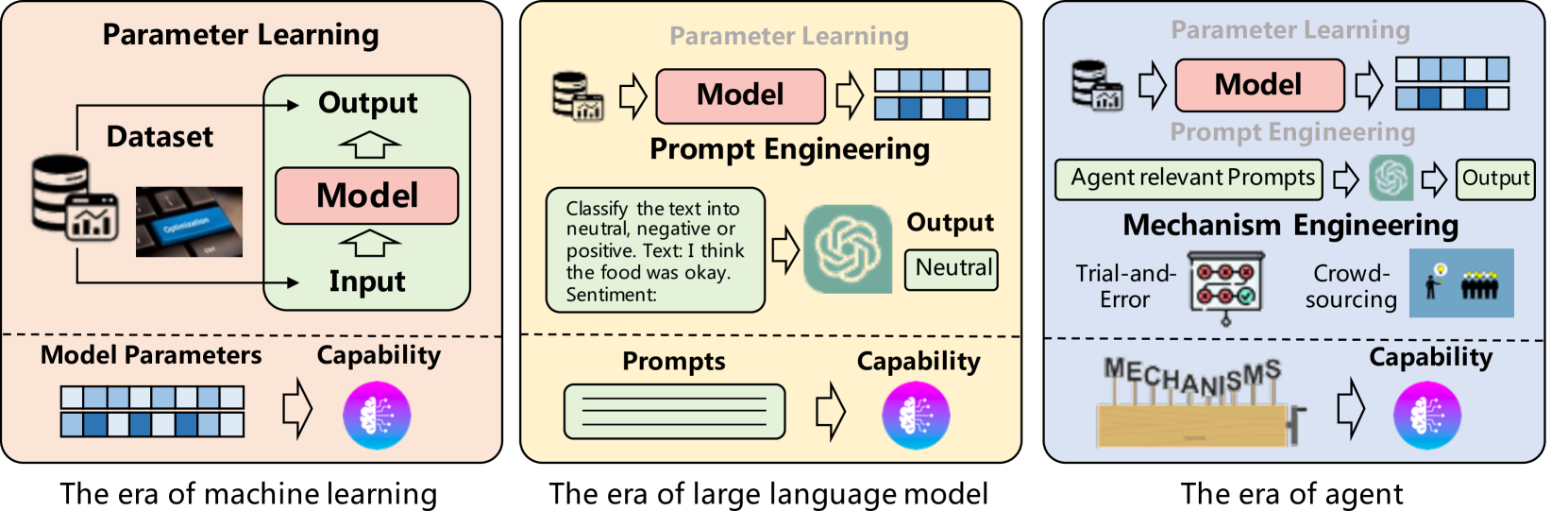
This image is a conceptual diagram illustrating the progression of artificial intelligence development through three distinct stages: "The era of machine learning," "The era of large language model," and "The era of agent." Each stage is represented in a vertical panel with a specific background color (peach, yellow, and light blue, respectively) and is divided into an upper "Engineering" section and a lower "Capability" section by a dashed horizontal line.
---
### Components/Axes
The diagram is segmented into three main regions from left to right:
#### 1. The era of machine learning (Left Panel - Peach Background)
* **Header:** "Parameter Learning" (Bold black text).
* **Main Diagram (Top):**
* **Dataset:** Represented by a database icon, a bar chart icon, and a photograph of a keyboard with a blue key labeled "Optimization."
* **Flow:** Arrows point from the Dataset to "Input" and "Output" labels within a light green rounded rectangle.
* **Model:** A pink box labeled "Model" sits between "Input" and "Output." Arrows indicate a flow from Input -> Model -> Output.
* **Footer (Bottom):**
* **Model Parameters:** A 2x8 grid of squares in varying shades of blue, representing weight matrices or parameters.
* **Capability:** A glowing, multi-colored brain icon.
* **Relationship:** An arrow points from the Model Parameters grid to the Capability icon.
#### 2. The era of large language model (Center Panel - Yellow Background)
* **Header:** "Parameter Learning" (Faded grey text) above "Prompt Engineering" (Bold black text).
* **Main Diagram (Top):**
* **Legacy Flow (Faded):** A smaller, faded version of the machine learning flow (Dataset -> Model -> Parameters) is shown at the top.
* **Active Flow:** A large light green box contains a text prompt: *"Classify the text into neutral, negative or positive. Text: I think the food was okay. Sentiment:"*.
* **Processing:** An arrow points from the prompt box to an OpenAI logo icon.
* **Output:** An arrow points from the logo to a box labeled "Output" containing the word "Neutral".
* **Footer (Bottom):**
* **Prompts:** A light green box with horizontal lines representing text.
* **Capability:** The same glowing brain icon as in the first panel.
* **Relationship:** An arrow points from the Prompts box to the Capability icon.
#### 3. The era of agent (Right Panel - Light Blue Background)
* **Header:** "Parameter Learning" and "Prompt Engineering" (both Faded grey text) above "Mechanism Engineering" (Bold black text).
* **Main Diagram (Top/Middle):**
* **Legacy Flows (Faded):** Faded representations of the previous two eras' workflows are visible at the top.
* **Agent Flow:** A box labeled "Agent relevant Prompts" points to the OpenAI logo, which then points to an "Output" box.
* **Mechanism Engineering Components:**
* **Trial-and-Error:** Text label next to an icon of a board with red 'X' marks and green checkmarks.
* **Crowd-sourcing:** Text label next to an icon of four human silhouettes and a glowing lightbulb.
* **Footer (Bottom):**
* **MECHANISMS:** A wooden block with vertical pegs/pins, resembling a mechanical device or a "Galton board" style mechanism.
* **Capability:** The same glowing brain icon.
* **Relationship:** An arrow points from the MECHANISMS structure to the Capability icon.
---
### Content Details
| Era | Primary Engineering Focus | Input/Method | Core Component | Resulting Capability Driver |
| :--- | :--- | :--- | :--- | :--- |
| **Machine Learning** | Parameter Learning | Datasets & Optimization | Model (Pink Box) | Model Parameters (Weight Grids) |
| **Large Language Model** | Prompt Engineering | Natural Language Prompts | Pre-trained Model (OpenAI Logo) | Prompts (Textual Instructions) |
| **Agent** | Mechanism Engineering | Trial-and-Error, Crowd-sourcing | Agent-relevant Prompts | Mechanisms (Systemic Structures) |
---
### Key Observations
* **Cumulative Progression:** As the diagram moves from left to right, previous methods (Parameter Learning, Prompt Engineering) are not discarded but become "faded" background elements, suggesting they are now foundational or automated prerequisites rather than the primary focus of innovation.
* **Abstraction Level:** The focus shifts from low-level mathematical optimization (Parameters) to mid-level linguistic instruction (Prompts) to high-level systemic design (Mechanisms).
* **Consistency of Goal:** The "Capability" (brain icon) remains identical across all three eras, indicating that while the *methods* of achieving AI intelligence change, the ultimate *goal* of creating capable intelligence remains constant.
---
### Interpretation
The data suggests a paradigm shift in how AI systems are built and deployed.
1. **The Era of Machine Learning** was defined by "Parameter Learning," where the primary task was training models on specific datasets to optimize internal weights. The "intelligence" was baked directly into the parameters.
2. **The Era of Large Language Models** shifted the focus to "Prompt Engineering." Here, the model's parameters are largely fixed (pre-trained), and the primary way to unlock "Capability" is through the clever design of input text (prompts).
3. **The Era of Agent** introduces "Mechanism Engineering." This suggests that simply prompting a model is no longer the ceiling. Instead, developers are building complex systems ("Mechanisms") that might involve iterative loops (Trial-and-Error), human collaboration (Crowd-sourcing), and specialized agent-specific prompts to achieve higher-order capabilities.
The transition from a grid of squares (Parameters) to a wooden pegboard (Mechanisms) symbolizes a move from purely digital/mathematical structures to more complex, perhaps "architectural" or "algorithmic" systems where the interaction between components is as important as the components themselves.