## Diagram: Evolution of AI Paradigms
### Overview
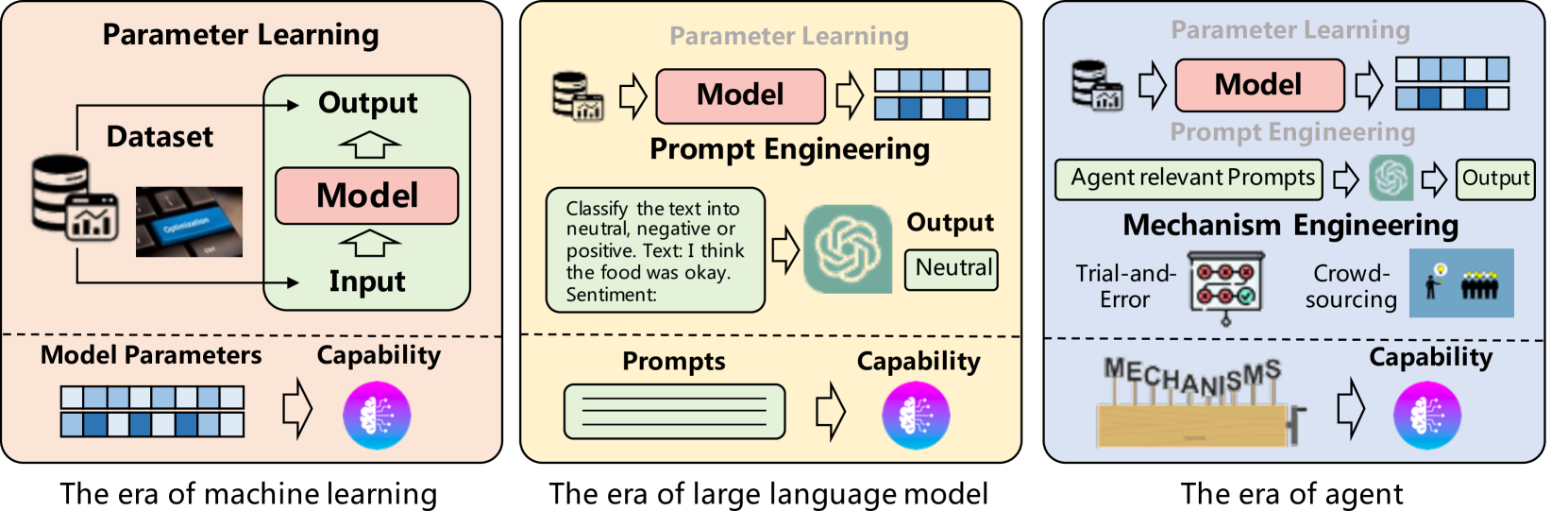
The image is a comparative diagram illustrating the evolution of AI development across three distinct eras: "The era of machine learning," "The era of large language model," and "The era of agent." Each era is represented by a vertical panel with a specific color scheme and engineering focus, showing how the drivers of AI "Capability" have shifted over time.
### Components/Axes
The diagram is divided into three vertical panels:
* **Left Panel (Peach background):** Represents "The era of machine learning."
* **Center Panel (Yellow background):** Represents "The era of large language model."
* **Right Panel (Blue background):** Represents "The era of agent."
**Common Elements:**
* **Capability:** Represented in all three panels by a colorful brain icon, indicating the ultimate goal of each era.
* **Data Flow:** All panels include a database icon and a "Model" box, though the surrounding engineering focus changes.
---
### Detailed Analysis
#### 1. The era of machine learning (Left Panel)
* **Focus:** "Parameter Learning" (Bold text at the top).
* **Process Flow:** A "Dataset" (database icon + chart) feeds into a "Model" (pink box). The model processes "Input" and generates "Output."
* **Visual Details:** Includes an icon of a keyboard key labeled "Optimization."
* **Capability Driver:** "Model Parameters" (represented by a grid of squares) leads directly to "Capability" (brain icon).
#### 2. The era of large language model (Center Panel)
* **Focus:** "Prompt Engineering" (Bold text at the top; "Parameter Learning" is present but faded).
* **Process Flow:** A database icon feeds into a "Model," which outputs to a grid of squares.
* **Example:** A text box contains the prompt: *"Classify the text into neutral, negative or positive. Text: I think the food was okay. Sentiment:"*. This points to the ChatGPT logo, which outputs: *"Neutral"*.
* **Capability Driver:** "Prompts" (represented by lines on a page) leads to "Capability" (brain icon).
#### 3. The era of agent (Right Panel)
* **Focus:** "Mechanism Engineering" (Bold text at the top; "Parameter Learning" and "Prompt Engineering" are present but faded).
* **Process Flow:** A database icon feeds into a "Model," which outputs to a grid of squares.
* **Agent Interaction:** "Agent relevant Prompts" feed into the ChatGPT logo, which then produces an "Output."
* **Mechanism Components:**
* "Trial-and-Error": Represented by an icon showing a sequence of red/green circles.
* "Crowd-sourcing": Represented by an icon of people and a lightbulb.
* **Capability Driver:** "MECHANISMS" (represented by wooden block text) leads to "Capability" (brain icon).
---
### Key Observations
* **Shift in Engineering Focus:** The diagram explicitly shows a transition in the primary engineering challenge: from optimizing model parameters (ML) to crafting prompts (LLM) to engineering external mechanisms (Agent).
* **Fading Relevance:** The text "Parameter Learning" is bold in the first panel but becomes faded in the second and third, suggesting that while it remains a foundation, it is no longer the primary focus of innovation in later eras.
* **Complexity Escalation:** The "Capability" driver evolves from internal model parameters to external inputs (prompts) to complex system-level structures (mechanisms).
### Interpretation
This diagram serves as a conceptual roadmap for the progression of AI development. It demonstrates that as models have become more powerful, the "bottleneck" or primary area of innovation has moved outward:
1. **Machine Learning Era:** The focus was on the model itself—training it on datasets to optimize internal parameters.
2. **LLM Era:** The focus shifted to the interface—how to effectively communicate with the model via "Prompt Engineering" to elicit desired behaviors.
3. **Agent Era:** The focus has moved to the system architecture—wrapping the model in "Mechanisms" (like trial-and-error loops or crowd-sourced feedback) to allow the AI to act autonomously and solve complex tasks.
The diagram suggests that "Capability" is no longer just a function of the model's internal weights, but a result of the surrounding engineering ecosystem.