## Diagram: Evolution of AI Approaches
### Overview
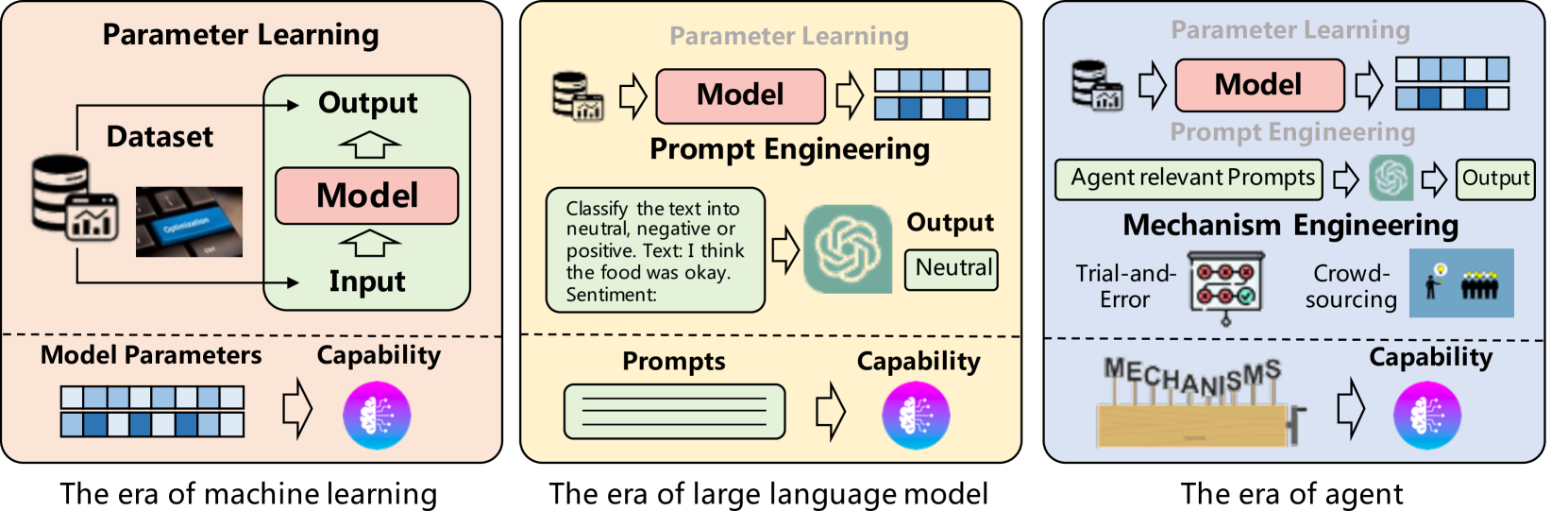
The image presents a comparative diagram illustrating the evolution of AI approaches across three distinct eras: Parameter Learning, the era of Large Language Models, and the era of Agents. Each era is represented within a rounded rectangle, showcasing the core components, processes, and resulting capabilities. The diagram uses arrows to indicate the flow of information and the relationship between different elements.
### Components/Axes
Each of the three sections contains the following elements:
* **Parameter Learning:** Dataset, Model, Input, Output, Model Parameters, Capability.
* **Large Language Model:** Model, Prompt Engineering, Output, Prompts, Capability.
* **Agent:** Model, Prompt Engineering, Agent relevant Prompts, Output, Mechanism Engineering, Capability.
Each section also has a title indicating the era it represents.
### Detailed Analysis or Content Details
**Section 1: Parameter Learning (Left)**
* **Dataset:** Represented by a cylinder with data symbols, connected to the "Model" via an arrow.
* **Model:** A dark purple rectangle labeled "Model". An arrow points from the "Dataset" to the "Model", and another from the "Model" to "Output". A smaller icon representing optimization is placed within the "Dataset" component.
* **Input:** An arrow points to the "Model" from a source labeled "Input".
* **Output:** An arrow points from the "Model" to a destination labeled "Output".
* **Model Parameters:** Represented by a series of blue and white rectangles, connected to "Capability" via an arrow.
* **Capability:** A blue sphere labeled "Capability".
* **Title:** "The era of machine learning"
**Section 2: The Era of Large Language Model (Center)**
* **Model:** Represented by a stack of blue rectangles, connected to "Prompt Engineering" via an arrow.
* **Prompt Engineering:** A light blue rectangle labeled "Prompt Engineering". An arrow points from the "Model" to the "Prompt Engineering", and another from the "Prompt Engineering" to "Output".
* **Output:** An arrow points from the "Prompt Engineering" to a destination labeled "Output".
* **Prompts:** Represented by a series of horizontal lines, connected to "Capability" via an arrow.
* **Capability:** A blue sphere labeled "Capability".
* **Text Box:** Within the "Prompt Engineering" section, a text box reads: "Classify the text into neutral, negative or positive. Text: I think the food was okay. Sentiment: Neutral".
* **Title:** "The era of large language model"
**Section 3: The Era of Agent (Right)**
* **Model:** Represented by a stack of blue rectangles, connected to "Prompt Engineering" via an arrow.
* **Prompt Engineering:** A light blue rectangle labeled "Prompt Engineering". An arrow points from the "Model" to the "Prompt Engineering".
* **Agent relevant Prompts:** A light blue rectangle labeled "Agent relevant Prompts". An arrow points from the "Prompt Engineering" to the "Agent relevant Prompts", and another from the "Agent relevant Prompts" to "Output".
* **Output:** An arrow points from the "Agent relevant Prompts" to a destination labeled "Output".
* **Mechanism Engineering:** A green rectangle labeled "Mechanism Engineering".
* **Trial-and-Error:** A set of icons representing trial and error.
* **Crowd-sourcing:** A set of icons representing crowd-sourcing.
* **MECHANISMS:** A complex diagram of gears and mechanical components.
* **Capability:** A blue sphere labeled "Capability".
* **Title:** "The era of agent"
### Key Observations
The diagram illustrates a progression from data-driven parameter learning to prompt-driven language models, and finally to agent-based systems incorporating mechanism engineering. The complexity of the system increases with each era. The inclusion of "Mechanism Engineering" in the final stage suggests a move towards more autonomous and interactive AI systems. The text box in the LLM section provides a concrete example of a prompt and its expected output.
### Interpretation
The diagram depicts a clear evolutionary path in AI development. The initial "era of machine learning" focuses on learning parameters from large datasets. This evolves into the "era of large language models" where the focus shifts to crafting effective prompts to elicit desired responses from pre-trained models. Finally, the "era of agent" introduces the concept of mechanism engineering, suggesting a move towards building AI systems that can actively interact with their environment and learn through trial and error, potentially leveraging crowd-sourcing for improved performance. The diagram highlights a shift from passive learning to active problem-solving and adaptation. The increasing complexity of the diagrams in each section visually reinforces the idea that AI systems are becoming more sophisticated and capable over time.