## Diagram: Evolution of Machine Learning Paradigms
### Overview
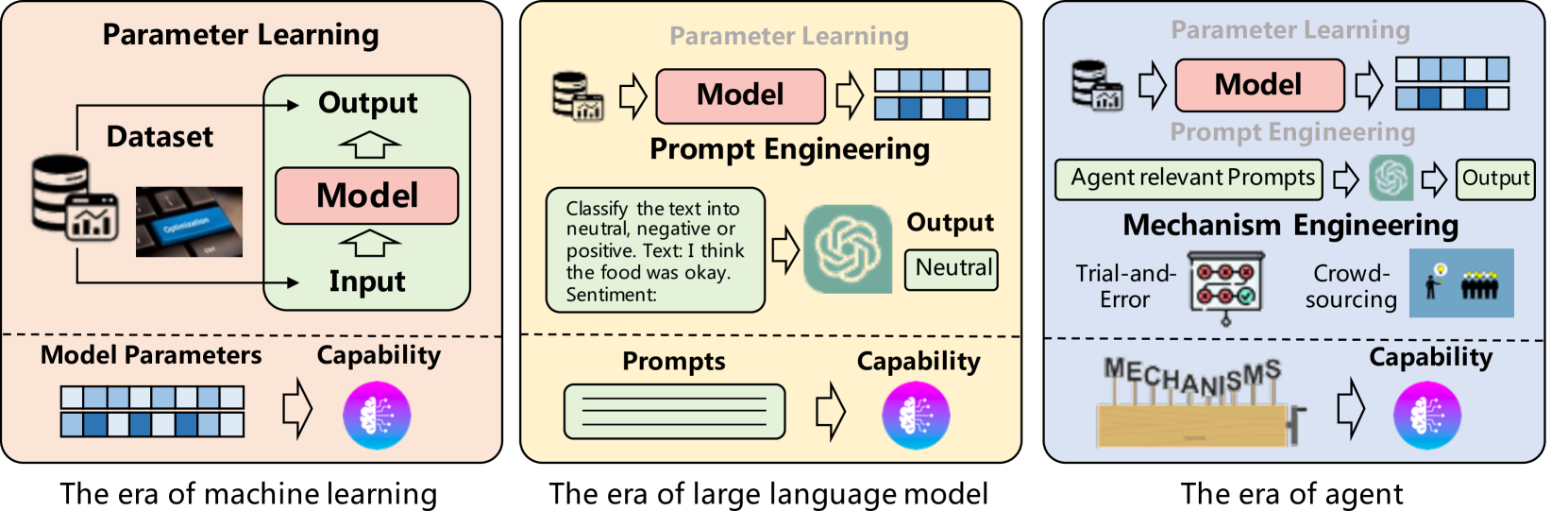
The diagram illustrates the progression of machine learning paradigms across three eras: "The era of machine learning," "The era of large language model," and "The era of agent." Each era is structured around three core components: **Parameter Learning**, **Prompt Engineering**, and **Mechanism Engineering**, with increasing complexity and abstraction in later eras.
---
### Components/Axes
#### Era 1: The era of machine learning
- **Parameter Learning**:
- Input: Dataset (icon: database + chart)
- Output: Model (pink box)
- Flow: Dataset → Model → Output/Input
- Model Parameters: Grid of blue/gray squares
- Capability: Brain icon (pink-to-blue gradient)
#### Era 2: The era of large language model
- **Parameter Learning**:
- Model (pink box) → Output (blue/gray grid)
- **Prompt Engineering**:
- Example: "Classify the text into neutral, negative, or positive. Text: I think the food was okay. Sentiment:"
- Output: "Neutral" (green box)
- Prompts: Text box with horizontal lines
- Capability: Brain icon (same as Era 1)
#### Era 3: The era of agent
- **Parameter Learning**:
- Model (pink box) → Output (blue/gray grid)
- **Prompt Engineering**:
- Agent relevant Prompts (green box) → Output
- **Mechanism Engineering**:
- Trial-and-Error (red/green chart)
- Crowd-sourcing (blue icon: person with speech bubble)
- MECHANISMS (wooden board with labeled pegs)
- Capability: Brain icon (same as prior eras)
---
### Detailed Analysis
#### Era 1: Machine Learning
- **Flow**: Raw data (Dataset) is processed by a Model to produce Output/Input. Model Parameters (grid) represent learned features, while Capability (brain icon) symbolizes the system's functional scope.
- **Key Elements**:
- Dataset and Model are foundational.
- Output/Input loops suggest iterative refinement.
#### Era 2: Large Language Models
- **Flow**:
- Model generates Output via Parameter Learning.
- Prompt Engineering introduces human-guided input (e.g., sentiment classification).
- Output is discrete (e.g., "Neutral").
- **Key Elements**:
- Prompts act as intermediaries between user intent and model output.
- Capability remains tied to the brain icon, implying static functionality.
#### Era 3: Agents
- **Flow**:
- Model Output is refined via **Agent relevant Prompts**.
- **Mechanism Engineering** introduces dynamic processes:
- Trial-and-Error (feedback loop).
- Crowd-sourcing (collaborative input).
- MECHANISMS (modular, labeled components).
- **Key Elements**:
- Output is now agent-driven, not just model-driven.
- Capability evolves to include distributed, adaptive systems.
---
### Key Observations
1. **Progression of Complexity**:
- Era 1 focuses on static models and data.
- Era 2 adds human-guided prompts for specificity.
- Era 3 introduces autonomous, collaborative mechanisms.
2. **Capability Consistency**:
- The brain icon persists across eras, suggesting capability is a constant metric despite evolving methods.
3. **Mechanism Engineering**:
- Era 3 replaces simple Prompt Engineering with Trial-and-Error and Crowd-sourcing, emphasizing adaptability.
---
### Interpretation
The diagram traces the shift from **data-centric models** (Era 1) to **human-in-the-loop systems** (Era 2) and finally to **autonomous, distributed agents** (Era 3). Each era retains the core concept of **Parameter Learning** but diverges in how outputs are generated and refined:
- **Era 1**: Output is a direct function of input data.
- **Era 2**: Output is shaped by structured human prompts.
- **Era 3**: Output emerges from iterative, collaborative mechanisms (Trial-and-Error, Crowd-sourcing), reflecting a move toward self-improving systems.
The **MECHANISMS** component in Era 3 (wooden board with labeled pegs) symbolizes modular, composable processes, contrasting with the linear flows of earlier eras. This suggests a transition from **predictive models** to **adaptive, goal-oriented agents** capable of dynamic problem-solving.