## Knowledge Graph Taxonomy Diagram
### Overview
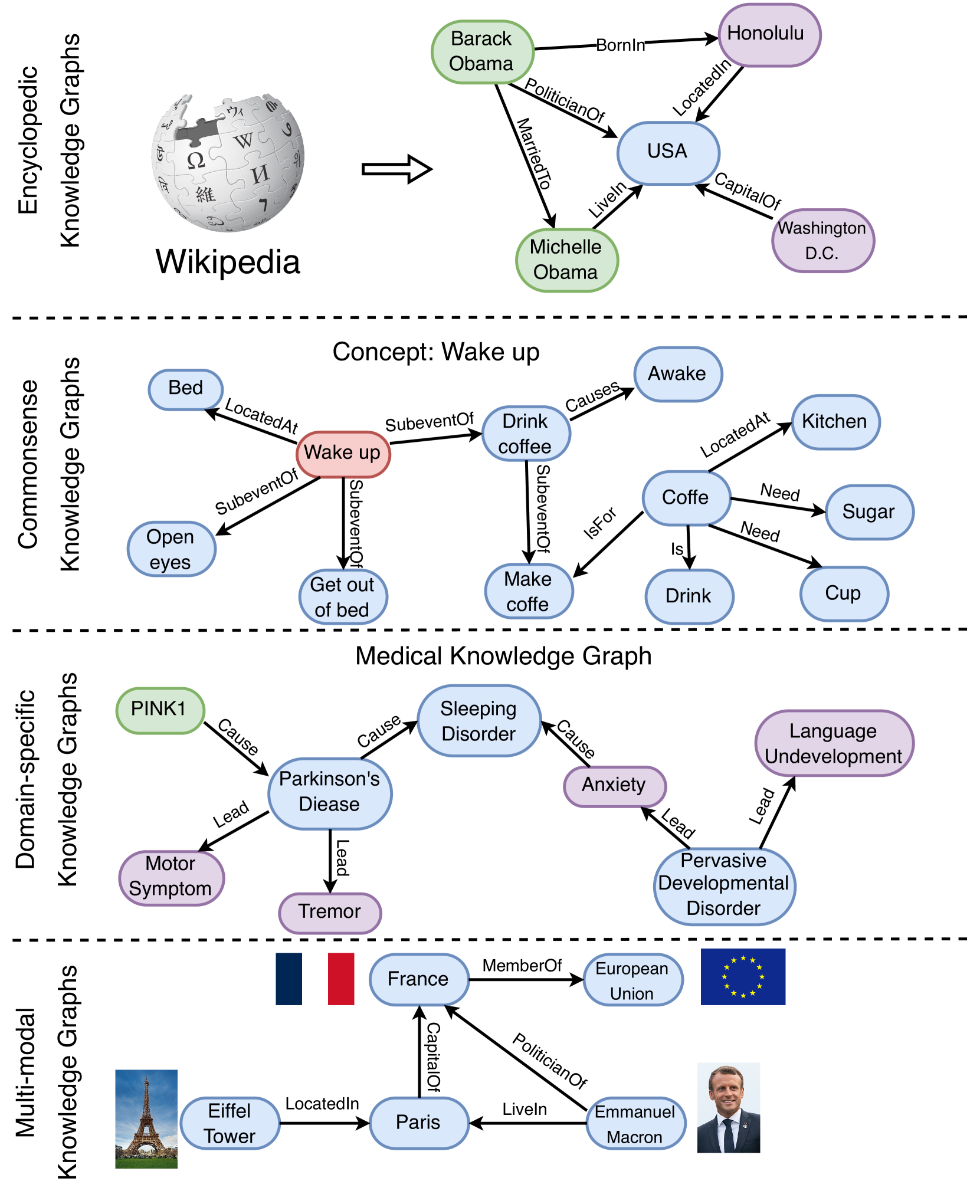
The image presents a hierarchical taxonomy of knowledge graphs, organized into four primary categories: Encyclopedic, Commonsense, Domain-specific, and Multi-modal Knowledge Graphs. Each category contains interconnected nodes representing entities, concepts, and relationships, with directional arrows indicating semantic connections.
### Components/Axes
- **Categories**:
1. **Encyclopedic Knowledge Graphs** (Top section)
- Example: Wikipedia logo with a puzzle-piece globe.
- Subcomponents:
- Entities: Barack Obama, Michelle Obama, USA, Honolulu, Washington D.C.
- Relationships: `BornIn`, `PoliticianOf`, `MarriedTo`, `LocatedIn`, `CapitalOf`.
2. **Commonsense Knowledge Graphs** (Middle section)
- Example: "Wake up" concept with subevents.
- Subcomponents:
- Entities: Bed, Coffee, Kitchen, Sugar, Cup.
- Relationships: `LocatedAt`, `SubeventOf`, `Causes`, `Need`, `IsFor`.
3. **Domain-specific Knowledge Graphs** (Lower middle section)
- Example: Parkinson’s Disease and related terms.
- Subcomponents:
- Entities: PINK1, Parkinson’s Disease, Motor Symptom, Tremor, Sleeping Disorder, Anxiety, Language Undevelopment, Pervasive Developmental Disorder.
- Relationships: `Cause`, `Lead`.
4. **Multi-modal Knowledge Graphs** (Bottom section)
- Example: France, Paris, Eiffel Tower, Emmanuel Macron.
- Relationships: `LocatedIn`, `MemberOf`, `PoliticianOf`, `CapitalOf`.
- **Color Coding**:
- Green: Encyclopedic entities (e.g., Barack Obama).
- Blue: Commonsense/conceptual nodes (e.g., "Wake up").
- Purple: Medical/biological terms (e.g., PINK1).
- Images: Multi-modal entities (e.g., Eiffel Tower, Emmanuel Macron).
### Detailed Analysis
#### Encyclopedic Knowledge Graphs
- **Entities**:
- Barack Obama (PoliticianOf USA, BornIn Honolulu).
- Michelle Obama (MarriedTo Barack Obama).
- USA (CapitalOf Washington D.C., LocatedIn).
- **Relationships**:
- `BornIn`: Barack Obama → Honolulu.
- `PoliticianOf`: Barack Obama → USA.
- `MarriedTo`: Barack Obama ↔ Michelle Obama.
- `LocatedIn`: USA → Washington D.C.
#### Commonsense Knowledge Graphs
- **Concept**: "Wake up" (central node).
- **Subevents**:
- `Get out of bed` → `Wake up`.
- `Drink coffee` → `Wake up` (via `SubeventOf`).
- **Causal Links**:
- `Causes`: Coffee → Awake.
- `Need`: Coffee → Sugar, Cup.
#### Domain-specific Knowledge Graphs
- **Medical Relationships**:
- `Cause`: PINK1 → Parkinson’s Disease.
- `Lead`: Parkinson’s Disease → Motor Symptom, Tremor.
- `Cause`: Sleeping Disorder → Anxiety.
- `Lead`: Anxiety → Pervasive Developmental Disorder, Language Undevelopment.
#### Multi-modal Knowledge Graphs
- **Geopolitical Connections**:
- `LocatedIn`: Eiffel Tower → Paris.
- `MemberOf`: France → European Union.
- `PoliticianOf`: Emmanuel Macron → France.
- `CapitalOf`: Paris → France.
### Key Observations
1. **Hierarchical Structure**:
- Encyclopedic graphs form the broadest layer, while domain-specific graphs focus on niche topics.
- Multi-modal graphs integrate visual and textual data (e.g., flags, images).
2. **Relationship Patterns**:
- Encyclopedic graphs emphasize geographical and biographical links.
- Commonsense graphs model daily routines and object interactions.
- Domain-specific graphs highlight causal biological pathways.
3. **Color Consistency**:
- Green nodes (Encyclopedic) are distinct from blue (Commonsense) and purple (Medical).
- Multi-modal nodes use images instead of text labels.
### Interpretation
The diagram illustrates how knowledge graphs categorize and interconnect information across domains. Encyclopedic graphs serve as foundational repositories of factual data, while commonsense graphs model everyday reasoning. Domain-specific graphs specialize in causal relationships (e.g., genetics to disease), and multi-modal graphs bridge visual and textual data. The absence of numerical values suggests a focus on semantic relationships rather than quantitative analysis. This taxonomy could underpin applications like AI reasoning, data integration, or ontology design, where understanding interconnections between entities is critical.