## Bar Chart: Creativity Score Comparison
### Overview
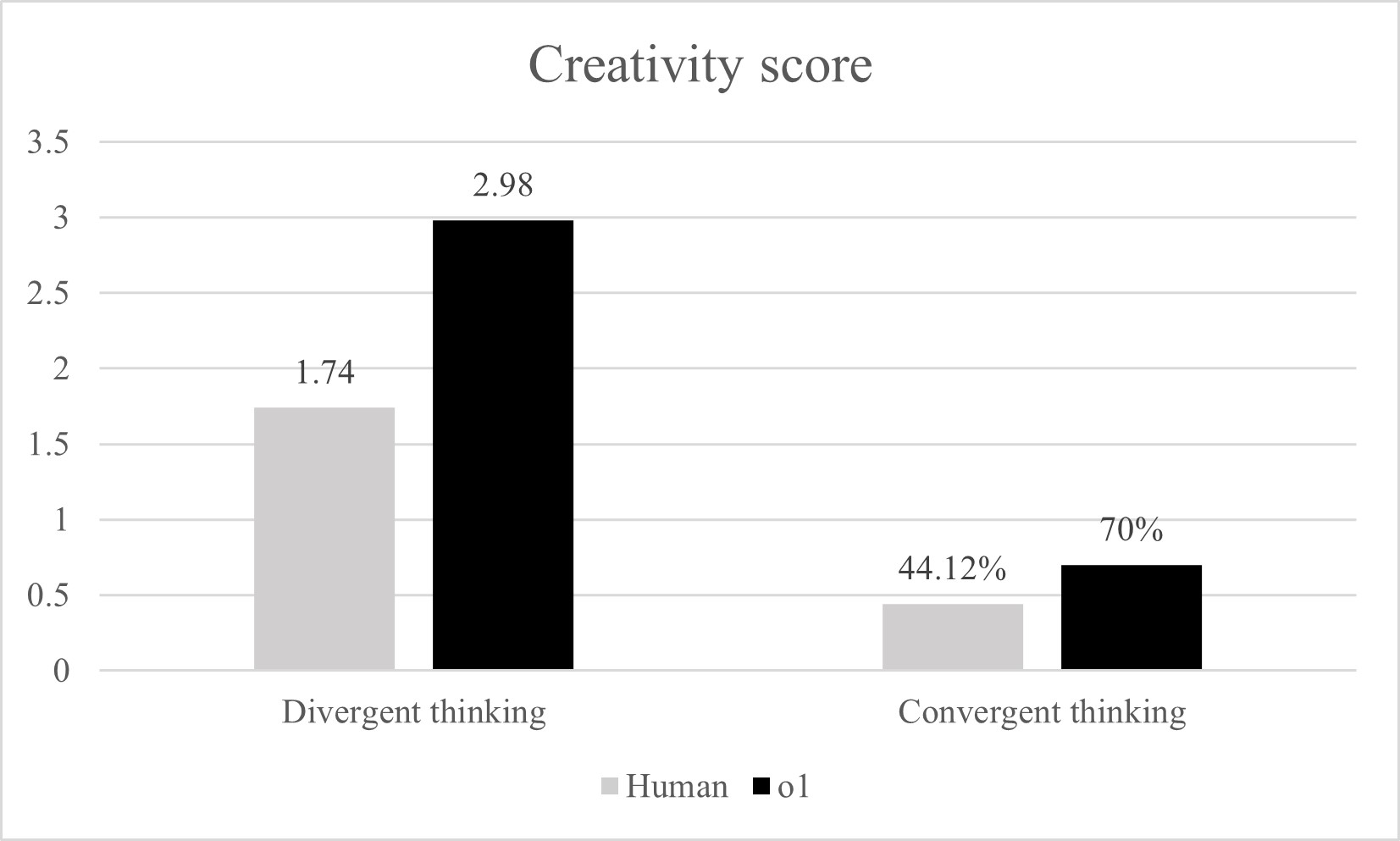
The image is a bar chart comparing the creativity scores of "Human" and "o1" across two categories: "Divergent thinking" and "Convergent thinking". The chart displays the scores as vertical bars, with the y-axis representing the creativity score and the x-axis representing the type of thinking.
### Components/Axes
* **Title:** Creativity score
* **X-axis:**
* Label: Divergent thinking, Convergent thinking
* **Y-axis:**
* Label: (Implied Creativity Score)
* Scale: 0, 0.5, 1, 1.5, 2, 2.5, 3, 3.5
* **Legend:** Located at the bottom of the chart.
* Human (light gray bar)
* o1 (black bar)
### Detailed Analysis
* **Divergent thinking:**
* Human: 1.74 (light gray bar)
* o1: 2.98 (black bar)
* **Convergent thinking:**
* Human: 44.12% (light gray bar)
* o1: 70% (black bar)
### Key Observations
* For both Divergent and Convergent thinking, the "o1" scores are higher than the "Human" scores.
* The difference in scores between "Human" and "o1" is more pronounced in Divergent thinking than in Convergent thinking.
### Interpretation
The bar chart suggests that "o1" performs better than "Human" in both divergent and convergent thinking tasks, as measured by the "Creativity score". The larger difference in divergent thinking scores may indicate that "o1" has a greater advantage in tasks requiring creative problem-solving or generating novel ideas. The convergent thinking scores, while still higher for "o1", are presented as percentages, which may represent a different scoring methodology or a normalized measure. The chart highlights the relative strengths of "o1" compared to "Human" in these two cognitive domains.