\n
## Bar Chart: Creativity Score
### Overview
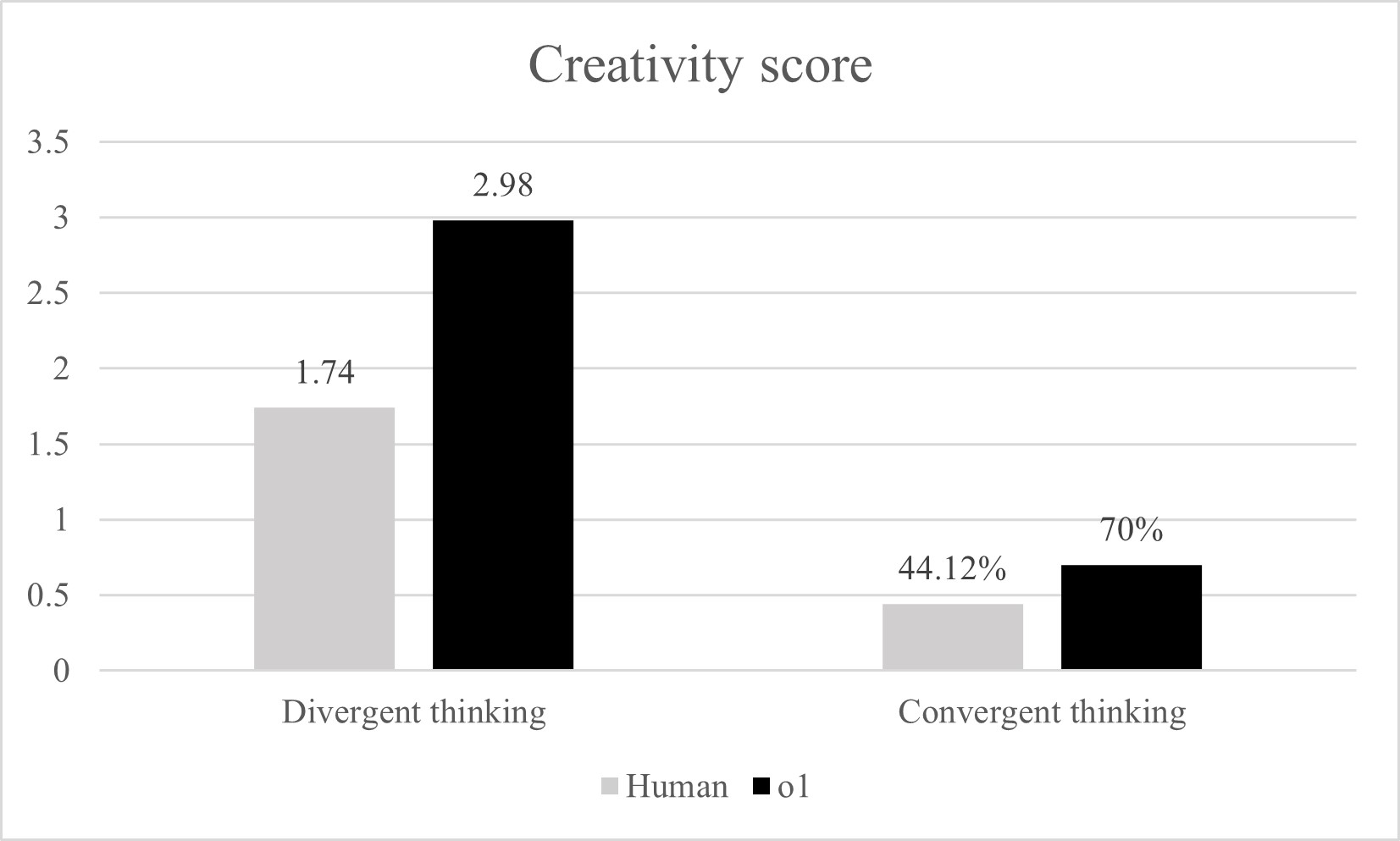
This image presents a bar chart comparing "Creativity Score" for "Divergent thinking" and "Convergent thinking" between "Human" and "ol" (likely representing an algorithm or model). The chart uses paired bars for each thinking type, one for humans and one for "ol".
### Components/Axes
* **Title:** "Creativity score" (centered at the top)
* **X-axis:** "Divergent thinking" and "Convergent thinking" (two categories)
* **Y-axis:** Scale ranging from 0 to 3.5, with increments of 0.5.
* **Legend:** Located at the bottom-right, with two entries:
* Light Gray: "Human"
* Black: "ol"
### Detailed Analysis
The chart consists of four bars, two for each thinking type.
**Divergent Thinking:**
* Human (Light Gray): The bar reaches approximately 1.74 on the Y-axis.
* ol (Black): The bar reaches approximately 2.98 on the Y-axis. This bar is significantly taller than the human bar.
**Convergent Thinking:**
* Human (Light Gray): The bar reaches approximately 0.44 on the Y-axis (labeled as 44.12%).
* ol (Black): The bar reaches approximately 0.70 on the Y-axis (labeled as 70%). This bar is also taller than the human bar, but the difference is less pronounced than in divergent thinking.
### Key Observations
* The "ol" consistently scores higher than "Human" in both "Divergent thinking" and "Convergent thinking".
* The difference in scores is much larger for "Divergent thinking" than for "Convergent thinking". The "ol" score for divergent thinking is almost double that of the human score.
* The convergent thinking scores are presented as percentages (44.12% and 70%), while the divergent thinking scores are presented as raw values (1.74 and 2.98).
### Interpretation
The data suggests that the "ol" (algorithm/model) outperforms humans in both divergent and convergent thinking, as measured by this "Creativity Score". The substantial difference in divergent thinking scores is particularly noteworthy. This could indicate that the "ol" is better at generating novel ideas or solutions, while its advantage in convergent thinking (selecting the best solution) is less pronounced. The use of different units (raw values vs. percentages) for the two thinking types makes direct comparison difficult, and raises questions about the nature of the "Creativity Score" metric. It's possible the score is normalized differently for each type of thinking. Further investigation into the methodology behind the "Creativity Score" is needed to fully understand the implications of these results. The chart implies a potential for AI or algorithmic approaches to surpass human capabilities in certain aspects of creativity.