## Code Snippets: DomiKnowS, DeepProbLog, and Scallop
### Overview
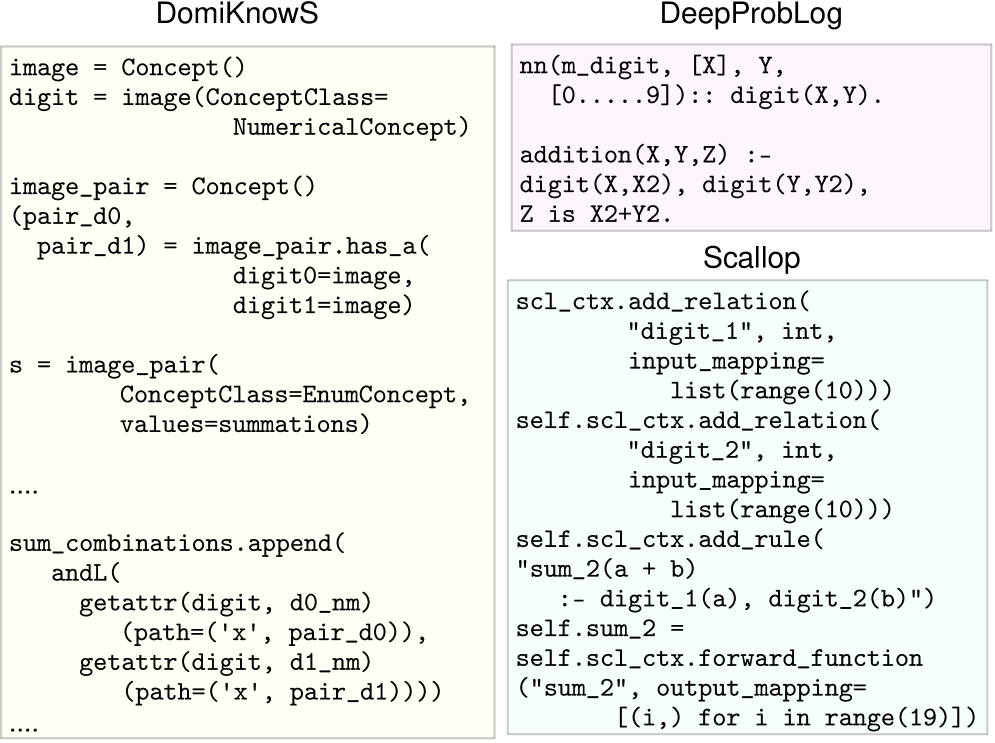
The image presents three code snippets, each associated with a different system or framework: DomiKnowS, DeepProbLog, and Scallop. Each snippet demonstrates a specific aspect of the respective system, likely related to defining concepts, probabilistic logic, and data relations.
### Components/Axes
* **DomiKnowS (Top-Left, Light Beige Background):** Code snippet defining concepts related to images, digits, and summations.
* **DeepProbLog (Top-Right, Light Purple Background):** Code snippet demonstrating probabilistic logic rules for digits and addition.
* **Scallop (Bottom-Center, Light Green Background):** Code snippet showing how to add relations and rules within the Scallop framework, specifically for digits and their summation.
### Detailed Analysis or ### Content Details
**DomiKnowS:**
```
image = Concept()
digit = image(ConceptClass=NumericalConcept)
image_pair = Concept()
(pair_d0,
pair_d1) = image_pair.has_a(
digit0=image,
digit1=image)
s = image_pair(
ConceptClass=EnumConcept,
values=summations)
...
sum_combinations.append(
andL(
getattr(digit, d0_nm)
(path=('x', pair_d0)),
getattr(digit, d1_nm)
(path=('x', pair_d1))))
...
```
**DeepProbLog:**
```
nn(m_digit, [X], Y,
[0.....9]):: digit(X,Y).
addition(X,Y,Z) :-
digit(X,X2), digit(Y,Y2),
Z is X2+Y2.
```
**Scallop:**
```
scl_ctx.add_relation(
"digit_1", int,
input_mapping=
list(range(10)))
self.scl_ctx.add_relation(
"digit_2", int,
input_mapping=
list(range(10)))
self.scl_ctx.add_rule(
"sum_2(a + b)
:- digit_1(a), digit_2(b)")
self.sum_2 =
self.scl_ctx.forward_function
("sum_2", output_mapping=
[(i,) for i in range(19)])
```
### Key Observations
* **DomiKnowS:** Focuses on defining hierarchical concepts, such as `image`, `digit`, and `image_pair`. It uses `getattr` to access attributes within these concepts.
* **DeepProbLog:** Uses a probabilistic logic syntax to define a digit predicate based on neural network output and an addition rule.
* **Scallop:** Demonstrates the creation of relations (`digit_1`, `digit_2`) and a rule for summing two digits (`sum_2`). It also shows the use of a forward function to map the sum.
### Interpretation
The image provides a glimpse into three different approaches to knowledge representation and reasoning. DomiKnowS appears to use a concept-based approach with attribute access, DeepProbLog employs probabilistic logic, and Scallop utilizes relations and rules for data manipulation. The snippets suggest that each system is designed for different types of tasks, with DomiKnowS potentially suited for hierarchical knowledge representation, DeepProbLog for probabilistic reasoning, and Scallop for data-driven computations. The common theme is the manipulation of digits and their summation, showcasing how each system handles this basic operation.