\n
## Code Snippets: Logic and Relation Definitions
### Overview
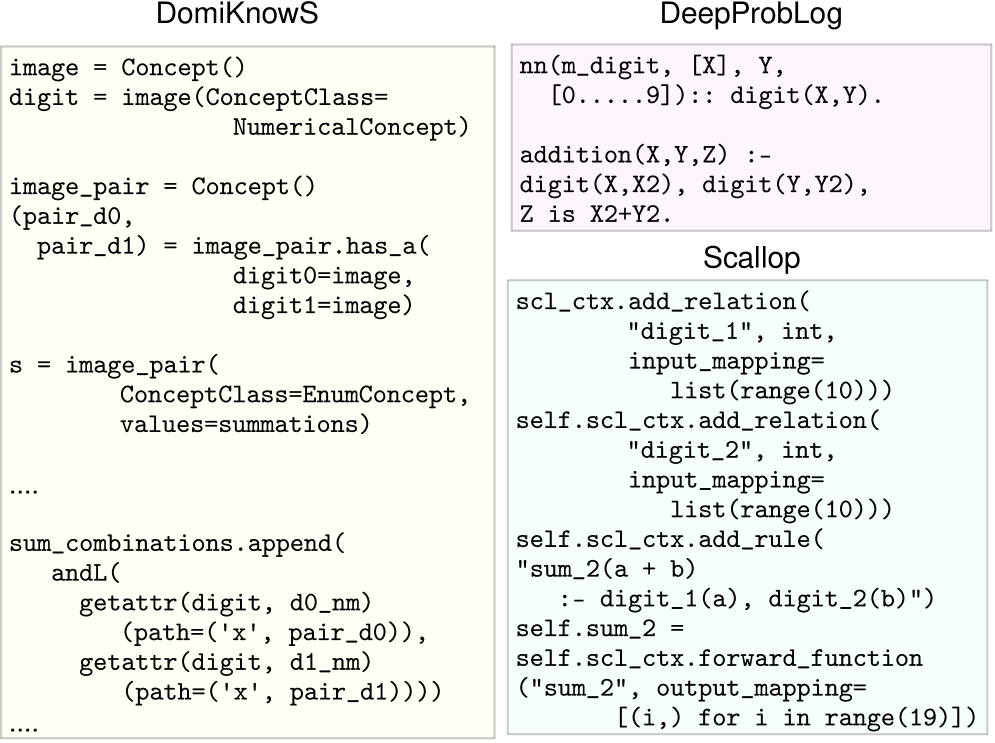
The image presents four distinct code snippets, likely representing different modules or components of a larger system. The snippets appear to define concepts, relations, and functions related to numerical operations and image processing. The snippets are arranged in a 2x2 grid.
### Components/Axes
The image does not contain axes or charts. It consists of text-based code snippets. The snippets are labeled as follows:
* **Top-Left:** DomiKnowS
* **Top-Right:** DeepProbLog
* **Bottom-Left:** (No explicit label, but related to DomiKnowS)
* **Bottom-Right:** Scallop
### Detailed Analysis or Content Details
**1. DomiKnowS (Top-Left)**
```python
image = Concept()
digit = image(ConceptClass=NumericalConcept)
image_pair = Concept()
(pair_d0, pair_d1) = image_pair.has_a(
digit0=image, digit1=image)
s = image_pair(
ConceptClass=EnumConcept,
values=summations)
....
sum_combinations.append(
andL(
getattr(digit, d0_nm)(path=('x', pair_d0)),
getattr(digit, d1_nm)(path=('x', pair_d1))))
....
```
This snippet defines a concept `image` and a `digit` associated with it, classified as `NumericalConcept`. It also defines `image_pair` and its relationship to two digits (`pair_d0`, `pair_d1`). The `s` variable is an `image_pair` with a `ConceptClass` of `EnumConcept` and `values` set to `summations`. The code also includes a section appending to `sum_combinations` based on attributes of `digit` and paths related to `pair_d0` and `pair_d1`.
**2. DeepProbLog (Top-Right)**
```prolog
nn(m_digit, [X], Y, [0....9]):: digit(X,Y).
addition(X,Y,Z) :-
digit(X,X2), digit(Y,Y2),
Z is X2+Y2.
```
This snippet appears to be written in Prolog. It defines a neural network `nn` that takes a digit `X` as input and produces an output `Y`. The rule `digit(X,Y)` is associated with the range 0 to 9. It also defines an `addition` predicate that takes two inputs `X` and `Y`, finds their digit representations `X2` and `Y2`, and calculates their sum `Z`.
**3. DomiKnowS (Bottom-Left)**
```python
s = image_pair(
ConceptClass=EnumConcept,
values=summations)
....
sum_combinations.append(
andL(
getattr(digit, d0_nm)(path=('x', pair_d0)),
getattr(digit, d1_nm)(path=('x', pair_d1))))
....
```
This snippet is a continuation of the DomiKnowS code from the top-left, repeating the definition of `s` and the `sum_combinations.append` section.
**4. Scallop (Bottom-Right)**
```python
scl_ctx.add_relation(
"digit_1", int,
input_mapping=list(range(10)))
self.scl_ctx.add_relation(
"digit_2", int,
input_mapping=list(range(10)))
self.scl_ctx.add_rule(
"sum_2(a + b) :- digit_1(a), digit_2(b)")
self.sum_2 = self.scl_ctx.forward_function(
"sum_2", output_mapping=[(i, i) for i in range(19)])
```
This snippet defines relations `digit_1` and `digit_2` using `scl_ctx.add_relation`, both of type `int` and with input mappings ranging from 0 to 9. It then adds a rule `sum_2(a + b)` that depends on `digit_1(a)` and `digit_2(b)`. Finally, it defines `self.sum_2` as a forward function of `sum_2` with an output mapping that maps each input `i` to itself for `i` in the range 0 to 18.
### Key Observations
* The code snippets demonstrate a combination of different programming paradigms (Python, Prolog).
* The snippets focus on defining concepts and relations related to digits, images, and summations.
* The Scallop snippet appears to be building a system for performing addition of digits.
* The DomiKnowS snippets seem to be related to representing and manipulating concepts and their attributes.
* The DeepProbLog snippet suggests a probabilistic approach to digit recognition.
### Interpretation
The image suggests a system that integrates different approaches to numerical reasoning and image understanding. DomiKnowS appears to provide a conceptual framework, DeepProbLog offers a probabilistic model for digit recognition, and Scallop implements a rule-based system for addition. The combination of these components could be used to build a more robust and flexible system for tasks such as image-based arithmetic or logical reasoning. The repetition in the DomiKnowS snippets might indicate an incomplete or iterative development process. The use of `getattr` and `path` suggests a dynamic and potentially complex object model. The output mapping in Scallop's `forward_function` is a simple identity mapping, which might be a placeholder for a more sophisticated transformation. The overall system seems to be focused on representing and manipulating numerical concepts and their relationships.