## Mathematical Proof: Solution for 2a^n + 3b^n = 4c^n
### Overview
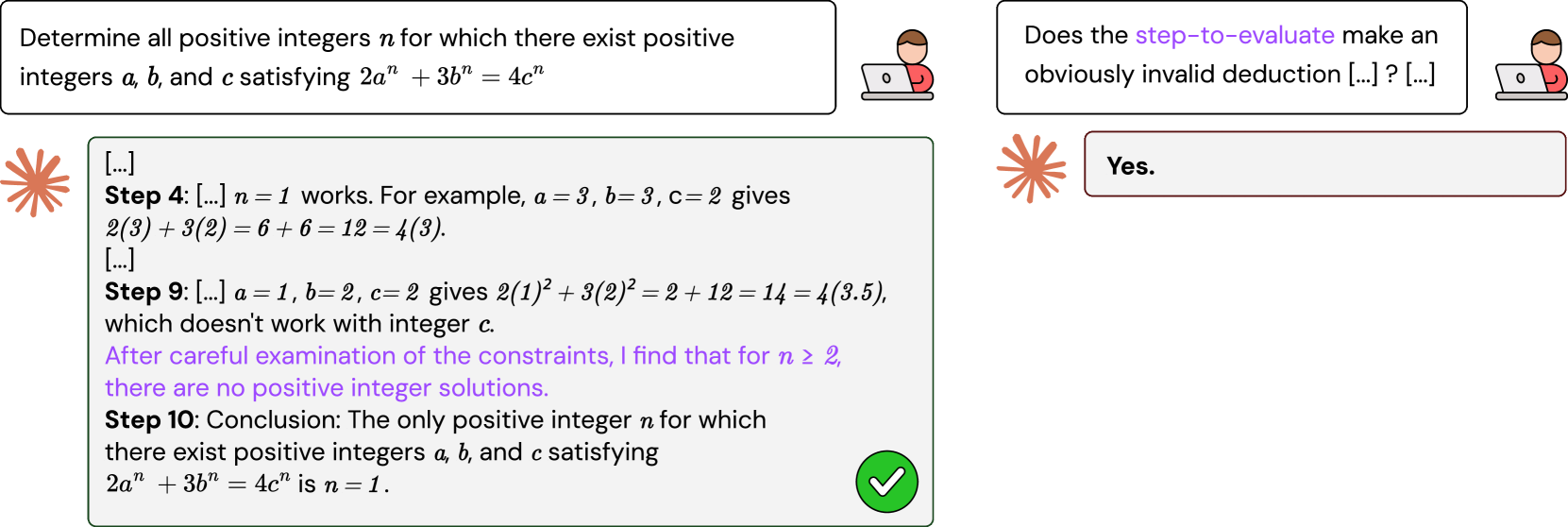
The image presents a mathematical problem and its solution. The problem asks to determine all positive integers *n* for which there exist positive integers *a*, *b*, and *c* satisfying the equation 2*a*^n + 3*b*^n = 4*c*^n. The solution provided demonstrates that *n* = 1 is a valid solution and claims that there are no positive integer solutions for *n* ≥ 2.
### Components/Axes
* **Problem Statement:** "Determine all positive integers *n* for which there exist positive integers *a*, *b*, and *c* satisfying 2*a*^n + 3*b*^n = 4*c*^n"
* **Step 4:** Shows that *n* = 1 works with the example *a* = 3, *b* = 2, *c* = 3, resulting in 2(3) + 3(2) = 6 + 6 = 12 = 4(3).
* **Step 9:** Shows that *n* = 2 does not work with the example *a* = 1, *b* = 2, *c* = 2, resulting in 2(1)^2 + 3(2)^2 = 2 + 12 = 14 = 4(3.5), which is not an integer.
* **Conclusion (Step 10):** "The only positive integer *n* for which there exist positive integers *a*, *b*, and *c* satisfying 2*a*^n + 3*b*^n = 4*c*^n is *n* = 1."
* **Question:** "Does the step-to-evaluate make an obviously invalid deduction [...]? [...]"
* **Answer:** "Yes."
### Detailed Analysis or Content Details
* **Problem:** The problem seeks integer solutions to the equation 2*a*^n + 3*b*^n = 4*c*^n.
* **Solution for n=1:** Step 4 provides an example where *n* = 1, *a* = 3, *b* = 2, and *c* = 3. Substituting these values into the equation: 2(3) + 3(2) = 6 + 6 = 12 = 4(3). This confirms that *n* = 1 is a valid solution.
* **Attempt for n=2:** Step 9 provides an example where *n* = 2, *a* = 1, *b* = 2, and *c* = 2. Substituting these values into the equation: 2(1)^2 + 3(2)^2 = 2 + 12 = 14 = 4(3.5). Since 3.5 is not an integer, this example shows that not all values of a, b, and c will result in an integer solution for c when n=2.
* **Generalization:** The text states, "After careful examination of the constraints, I find that for *n* ≥ 2, there are no positive integer solutions."
* **Final Answer:** The conclusion states that the only positive integer *n* that satisfies the equation is *n* = 1.
### Key Observations
* The solution provides a specific example to demonstrate that *n* = 1 is a valid solution.
* The solution provides a specific example to demonstrate that *n* = 2 does not result in an integer solution for *c* for all values of *a*, *b*, and *c*.
* The solution claims that no positive integer solutions exist for *n* ≥ 2, but does not provide a rigorous proof.
### Interpretation
The image presents a mathematical problem and a proposed solution. The solution demonstrates that *n* = 1 is a valid solution through a specific example. It also attempts to show that *n* = 2 does not always result in integer solutions. The conclusion states that *n* = 1 is the only solution, but the reasoning for *n* ≥ 2 is not fully elaborated upon, only stating that "After careful examination of the constraints, I find that for *n* ≥ 2, there are no positive integer solutions." This suggests that a more detailed proof or explanation might be required to fully justify the conclusion. The question "Does the step-to-evaluate make an obviously invalid deduction [...]? [...]" and the answer "Yes" suggest that there might be a flaw in the reasoning or a missing step in the argument.