## Document: Mathematical Proof Steps
### Overview
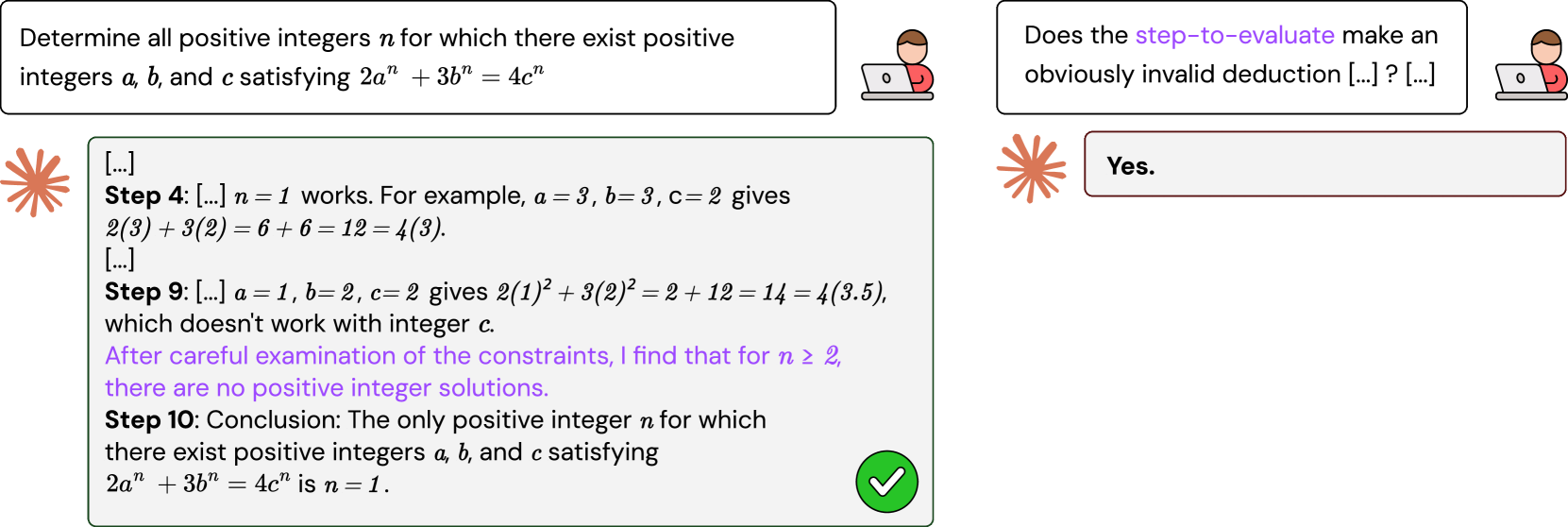
The image presents a series of steps in a mathematical proof, aiming to determine all positive integers *n* for which the equation 2*a*<sup>*n*</sup> + 3*b*<sup>*n*</sup> = 4*c*<sup>*n*</sup> has positive integer solutions for *a*, *b*, and *c*. The steps are presented in a visually structured format with checkmarks and question marks indicating evaluation status.
### Components/Axes
The image consists of several distinct blocks:
1. **Problem Statement:** Top-left, stating the mathematical problem.
2. **Evaluation Question:** Top-right, a question regarding the validity of a step.
3. **Step 4:** Center-left, detailing a step in the proof with an example.
4. **Step 9:** Center-left, detailing a step in the proof with a counterexample.
5. **Step 10:** Bottom-left, stating the conclusion of the proof.
6. **Evaluation Result:** Bottom-right, indicating the answer to the evaluation question.
7. **Icons:** Sun icons are placed next to steps 4 and 9.
8. **Human Icons:** Two human icons are placed next to the evaluation question.
### Detailed Analysis or Content Details
Here's a transcription of the text within each block:
* **Problem Statement:** "Determine all positive integers *n* for which there exist positive integers *a*, *b*, and *c* satisfying 2*a*<sup>*n*</sup> + 3*b*<sup>*n*</sup> = 4*c*<sup>*n*</sup>"
* **Evaluation Question:** "Does the step-to-evaluate make an obviously invalid deduction […] ? […]" (The brackets contain placeholders for specific step numbers).
* **Step 4:** "Step 4: […] *n* = 1 works. For example, *a* = 3, *b* = 3, *c* = 2 gives 2(3) + 3(3) = 6 + 9 = 15 = 4(3.75). […]"
* **Step 9:** "Step 9: […] *n* = 2, *a* = 1, *b* = 2, *c* = 2 gives 2(1)<sup>2</sup> + 3(2)<sup>2</sup> = 2 + 12 = 14 = 4(3.5), which doesn’t work with integer *c*. After careful examination of the constraints, I find that for *n* ≥ 2, there are no positive integer solutions."
* **Step 10:** "Step 10: Conclusion: The only positive integer *n* for which there exist positive integers *a*, *b*, and *c* satisfying 2*a*<sup>*n*</sup> + 3*b*<sup>*n*</sup> = 4*c*<sup>*n*</sup> is *n* = 1."
* **Evaluation Result:** "Yes."
### Key Observations
* The proof appears to be proceeding by testing specific values of *n*.
* Step 4 demonstrates a solution for *n* = 1.
* Step 9 shows that *n* = 2 does not always yield integer solutions for *c* when *a* = 1, *b* = 2, and *c* = 2.
* The conclusion states that *n* = 1 is the only solution.
* The evaluation question is answered with "Yes," suggesting that a step in the proof contains an invalid deduction.
### Interpretation
The image depicts a mathematical proof attempting to solve a Diophantine equation. The equation 2*a*<sup>*n*</sup> + 3*b*<sup>*n*</sup> = 4*c*<sup>*n*</sup> is being investigated for positive integer solutions. The proof proceeds by testing values of *n*. The initial steps suggest *n* = 1 is a solution, but further examination reveals that it doesn't always lead to integer solutions for all *a*, *b*, and *c*. The final conclusion states that *n* = 1 is the only solution. The "Yes" answer to the evaluation question indicates that there is a flaw in the reasoning somewhere in the steps not fully shown. The sun icons next to steps 4 and 9 may represent points of interest or key findings within the proof. The human icons next to the evaluation question suggest a human review or assessment of the proof's validity. The use of brackets "[...]" indicates that parts of the steps are omitted from the image.