## Screenshot: Math Problem Discussion
### Overview
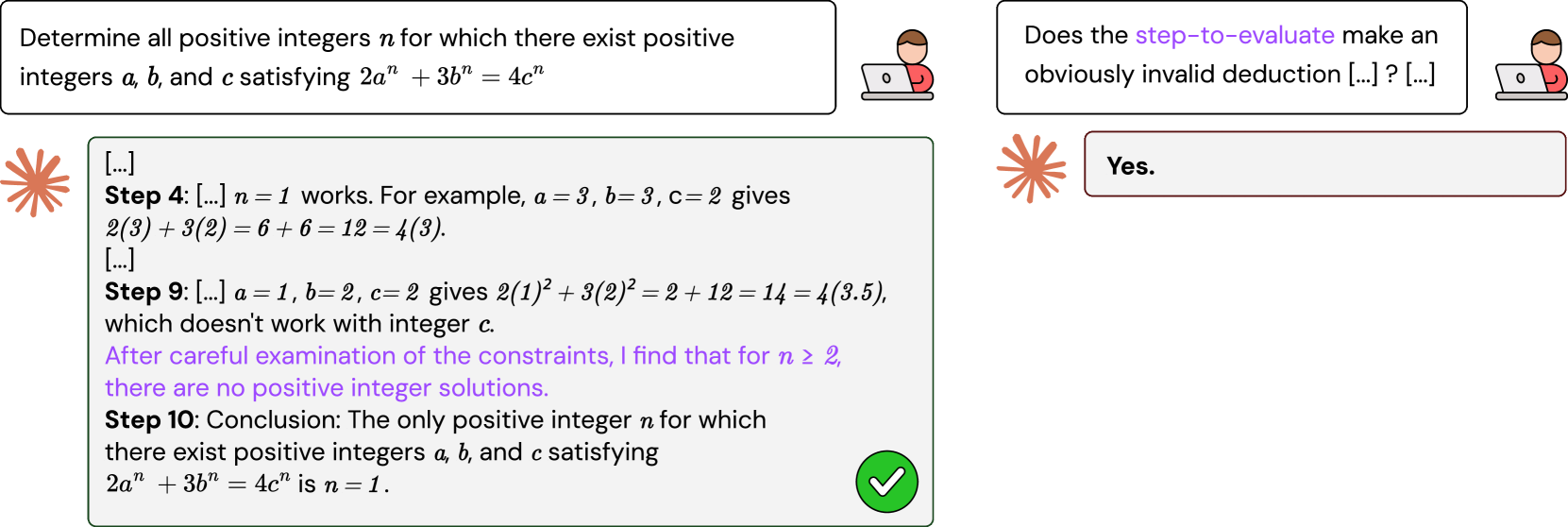
The image shows a technical discussion about solving a Diophantine equation: finding all positive integers \( n \) for which there exist positive integers \( a, b, c \) satisfying \( 2a^n + 3b^n = 4c^n \). The conversation includes a problem statement, step-by-step reasoning, and a conclusion.
### Components/Axes
- **Left Text Box**: Contains the problem statement and solution steps.
- **Step 4**: Example for \( n = 1 \): \( a = 3, b = 3, c = 2 \) satisfies \( 2(3) + 3(2) = 6 + 6 = 12 = 4(3) \).
- **Step 9**: Attempt with \( a = 1, b = 2, c = 2 \): \( 2(1)^2 + 3(2)^2 = 2 + 12 = 14 \), which equals \( 4(3.5) \), invalid since \( c \) must be an integer.
- **Step 10**: Conclusion: Only \( n = 1 \) works.
- **Right Text Box**: Contains a question about the validity of a deduction and the answer "Yes."
- **Annotations**:
- A green checkmark in the bottom-right corner of the left box.
- A red starburst icon in the top-left corner of the left box.
- A red starburst icon in the top-right corner of the right box.
### Content Details
- **Problem Statement**:
"Determine all positive integers \( n \) for which there exist positive integers \( a, b, c \) satisfying \( 2a^n + 3b^n = 4c^n \)."
- **Solution Steps**:
- **Step 4**: Demonstrates \( n = 1 \) works with \( a = 3, b = 3, c = 2 \).
- **Step 9**: Tests \( n = 2 \) with \( a = 1, b = 2, c = 2 \), but \( c = 3.5 \) is invalid.
- **Step 10**: Concludes \( n = 1 \) is the only solution.
- **Question/Answer**:
- Question: "Does the step-to-evaluate make an obviously invalid deduction?"
- Answer: "Yes."
### Key Observations
1. The example in Step 4 validates \( n = 1 \) as a solution.
2. Step 9 explicitly shows \( n = 2 \) fails due to non-integer \( c \).
3. The conclusion in Step 10 generalizes that no solutions exist for \( n \geq 2 \).
4. The right box confirms the deduction in Step 9 is invalid, reinforcing the conclusion.
### Interpretation
The discussion uses trial-and-error to test small values of \( n \). For \( n = 1 \), a valid solution exists, but for \( n = 2 \), the equation \( 2a^2 + 3b^2 = 4c^2 \) requires \( c \) to be non-integer, violating the problem constraints. The final conclusion that \( n = 1 \) is the only solution is logically consistent with the steps provided. The question in the right box highlights a critical flaw in the reasoning for \( n \geq 2 \), which the answer "Yes" acknowledges. This aligns with the conclusion that no solutions exist beyond \( n = 1 \).
No numerical data or trends are present, as the image focuses on textual reasoning rather than visual data.