## Histogram: Consistency Score vs. Density
### Overview
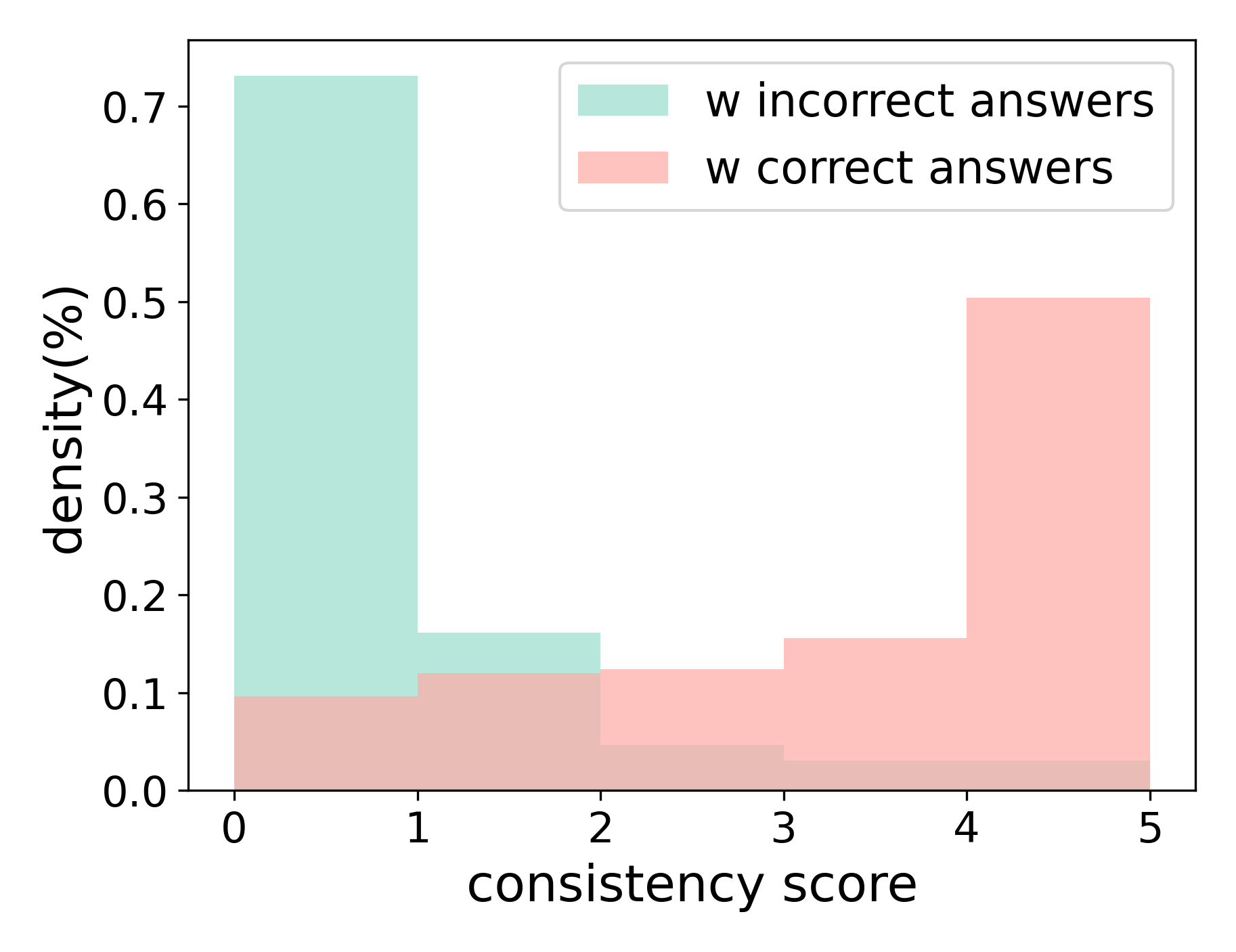
The image is a histogram comparing the density (%) of consistency scores for data associated with incorrect answers and correct answers. The x-axis represents the consistency score, ranging from 0 to 5. The y-axis represents the density (%), ranging from 0.0 to 0.7. The histogram uses two colors to differentiate between data associated with incorrect answers (light green) and correct answers (light red).
### Components/Axes
* **X-axis:** consistency score, with markers at 0, 1, 2, 3, 4, and 5.
* **Y-axis:** density(%), with markers at 0.0, 0.1, 0.2, 0.3, 0.4, 0.5, 0.6, and 0.7.
* **Legend (top-right):**
* Light Green: w incorrect answers
* Light Red: w correct answers
### Detailed Analysis
**Data for "w incorrect answers" (light green):**
* **Consistency Score 0-1:** Density is approximately 0.73.
* **Consistency Score 1-2:** Density is approximately 0.16.
* **Consistency Score 2-3:** Density is approximately 0.00.
* **Consistency Score 3-4:** Density is approximately 0.00.
* **Consistency Score 4-5:** Density is approximately 0.00.
**Data for "w correct answers" (light red):**
* **Consistency Score 0-1:** Density is approximately 0.10.
* **Consistency Score 1-2:** Density is approximately 0.13.
* **Consistency Score 2-3:** Density is approximately 0.13.
* **Consistency Score 3-4:** Density is approximately 0.16.
* **Consistency Score 4-5:** Density is approximately 0.51.
### Key Observations
* For incorrect answers, the highest density occurs at a consistency score between 0 and 1.
* For correct answers, the density increases with the consistency score, peaking between 4 and 5.
* The density of incorrect answers is significantly higher than correct answers at lower consistency scores (0-2).
* The density of correct answers is significantly higher than incorrect answers at higher consistency scores (4-5).
### Interpretation
The histogram suggests a strong correlation between consistency score and the correctness of answers. Lower consistency scores are more frequently associated with incorrect answers, while higher consistency scores are more frequently associated with correct answers. This indicates that a higher consistency score is a good predictor of answer accuracy. The data implies that the consistency score is a useful metric for evaluating the reliability or validity of the answers.