# Technical Document Extraction: Hierarchical Reasoning Categories and Failure Analysis
## Diagram Overview
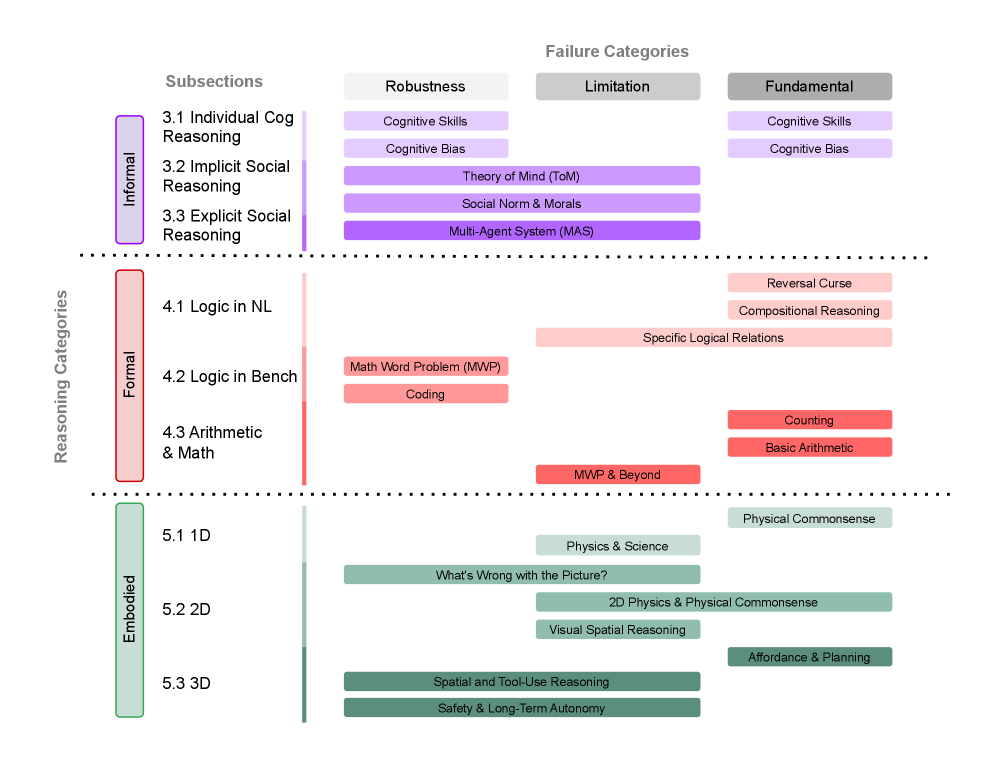
The image presents a **hierarchical taxonomy of reasoning categories** and their associated **failure modes**, organized into three primary sections: **Subsections**, **Formal**, and **Embedded**. Each section contains subcategories, failure types, and specific failure examples. Color coding distinguishes the sections, with a legend on the left.
---
### **Legend**
- **Subsections**: Purple gradient (`#E6E6FA` to `#8A2BE2`)
- **Formal**: Red gradient (`#FFA07A` to `#B22222`)
- **Embedded**: Green gradient (`#98FB98` to `#228B22`)
- **Failure Categories**: Gray (`#D3D3D3`) with subcategory-specific colors.
---
## Section 1: Subsections
### Labels & Subcategories
1. **3.1 Individual Cognitive Reasoning**
- **Failure Categories**:
- **Robustness**: Cognitive Skills, Cognitive Bias
- **Limitation**: Theory of Mind (ToM), Social Norm & Morals, Multi-Agent System (MAS)
- **Fundamental**: Cognitive Skills, Cognitive Bias
2. **3.2 Implicit Social Reasoning**
- No explicit failure categories listed.
3. **3.3 Explicit Social Reasoning**
- No explicit failure categories listed.
---
## Section 2: Formal
### Labels & Subcategories
1. **4.1 Logic in NL**
- **Failure Categories**:
- **Robustness**: None
- **Limitation**: None
- **Fundamental**: Reversal Curse, Compositional Reasoning, Specific Logical Relations
2. **4.2 Logic in Bench**
- **Failure Categories**:
- **Robustness**: Math Word Problem (MWP), Coding
- **Limitation**: MWP & Beyond
- **Fundamental**: Counting, Basic Arithmetic
3. **4.3 Arithmetic & Math**
- No explicit failure categories listed.
---
## Section 3: Embodied
### Labels & Subcategories
1. **5.1 1D**
- **Failure Categories**:
- **Robustness**: None
- **Limitation**: Physics & Science
- **Fundamental**: Physical Commonsense
2. **5.2 2D**
- **Failure Categories**:
- **Robustness**: What’s Wrong with the Picture?
- **Limitation**: 2D Physics & Physical Commonsense, Visual Spatial Reasoning
- **Fundamental**: Affordance & Planning
3. **5.3 3D**
- **Failure Categories**:
- **Robustness**: Spatial and Tool-Use Reasoning, Safety & Long-Term Autonomy
- **Limitation**: None
- **Fundamental**: None
---
## Spatial Grounding & Color Verification
- **Legend Position**: Left-aligned, with color blocks matching section headers.
- **Color Consistency**:
- Subsections: Purple shades (e.g., `3.1` = light purple, `3.3` = dark purple).
- Formal: Red shades (e.g., `4.1` = light red, `4.3` = dark red).
- Embodied: Green shades (e.g., `5.1` = light green, `5.3` = dark green).
---
## Key Trends & Data Points
1. **Subsections**: Focus on cognitive and social reasoning, with failure modes tied to robustness (e.g., cognitive biases) and limitations (e.g., multi-agent systems).
2. **Formal**: Emphasizes logic and arithmetic, with failures in compositional reasoning (e.g., reversal curse) and basic arithmetic.
3. **Embedded**: Highlights spatial and physical reasoning, with failures in 2D/3D physics and long-term autonomy.
---
## Notes
- No data tables or numerical values are present; the diagram is purely categorical.
- All textual information is transcribed verbatim, with colors cross-referenced to the legend.
- Diagram structure is hierarchical, with failure categories nested under reasoning subcategories.