## Reasoning Categories Diagram
### Overview
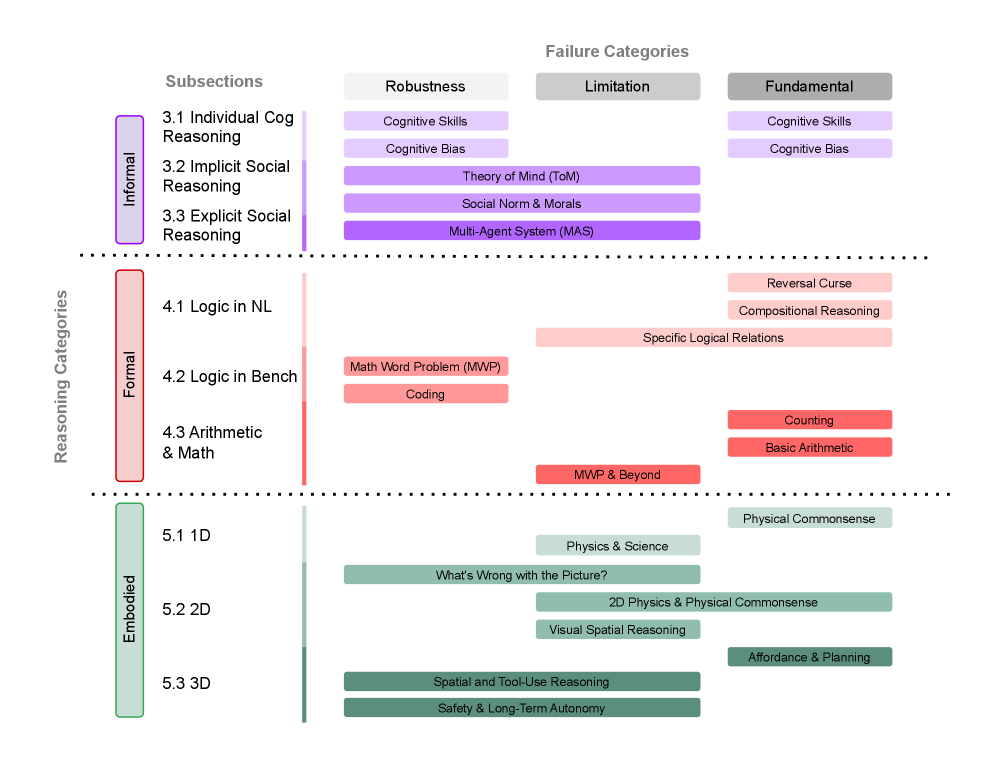
The image is a diagram categorizing reasoning types (Informal, Formal, Embodied) and their subsections, along with associated failure categories (Robustness, Limitation, Fundamental). The diagram uses color-coding to visually link each reasoning category to its corresponding subsections and failure modes.
### Components/Axes
* **Reasoning Categories (Left Vertical Axis):**
* Informal (Purple)
* Formal (Red)
* Embodied (Green)
* **Subsections (Left Column):** Lists specific reasoning tasks or areas within each category.
* **Failure Categories (Top Horizontal Axis):**
* Robustness (Light Purple)
* Limitation (Gray)
* Fundamental (Light Gray)
### Detailed Analysis
**1. Informal Reasoning (Purple):**
* **Subsections:**
* 3.1 Individual Cog Reasoning
* 3.2 Implicit Social Reasoning
* 3.3 Explicit Social Reasoning
* **Failure Categories:**
* Robustness: Cognitive Skills, Cognitive Bias
* Limitation: Theory of Mind (ToM), Social Norm & Morals, Multi-Agent System (MAS)
**2. Formal Reasoning (Red):**
* **Subsections:**
* 4.1 Logic in NL
* 4.2 Logic in Bench
* 4.3 Arithmetic & Math
* **Failure Categories:**
* Limitation: Specific Logical Relations, Math Word Problem (MWP), Coding, MWP & Beyond
* Fundamental: Reversal Curse, Compositional Reasoning, Counting, Basic Arithmetic
**3. Embodied Reasoning (Green):**
* **Subsections:**
* 5.1 1D
* 5.2 2D
* 5.3 3D
* **Failure Categories:**
* Limitation: Physics & Science, What's Wrong with the Picture?, 2D Physics & Physical Commonsense, Visual Spatial Reasoning, Spatial and Tool-Use Reasoning, Safety & Long-Term Autonomy
* Fundamental: Physical Commonsense, Affordance & Planning
### Key Observations
* Each reasoning category (Informal, Formal, Embodied) is associated with specific subsections and failure categories.
* The "Robustness" failure category is only associated with the "Informal" reasoning category.
* The "Limitation" failure category is associated with all three reasoning categories.
* The "Fundamental" failure category is associated with "Formal" and "Embodied" reasoning categories.
### Interpretation
The diagram presents a structured view of different reasoning categories and their potential failure modes. It suggests that:
* **Informal Reasoning:** Is more susceptible to failures related to cognitive skills and biases, and limitations in social understanding.
* **Formal Reasoning:** Can fail due to limitations in logical relations, mathematical problem-solving, and fundamental arithmetic skills.
* **Embodied Reasoning:** Is prone to failures related to understanding physical principles, spatial relationships, and tool usage.
The diagram highlights the diverse challenges associated with different types of reasoning and provides a framework for analyzing and addressing these challenges. The absence of "Robustness" failures in Formal and Embodied reasoning might imply that these categories are less prone to certain types of errors or that robustness is defined differently in these contexts.