\n
## Diagram: Reasoning Categories and Failure Modes
### Overview
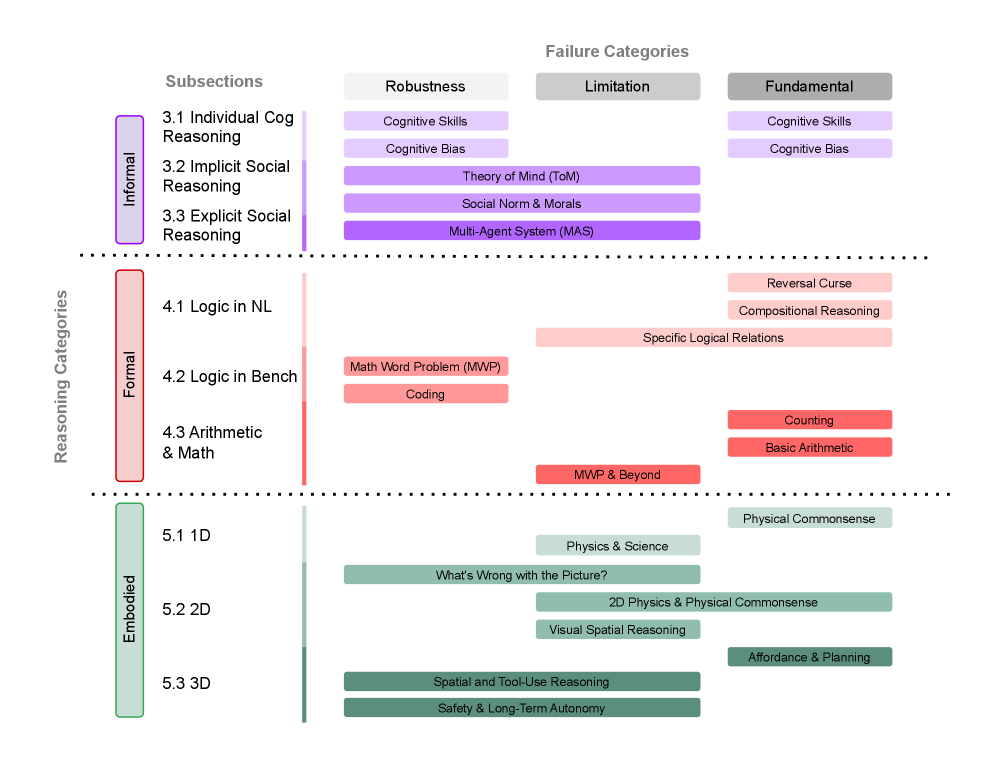
The image is a diagram categorizing reasoning abilities into Informal, Formal, and Embedded types. Each category is further broken down into subsections, and associated with potential failure categories: Robustness, Limitation, and Fundamental. The diagram uses color-coding to visually distinguish the different reasoning types and failure modes.
### Components/Axes
The diagram has two primary axes:
* **Vertical Axis:** "Reasoning Categories" with three main categories: Informal (pink), Formal (orange), and Embedded (green). These are numbered 3.1-3.3, 4.1-4.3, and 5.1-5.3 respectively.
* **Horizontal Axis:** "Failure Categories" with three categories: Robustness (light gray), Limitation (medium gray), and Fundamental (dark gray).
The diagram also includes subsections within each reasoning category, and specific failure modes associated with each subsection.
### Detailed Analysis or Content Details
**Informal Reasoning (Pink)**
* **3.1 Individual Cog Reasoning:** Associated with "Cognitive Skills" under Robustness and "Cognitive Skills" under Fundamental.
* **3.2 Implicit Social Reasoning:** Associated with "Cognitive Bias" under Robustness and "Cognitive Bias" under Fundamental.
* **3.3 Explicit Social Reasoning:** Associated with "Theory of Mind (ToM)" under Robustness, "Social Norm & Morals" under Limitation, and "Multi-Agent System (MAS)" under Limitation.
**Formal Reasoning (Orange)**
* **4.1 Logic in NL:** Associated with "Reversal Curse" and "Compositional Reasoning" under Limitation, and "Specific Logical Relations" under Fundamental.
* **4.2 Logic in Bench:** Associated with "Math Word Problem (MWP)" and "Coding" under Robustness.
* **4.3 Arithmetic & Math:** Associated with "MWP & Beyond" under Robustness, "Counting" and "Basic Arithmetic" under Fundamental.
**Embedded Reasoning (Green)**
* **5.1 1D:** Associated with "Physics & Science" and "What's Wrong with the Picture?" under Robustness, and "Physical Commonsense" under Fundamental.
* **5.2 2D:** Associated with "2D Physics & Physical Commonsense" under Robustness, "Visual Spatial Reasoning" under Limitation, and "Affordance & Planning" under Fundamental.
* **5.3 3D:** Associated with "Spatial & Tool-Use Reasoning" and "Safety & Long-Term Autonomy" under Robustness.
### Key Observations
* The "Fundamental" failure category appears to be consistently associated with core cognitive abilities (Cognitive Skills, Cognitive Bias, Counting, Basic Arithmetic).
* "Robustness" failures are more diverse, encompassing specific skills like Physics & Science, Math Word Problems, and Cognitive skills.
* "Limitation" failures seem to relate to higher-level reasoning abilities like Theory of Mind, Compositional Reasoning, and Visual Spatial Reasoning.
* The diagram suggests a hierarchy of reasoning complexity, moving from Informal (social and cognitive) to Formal (logical and mathematical) to Embedded (physical and spatial).
### Interpretation
This diagram presents a framework for understanding the different types of reasoning and the potential ways in which these reasoning processes can fail. The categorization into Informal, Formal, and Embedded reasoning reflects a progression in the complexity and abstraction of the reasoning task. The failure categories (Robustness, Limitation, and Fundamental) highlight different levels of cognitive vulnerability.
The association of "Fundamental" failures with core cognitive skills suggests that these failures represent basic limitations in the underlying cognitive architecture. "Robustness" failures indicate vulnerabilities to specific types of input or context, while "Limitation" failures point to constraints in the capacity for higher-level reasoning.
The diagram is likely intended to guide the development and evaluation of AI systems, by identifying the specific reasoning abilities that are most challenging to replicate and the types of failures that are most likely to occur. The diagram also provides a useful framework for understanding human reasoning errors. The use of color-coding and visual layout makes the information accessible and easy to understand.