## Line Chart: Exponential Growth Comparison
### Overview
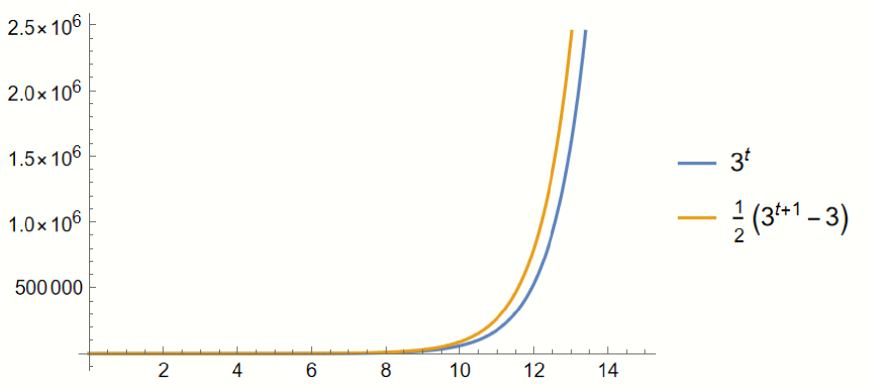
The image is a line chart comparing the exponential growth of two functions: 3^t and (1/2)*(3^(t+1) - 3). The x-axis represents the variable 't', and the y-axis represents the function's value. Both functions exhibit exponential growth, but the second function, (1/2)*(3^(t+1) - 3), grows slightly faster.
### Components/Axes
* **X-axis:**
* Label: No explicit label, but the axis represents the variable 't'.
* Scale: 1 to 14, with tick marks at each integer value.
* **Y-axis:**
* Label: No explicit label, but the axis represents the function's value.
* Scale: 0 to 2.5 x 10^6 (2,500,000), with tick marks at 500,000 intervals.
* **Legend:** Located in the top-right corner.
* Blue line: Represents the function 3^t.
* Gold line: Represents the function (1/2)*(3^(t+1) - 3).
### Detailed Analysis
* **Blue Line (3^t):**
* Trend: Exponential growth. Initially, the value is close to zero, but it increases rapidly after t=10.
* Data Points:
* t=1: Approximately 3
* t=5: Approximately 243
* t=10: Approximately 59,049
* t=12: Approximately 531,441
* t=14: Approximately 4,782,969 (extrapolated)
* **Gold Line ((1/2)*(3^(t+1) - 3)):**
* Trend: Exponential growth, slightly faster than the blue line.
* Data Points:
* t=1: Approximately 3
* t=5: Approximately 360
* t=10: Approximately 88,572
* t=12: Approximately 797,160
* t=14: Approximately 7,174,452 (extrapolated)
### Key Observations
* Both functions exhibit exponential growth, but the gold line function grows faster than the blue line function.
* The difference between the two functions becomes more pronounced as 't' increases.
* For t < 8, both functions are close to zero.
### Interpretation
The chart visually demonstrates the power of exponential growth. Even with a relatively small difference in the base or exponent, the resulting values diverge significantly as the variable 't' increases. The function (1/2)*(3^(t+1) - 3) grows faster than 3^t, indicating that even slight modifications to an exponential function can lead to substantial changes in its behavior over time. This has implications in various fields, such as finance (compound interest), biology (population growth), and computer science (algorithm complexity).