# Technical Document Extraction: Kolmogorov-Arnold Networks (KANs)
## Key Components and Flow
### 1. **Historical Figures and Conceptual Foundation**
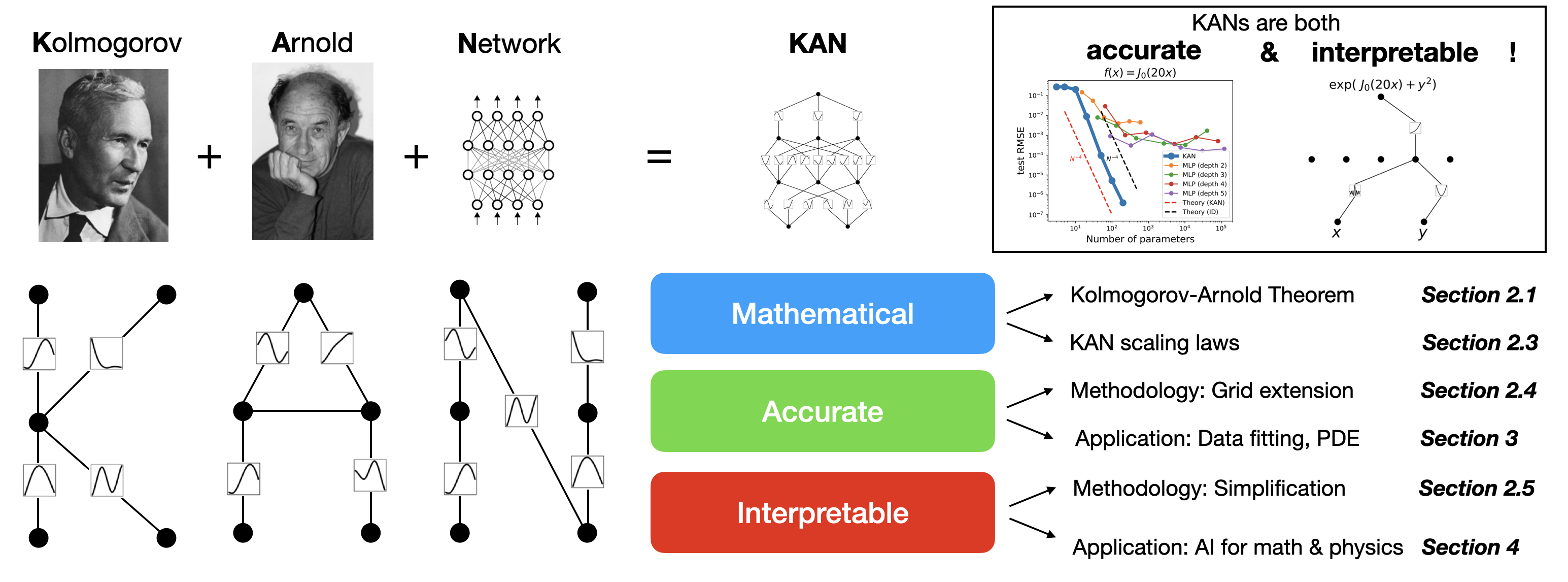
- **Kolmogorov** (left portrait): Mathematical logician, foundational work in function approximation.
- **Arnold** (right portrait): Mathematician, contributed to the development of the Kolmogorov-Arnold representation theorem.
- **Network Diagram**: Grid of interconnected nodes labeled "Network" (symbolizing traditional neural networks).
- **KAN Diagram**: Complex interconnected nodes labeled "KAN" (Kolmogorov-Arnold Network), representing a hybrid of mathematical and neural architectures.
### 2. **Core Equation and Claims**
- **Boxed Text**:
```
KANs are both
accurate & interpretable!
```
- **Mathematical Expressions**:
- `f(x) = J₀(20x)` (Bessel function of the first kind, order 0, scaled by 20).
- `exp(J₀(20x) + y²)` (Exponential function combining Bessel and quadratic terms).
### 3. **Performance Graph: Test RMSE vs. Parameters**
- **Axes**:
- **Y-axis**: `test RMSE` (log scale, `10⁻¹` to `10⁻⁷`).
- **X-axis**: `Number of parameters` (log scale, `10¹` to `10⁵`).
- **Legend**:
- **Blue**: KAN (lowest RMSE, steepest decline).
- **Orange**: MLP (depth 2).
- **Green**: MLP (depth 3).
- **Red**: MLP (depth 4).
- **Purple**: MLP (depth 5).
- **Dashed Red**: Theory (KAN).
- **Dashed Black**: Theory (ID).
- **Trend**: KANs outperform MLPs across all parameter scales, with RMSE decreasing exponentially as parameters increase.
### 4. **Flowchart: KAN Methodology and Applications**
- **Nodes and Arrows**:
- **Mathematical** (Blue):
- Kolmogorov-Arnold Theorem (Section 2.1).
- KAN scaling laws (Section 2.3).
- **Accurate** (Green):
- Methodology: Grid extension (Section 2.4).
- Application: Data fitting, PDE (Section 3).
- **Interpretable** (Red):
- Methodology: Simplification (Section 2.5).
- Application: AI for math & physics (Section 4).
### 5. **Diagrammatic Representations**
- **KAN Architecture**:
- Nodes with embedded functions (e.g., `x`, `y`, `J₀(20x)`).
- Connections represent function composition and parameter scaling.
- **Flowchart Structure**:
- Hierarchical organization of KAN properties (Mathematical → Accurate → Interpretable).
- Cross-references to technical sections (e.g., "Section 2.1" for Kolmogorov-Arnold Theorem).
### 6. **Critical Observations**
- **Accuracy**: KANs achieve lower test RMSE than MLPs of comparable depth, validating their theoretical efficiency.
- **Interpretability**: KANs retain mathematical transparency (e.g., explicit use of Bessel functions), unlike black-box MLPs.
- **Scalability**: KAN scaling laws (Section 2.3) suggest polynomial growth in performance with parameter count, contrasting with exponential MLP growth.
### 7. **Section References**
- **Section 2.1**: Kolmogorov-Arnold Theorem.
- **Section 2.3**: KAN scaling laws.
- **Section 2.4**: Grid extension methodology.
- **Section 2.5**: Simplification methodology.
- **Section 3**: Applications in data fitting and PDEs.
- **Section 4**: Applications in AI for mathematics and physics.
## Conclusion
The image illustrates the theoretical and practical advantages of KANs over traditional MLPs, emphasizing their mathematical rigor, accuracy, and interpretability. The performance graph and flowchart provide a roadmap for implementing KANs in scientific and engineering domains.