## ReRAM Device Characteristics and Array Metrics
### Overview
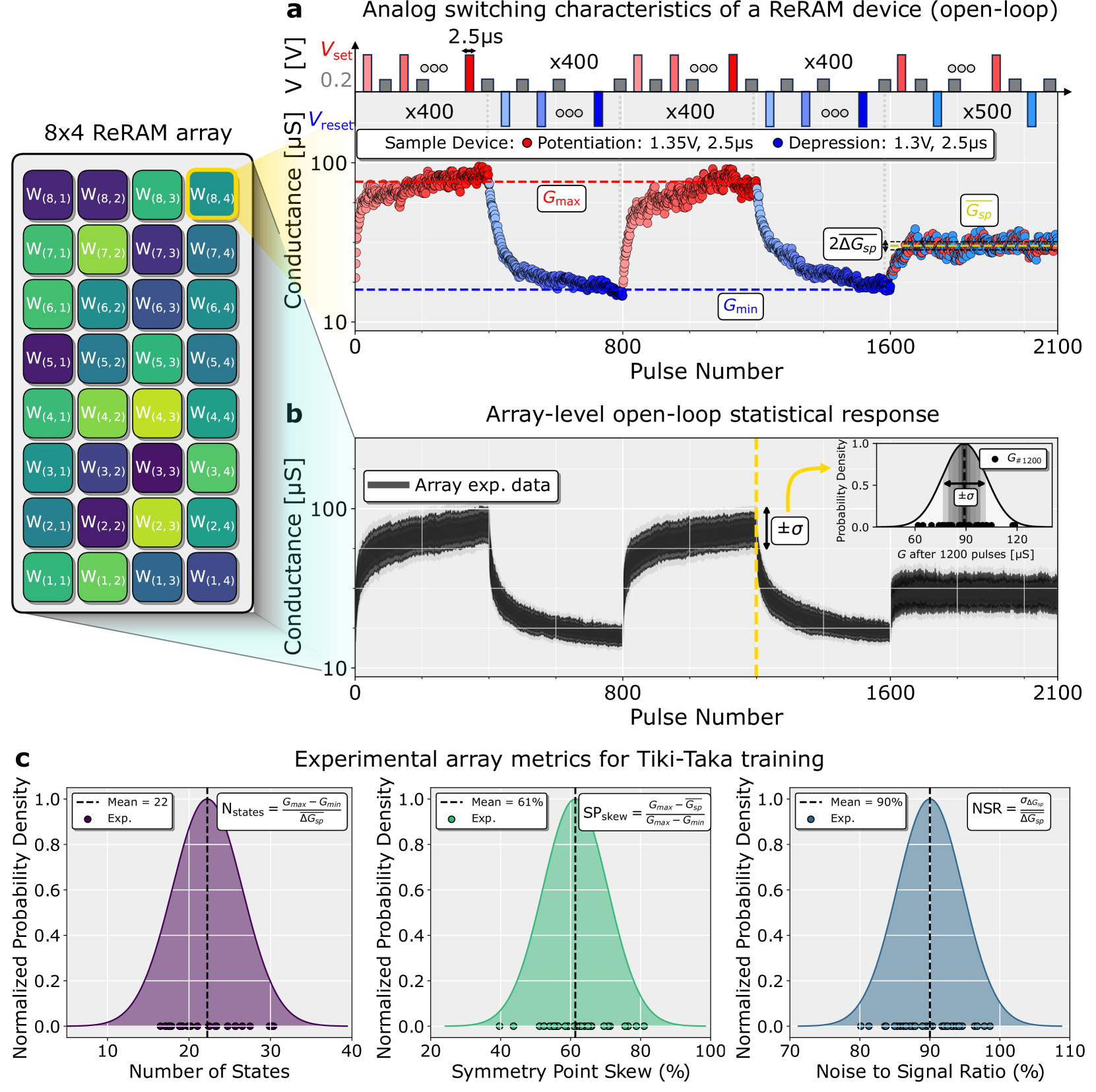
The image presents data on the analog switching characteristics of a ReRAM (Resistive Random-Access Memory) device in an open-loop configuration. It includes plots showing conductance changes over pulse number, statistical response of an array, and experimental array metrics related to Tiki-Taka training.
### Components/Axes
**Panel a: Analog Switching Characteristics**
* **Title:** Analog switching characteristics of a ReRAM device (open-loop)
* **Y-axis:** Conductance [µS], with a logarithmic scale from 10 to 100.
* **X-axis:** Pulse Number, ranging from 0 to 2100.
* **Voltage Pulses:** A schematic at the top shows alternating positive (Vset) and negative (Vreset) voltage pulses. Vset pulses are shown in red, and Vreset pulses are shown in blue. The pulse width is 2.5µs.
* **Annotations:**
* "x400", "x500" indicate the number of pulses in each block.
* "Sample Device: Potentiation: 1.35V, 2.5µs; Depression: 1.3V, 2.5µs" describes the pulse parameters.
* **Data Series:**
* A red-to-blue gradient line shows the conductance of a sample device over time. The red portion represents potentiation, and the blue portion represents depression.
* **Horizontal Lines:**
* A red dashed line labeled "Gmax" is at approximately 90 µS.
* A blue dashed line labeled "Gmin" is at approximately 15 µS.
* A yellow line labeled "Gsp" is at approximately 40 µS.
* A yellow line labeled "2ΔGsp" is at approximately 40 µS.
**Panel b: Array-Level Open-Loop Statistical Response**
* **Title:** Array-level open-loop statistical response
* **Y-axis:** Conductance [µS], with a logarithmic scale from 10 to 100.
* **X-axis:** Pulse Number, ranging from 0 to 2100.
* **Data Series:**
* A gray shaded region represents the array experimental data.
* **Vertical Line:**
* A yellow dashed line is present at x = 1200.
* **Annotation:**
* "±σ" indicates the standard deviation around the conductance value at the yellow line.
* **Inset Plot:**
* **Title:** G after 1200 pulses [µS]
* **Y-axis:** Probability Density, ranging from 0.0 to 1.0.
* **X-axis:** G after 1200 pulses [µS], ranging from 60 to 120.
* A black curve represents the probability density of the conductance after 1200 pulses.
* A black dot labeled "G#1200" is at approximately 90 µS.
* "±σ" indicates the standard deviation around the mean conductance value.
**Panel c: Experimental Array Metrics for Tiki-Taka Training**
* **Title:** Experimental array metrics for Tiki-Taka training
* **Subplots (from left to right):**
* **Number of States:**
* **Y-axis:** Normalized Probability Density, ranging from 0.0 to 1.0.
* **X-axis:** Number of States, ranging from 10 to 40.
* A purple curve represents the probability density.
* A black dashed line indicates the mean at 22.
* "Nstates = (Gmax - Gmin) / ΔGsp" is the formula for the number of states.
* Black dots represent experimental data points.
* "Mean = 22"
* "Exp."
* **Symmetry Point Skew:**
* **Y-axis:** Normalized Probability Density, ranging from 0.0 to 1.0.
* **X-axis:** Symmetry Point Skew (%), ranging from 20 to 100.
* A green curve represents the probability density.
* A black dashed line indicates the mean at 61%.
* "SPskew = (Gmax - Gsp) / (Gmax - Gmin)" is the formula for the symmetry point skew.
* Green dots represent experimental data points.
* "Mean = 61%"
* "Exp."
* **Noise to Signal Ratio:**
* **Y-axis:** Normalized Probability Density, ranging from 0.0 to 1.0.
* **X-axis:** Noise to Signal Ratio (%), ranging from 70 to 110.
* A blue curve represents the probability density.
* A black dashed line indicates the mean at 90%.
* "NSR = σΔGsp / ΔGsp" is the formula for the noise-to-signal ratio.
* Blue dots represent experimental data points.
* "Mean = 90%"
* "Exp."
**8x4 ReRAM Array Diagram**
* A schematic of an 8x4 ReRAM array is shown on the left side of the image.
* Each cell is labeled as W(row, column), where row ranges from 1 to 8 and column ranges from 1 to 4.
* The cells are colored in shades of green and purple.
* The cell W(7,4) is highlighted with a yellow border.
### Detailed Analysis
**Panel a:**
* The conductance initially increases rapidly with the application of positive voltage pulses (potentiation), reaching a maximum value (Gmax) of approximately 90 µS.
* After approximately 400 pulses, the polarity is switched to negative voltage pulses (depression), and the conductance decreases rapidly, reaching a minimum value (Gmin) of approximately 15 µS.
* The conductance then fluctuates around an intermediate value (Gsp) of approximately 40 µS.
**Panel b:**
* The array-level data shows a similar trend to the single-device data, but with more variability, represented by the gray shaded region.
* The inset plot shows the distribution of conductance values after 1200 pulses, with a mean value around 90 µS and a standard deviation of ±σ.
**Panel c:**
* The number of states (Nstates) has a mean value of 22.
* The symmetry point skew (SPskew) has a mean value of 61%.
* The noise-to-signal ratio (NSR) has a mean value of 90%.
### Key Observations
* The ReRAM device exhibits analog switching behavior, with conductance values that can be continuously adjusted by applying voltage pulses.
* The array-level data shows more variability than the single-device data, indicating device-to-device variations.
* The experimental array metrics provide insights into the performance of the ReRAM array for Tiki-Taka training.
### Interpretation
The data suggests that the ReRAM device is capable of analog switching, which is essential for implementing neuromorphic computing architectures. The array-level data highlights the importance of considering device-to-device variations when designing ReRAM-based systems. The experimental array metrics provide a quantitative assessment of the ReRAM array's performance for Tiki-Taka training, which is a specific type of machine learning algorithm. The high noise-to-signal ratio (NSR) could be a limiting factor for the performance of the ReRAM array in certain applications.