\n
## Diagram: Learning Paradigms - Direct, Reinforcement, and Experiential
### Overview
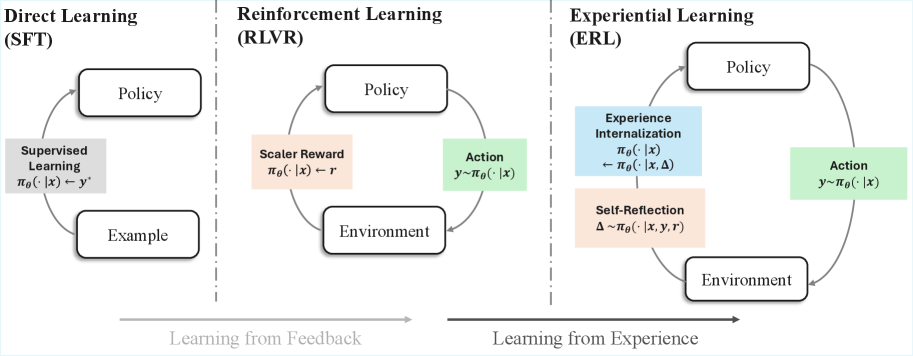
The image is a diagram illustrating three different learning paradigms: Direct Learning (SFT), Reinforcement Learning (RLVR), and Experiential Learning (ERL). It visually represents the flow of information and interaction within each paradigm, highlighting the differences in how learning occurs. The diagram uses boxes to represent components and arrows to indicate the direction of influence or data flow. A horizontal arrow at the bottom indicates a transition from "Learning from Feedback" to "Learning from Experience".
### Components/Axes
The diagram is divided into three main sections, each representing a learning paradigm. Each section contains the following components:
* **Policy:** Represented by a purple rectangle in all three paradigms.
* **Environment:** Represented by a brown rectangle in Reinforcement and Experiential Learning.
* **Action:** Represented by a green rectangle in Reinforcement and Experiential Learning.
* **Example:** Represented by a light purple rectangle in Direct Learning.
* **Scalar Reward:** Represented by a light green rectangle in Reinforcement Learning.
* **Experience Internalization & Self-Reflection:** Represented by a light blue and light orange rectangle in Experiential Learning.
The diagram also includes mathematical notations within the boxes, representing the underlying functions or processes. These include:
* π<sub>θ</sub><sup>(·)</sup>(x) → y<sup>*</sup> (Direct Learning)
* π<sub>θ</sub><sup>(·)</sup>(x) → r (Scalar Reward)
* y → π<sub>θ</sub><sup>(·)</sup>(x) (Action)
* π<sub>θ</sub><sup>(·)</sup>(x) (Experience Internalization)
* Δ ~ π<sub>θ</sub><sup>(·)</sup>(x, y, r) (Self-Reflection)
A horizontal arrow at the bottom is labeled "Learning from Feedback" on the left and "Learning from Experience" on the right.
### Detailed Analysis / Content Details
**Direct Learning (SFT):**
* The "Policy" box is connected to "Supervised Learning" which is connected to the "Example" box.
* The equation within the "Supervised Learning" box is: π<sub>θ</sub><sup>(·)</sup>(x) → y<sup>*</sup>.
* This paradigm appears to be a direct mapping from input (x) to output (y<sup>*</sup>) guided by a policy.
**Reinforcement Learning (RLVR):**
* The "Policy" box is connected to "Scalar Reward" and "Action".
* The "Scalar Reward" box has the equation: π<sub>θ</sub><sup>(·)</sup>(x) → r.
* The "Action" box has the equation: y → π<sub>θ</sub><sup>(·)</sup>(x).
* The "Action" box is connected to the "Environment" box, which then loops back to the "Policy" box.
* This paradigm involves learning through trial and error, receiving rewards (r) based on actions (y) taken in the environment (x).
**Experiential Learning (ERL):**
* The "Policy" box is connected to "Experience Internalization" and "Action".
* The "Experience Internalization" box has the equation: π<sub>θ</sub><sup>(·)</sup>(x).
* The "Self-Reflection" box has the equation: Δ ~ π<sub>θ</sub><sup>(·)</sup>(x, y, r).
* The "Action" box has the equation: y → π<sub>θ</sub><sup>(·)</sup>(x).
* The "Action" box is connected to the "Environment" box, which then loops back to the "Policy" box.
* This paradigm incorporates both experience internalization and self-reflection (Δ) in addition to action and environment interaction.
### Key Observations
* The diagram clearly illustrates a progression from direct, supervised learning to more complex learning paradigms that involve interaction with an environment.
* The inclusion of mathematical notations suggests a formal, algorithmic approach to each learning paradigm.
* The "Experiential Learning" paradigm appears to be the most complex, incorporating elements of both reinforcement learning and self-reflection.
* The transition from "Learning from Feedback" to "Learning from Experience" highlights a shift in the source of information used for learning.
### Interpretation
The diagram demonstrates a conceptual hierarchy of learning approaches. Direct Learning represents the simplest form, relying on explicit examples. Reinforcement Learning introduces the concept of learning through interaction and reward, while Experiential Learning builds upon this by adding a layer of self-reflection and internal experience processing. The diagram suggests that as learning becomes more complex, it moves away from relying solely on external feedback (examples or rewards) and incorporates internal processes for understanding and adapting to the environment. The mathematical notations indicate that these paradigms are not merely conceptual but can be formalized and implemented as algorithms. The diagram is a high-level overview and does not delve into the specifics of each algorithm or the underlying mechanisms of learning. It serves as a useful visual aid for understanding the fundamental differences between these three learning paradigms.